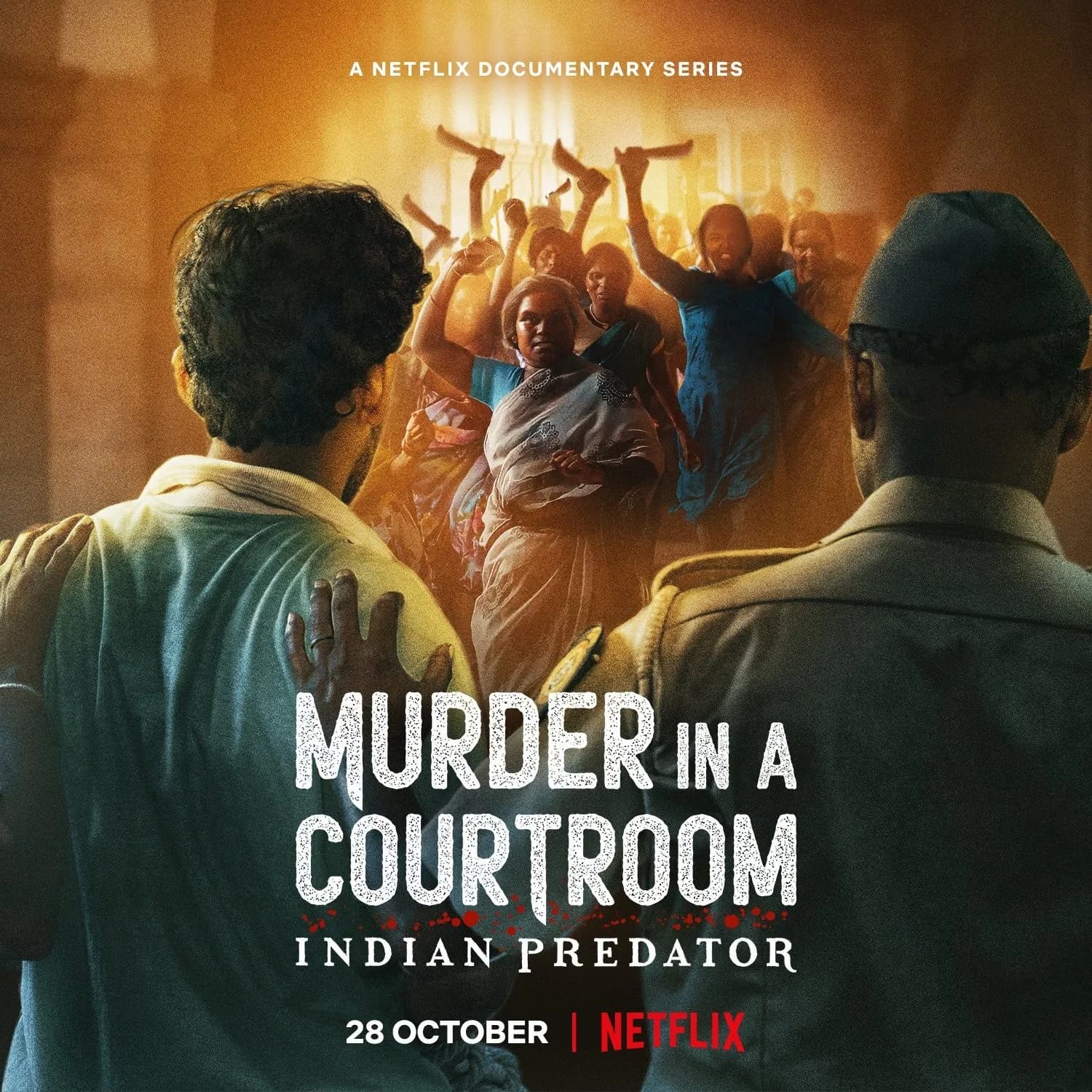
Indian Predator: Murder in a Courtroom
Netflix, 2022 — the vigilante lynching of serial rapist Akku Yadav by 200 women in a Nagpur courtroom
What Is the Series About?
Indian Predator: Murder in a Courtroom is a Netflix true crime documentary series that covers one of the most extraordinary acts of vigilante justice in modern Indian history: the courtroom lynching of notorious serial rapist and gangster Akku Yadav by approximately 200 women who were his victims. Released on October 28, 2022, the three-episode mini-series is the third installment of the Indian Predator anthology and examines not only the shocking events of August 14, 2004, but the years of systemic failure, police corruption, and community trauma that made them possible.
The series asks a question that cuts to the heart of the case and refuses to let go: when the state categorically fails to protect its citizens, does a community have the right — perhaps even the obligation — to deliver justice on its own terms? As widely discussed by viewers and critics, Murder in a Courtroom is not a straightforward whodunit. Everyone knows who carried out the killing. The deeper, more unsettling question the documentary poses is: who was the real predator, and who were the real victims?
---
The Case
Akku Yadav: A Decade of Terror
Bharat Kalicharan — universally known in Nagpur as Akku Yadav — was a gangster, serial rapist, murderer, and extortionist who terrorised the residents of the Kasturba Nagar slum in Nagpur, Maharashtra, for well over a decade. According to Radio Times, his first known crime was a gang rape committed in 1991. From that point forward, he operated with almost total impunity, preying specifically on the poor and marginalised women of Kasturba Nagar — a community that had little political clout and even less access to legal protection.
Yadav's crimes were not secret. Victims and witnesses repeatedly filed complaints with local police. But time and again, those complaints went nowhere. Officers reportedly dismissed the women, returned them to their abusers, or actively colluded with Yadav to suppress accusations. For the women of Kasturba Nagar, the legal system was not a shield — it was another instrument of their oppression.
The Lynching: August 14, 2004
By the summer of 2004, Yadav had been arrested and was scheduled to appear at Nagpur's Civil Court for a bail hearing. For his victims, this was the moment they had waited years for — but many had no confidence the justice system would finally hold him accountable. They had seen too many previous arrests dissolve into releases, too many hearings end without consequence.
On August 14, 2004 — the eve of India's Independence Day — approximately 200 women from Kasturba Nagar entered the courtroom. Armed with kitchen knives and stones, they attacked Yadav before authorities could intervene, killing him in the dock. As documented in community discussions of the case, the women did not flee or deny their actions. Many openly claimed responsibility, framing the killing as an act of collective self-defence after more than a decade of failed legal recourse.
Legal Aftermath
The women were arrested and charged with murder. The case immediately triggered fierce public and legal debate across India. Were these women cold-blooded killers, or were they victims of a broken system who had been pushed beyond the limits of endurance? The community of Kasturba Nagar stood firmly behind them, and the case drew attention to the catastrophic failures of law enforcement to protect vulnerable women from known, repeat predators. Specific sentencing outcomes for individual women involved were not clearly resolved in the public record, and the case remains one of India's most debated instances of extrajudicial justice.
---
Production
The series was produced under the Indian Predator anthology banner on Netflix, directed and created by Happy Kalizpuria, Shubham Gautam, and Lajari Kale. The documentary spans three episodes and draws on interviews with survivors, community members, legal observers, and journalists to reconstruct both the years of abuse and the events of August 14, 2004. The production team navigated the deeply sensitive nature of the subject matter — speaking with women who were both victims of horrific violence and, in the eyes of the law, perpetrators of a killing — and attempted to present multiple perspectives on what justice means in a context where institutional justice has completely collapsed.
The official trailer frames the series around the central moral ambiguity: the tagline questions who the "real killer" is, deliberately blurring the line between victim and perpetrator. The documentary does not shy away from the graphic realities of Yadav's crimes, nor from the visceral, unprecedented nature of the courtroom attack.
---
Reception
Indian Predator: Murder in a Courtroom holds an IMDB rating of 7.1/10 based on approximately 1,000 user ratings, placing it solidly within the upper tier of true crime docuseries reception. It is listed on IMDB as title tt22756480.
Reviewers and viewers have consistently highlighted the series as one of the most morally complex entries in the true crime genre — not because the facts are in dispute, but because the ethical framework for judging them is genuinely contested. The sight of 200 women killing a man in a courtroom is inherently shocking; what makes the series resonate is the meticulous construction of the context that led to that moment. Critics have noted that the documentary succeeds in making the viewer understand — if not necessarily endorse — the women's actions, which is a difficult tonal balance to achieve.
The central controversy the series engages with is both legal and philosophical: the moral legitimacy of vigilante justice when state institutions have demonstrably, repeatedly, and catastrophically failed. This is not a debate the series resolves. Instead, it lays out the evidence and leaves the audience to sit with the discomfort of a situation in which there are no clean answers.
---
The Case Today
Akku Yadav is dead. He was never formally sentenced for any of his crimes against the women of Kasturba Nagar — the legal process he had evaded for over a decade was ended by the very people he had victimised. The women who killed him faced murder charges, and the case remained a flashpoint in Indian discussions about gender violence, police accountability, and the limits of institutional justice.
The story of Kasturba Nagar has taken on renewed significance in the years since the documentary's release, as conversations about systemic failures in policing sexual violence have intensified globally. For many viewers, the series functions as both a true crime document and a broader indictment of what happens when communities — particularly poor, marginalised, and predominantly female communities — are systematically denied protection by the institutions meant to serve them.
The Indian Predator: Murder in a Courtroom docuseries brought this story to an international audience for the first time, and its impact on the conversation around vigilante justice in India is likely to be felt for years to come.