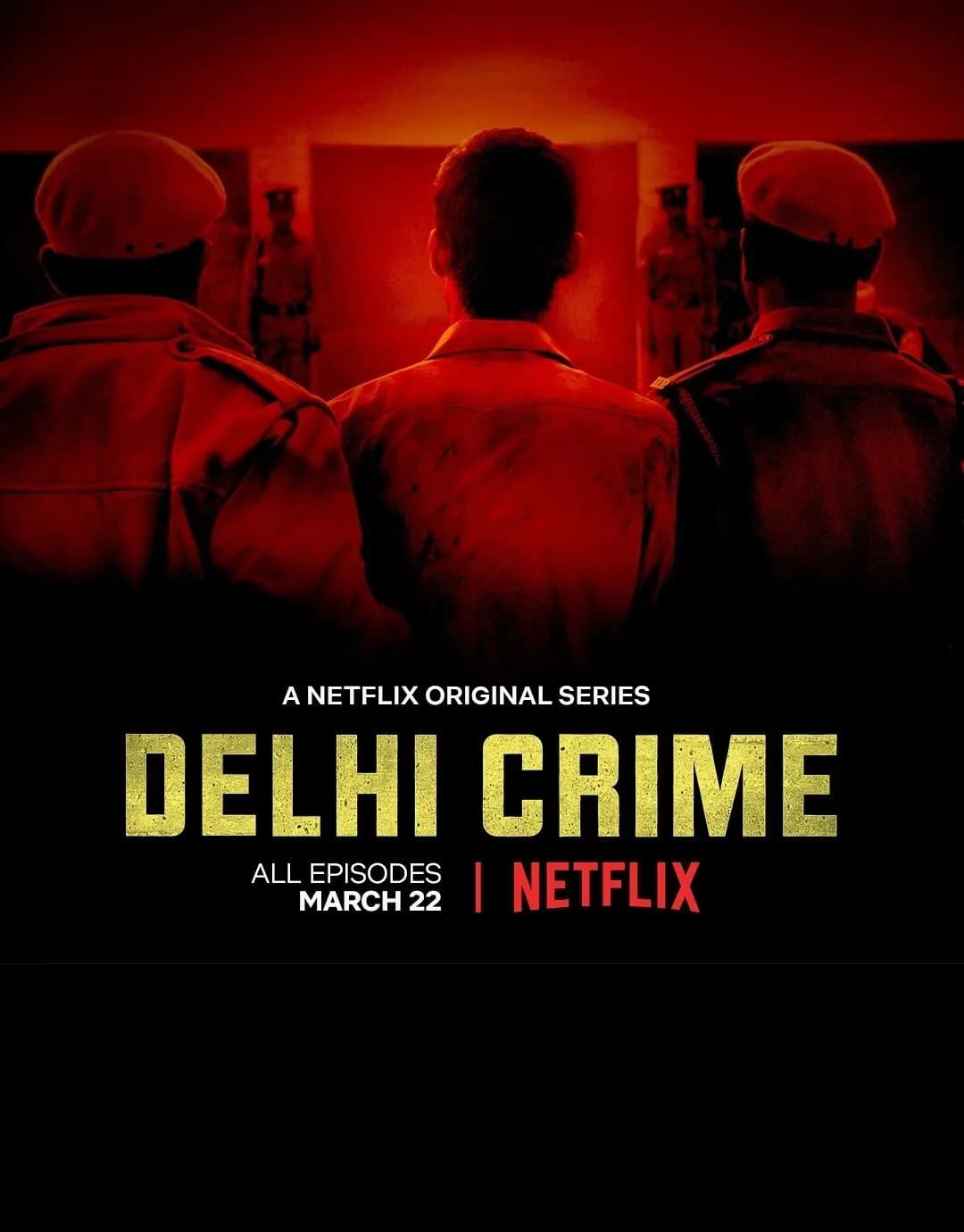
Delhi Crime
Netflix, 2019 — The true story behind India's most shocking gang rape and murder case
Quick facts
What Is the Series About?
Delhi Crime is a Netflix original drama series that reconstructs one of the most devastating criminal cases in modern Indian history — the December 2012 gang rape and murder of a 23-year-old medical student in New Delhi, known globally as the Nirbhaya case. Created, written, and directed by Richie Mehta after four years of meticulous research, the show follows the Delhi Police's investigation in the harrowing days immediately following the crime. Rather than sensationalizing the attack itself, the series focuses on the human cost — on the officers, the victim's family, and a city shaken to its core.
Season 1 consists of seven episodes and was released on Netflix on January 22, 2019. It was subsequently announced as an anthology series, with Season 2 covering an entirely different case. Delhi Crime holds an IMDb rating of 8.5 out of 10 based on over 30,000 votes, making it one of the highest-rated Indian productions on the platform.
---
The Case
On the evening of December 16, 2012, Jyoti Singh Pandey — a 23-year-old medical student — boarded a private, off-duty bus in New Delhi after watching a movie with her friend, Awindra Pratap Pandey. What followed was an act of horrific violence that would permanently alter the conversation around women's safety in India and around the world.
On board the bus were six men: Ram Singh (the bus driver), his brother Mukesh Singh, Vinay Sharma, Akshay Thakur, Pawan Gupta, and a juvenile whose identity remains protected by law. The men beat Awindra Pratap Pandey and gang raped Jyoti over the course of approximately an hour as the bus circled through New Delhi's streets. Both victims were subsequently thrown from the moving vehicle. Jyoti suffered catastrophic internal injuries.
She was transported to a hospital in New Delhi and later airlifted to a specialist hospital in Singapore, where she died from her injuries on December 29, 2012 — thirteen days after the attack. Her companion Awindra Pratap Pandey survived and was treated in hospital.
The Delhi Police, under enormous public and political pressure amid widespread street protests, identified and arrested all six accused within five days of the crime — a remarkable feat of investigative speed that forms the narrative spine of the series. The full true story behind the case has been documented extensively by journalists and researchers since the verdict.
The Perpetrators and Their Fates
- Ram Singh — The bus driver and ringleader. He died in Tihar Jail in March 2013. His death was officially ruled a suicide, though significant doubt and rumors of foul play have persisted among activists and legal observers.
- Mukesh Singh, Vinay Sharma, Akshay Thakur, and Pawan Gupta — All four were convicted of rape, kidnapping, murder, and destruction of evidence by a fast-track court and sentenced to death by hanging. All four filed clemency petitions in 2017; all were denied. As of the latest available information, they remain on death row.
- The Juvenile — Convicted of rape and murder, he received the maximum sentence available under Indian juvenile law: three years in a reform facility. He was released in December 2015 and now lives under a new identity.
The Victim
Jyoti Singh Pandey was widely referred to in Indian media by the pseudonym "Nirbhaya" — a Hindi word meaning "the fearless one" — as Indian law prohibits the naming of rape victims. Her parents have since chosen to publicly reveal her name as an act of dignity and defiance. At the time of her death, she was a 23-year-old pursuing a career in medicine and was, by all accounts, a determined and ambitious young woman.
---
Production
Delhi Crime was created by Canadian-Indian filmmaker Richie Mehta, who spent approximately four years researching and developing the project before a single frame was shot. Mehta conducted extensive interviews with Delhi Police officers directly involved in the investigation, gaining rare institutional access that allowed him to reconstruct the procedural details of the case with unusual accuracy.
The show's central character is Vartika Chaturvedi, a composite and fictionalized Deputy Commissioner of Police (DCP) who leads the investigation. She is played by Shefali Shah, whose performance has been universally singled out as the emotional and dramatic engine of the entire series. Also notable in the cast is Rasika Dugal as Neeti Singh, a junior officer navigating the psychological toll of the investigation.
Mehta's directorial approach is deliberately restrained. The gang rape itself is never depicted on screen. Instead, the series communicates the horror of the crime through its aftermath — through the trauma visible on the faces of police officers, through the chaos of hospital corridors, and through the rage of a grieving city. This choice has been widely praised as both ethically responsible and narratively powerful.
---
Reception
Delhi Crime was met with critical acclaim upon its release, with reviewers praising Richie Mehta's rigorous research, Shefali Shah's towering central performance, and the show's refusal to exploit the crime for shock value. Critics described it as "hard to watch but necessary" — a series that demands emotional engagement rather than passive consumption.
With an IMDb score of 8.5/10 from over 30,000 user ratings, the series ranks among the most celebrated Indian productions in Netflix's global catalogue. Community discussions on platforms like Reddit have reflected widespread appreciation from international audiences who may have been unfamiliar with the original case.
The series was not without controversy. Some critics and victim rights activists raised concerns about the ethical implications of dramatizing such a traumatic and recent case — particularly around the potential retraumatization of the victim's family and loved ones. Others questioned whether any fictional dramatization of a real rape and murder can be fully justified, regardless of its artistic intentions. These debates reflect broader tensions in the true crime genre about the line between public interest storytelling and exploitation.
Globally, Delhi Crime intensified ongoing discussions about women's safety in India, the systemic failures of the legal system, and the culture of impunity that the Nirbhaya case so viscerally exposed.
---
The Case Today
More than a decade after the crime, the Nirbhaya case continues to reverberate through Indian law, politics, and public life. In direct legislative response to the case and the mass protests it triggered, the Indian government passed the Criminal Law (Amendment) Act of 2013, which significantly strengthened laws around sexual assault, introduced the death penalty for repeat rape offenders, and criminalized stalking and voyeurism.
The four surviving adult convicts — Mukesh Singh, Vinay Sharma, Akshay Thakur, and Pawan Gupta — remain on death row. Their clemency petitions were denied in 2017, and further legal challenges have continued to delay execution. The juvenile offender, released in 2015, is living under a court-protected new identity.
Jyoti Singh Pandey's parents have become prominent public advocates for stronger protections for women in India, regularly speaking out in media and participating in legal proceedings. Her name — once withheld by law, now spoken openly at their insistence — has become a symbol of both the violence women face and the courage required to demand accountability.
Delhi Crime stands as a landmark in Indian true crime storytelling: a series that took one of the most painful events in recent memory and rendered it with unflinching honesty, institutional rigor, and deep human empathy.