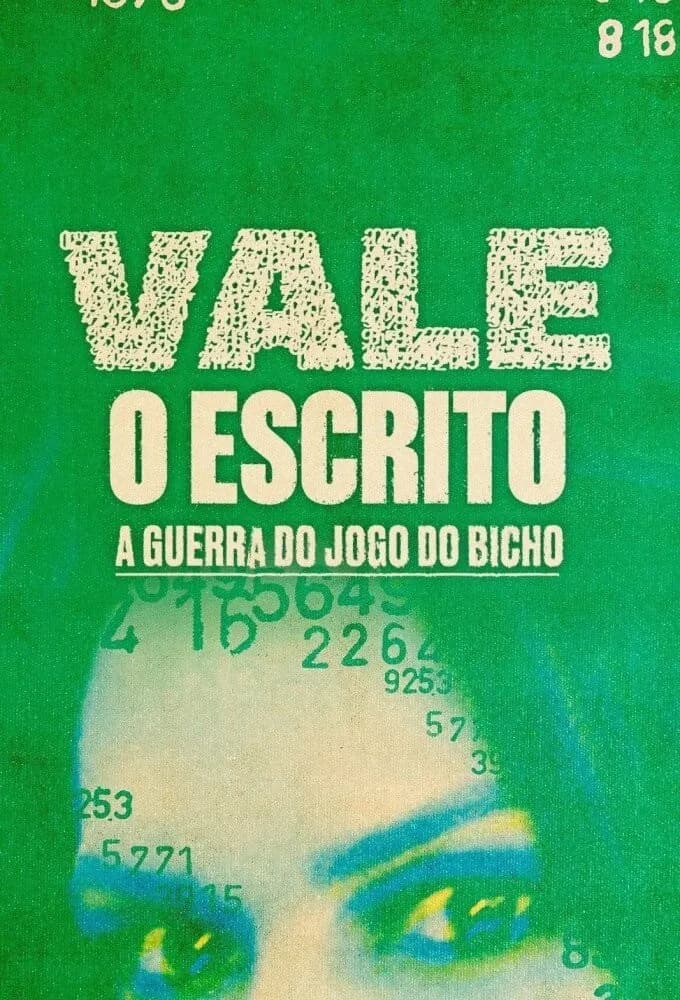
Vale o Escrito: A Guerra do Jogo do Bicho
Globoplay, 2023 — The violent succession wars inside Rio's illegal Animal Game empire
Quick facts
What Is the Series About?
Vale o Escrito: A Guerra do Jogo do Bicho is a Globoplay documentary series released on November 1, 2023, that chronicles the history, criminal operations, and bloody internal wars of the illegal gambling empire known as the Jogo do Bicho — or Animal Game — in Rio de Janeiro, Brazil. Unlike a documentary focused on a single murder or a single named perpetrator, the series is a sweeping investigative chronicle covering more than five decades of organized crime, from the 1970s through the present day, with particular emphasis on the violent succession battles waged between two powerful bicheiro dynasties: the Garcia family and the Andrade family.
The title — which roughly translates as A Bet Is a Debt: The War of the Animal Game — signals the code of honor and violence that governs this underground world, where debts are settled not in courtrooms but in the streets of Rio.
---
The Case
The Jogo do Bicho is one of Brazil's oldest and most deeply entrenched illegal gambling systems. Originally created in the late 19th century as a zoo lottery, it evolved over the 20th century into a vast criminal network employing tens of thousands of people across Rio de Janeiro and beyond. By the 1970s, powerful family-based organizations — known as bancas — had carved up Rio's territory between them, collecting bets, paying out winnings, and enforcing their monopolies with lethal efficiency.
The series focuses heavily on two rival dynasties. The Garcia family, led for years by matriarch Myriam Garcia, became one of the most powerful bancas in Rio. The succession conflict within the Garcia family proved fatal: Myrinho, Myriam's younger son, was killed in what investigators and journalists describe as a territorial power struggle. His death illustrates the documentary's central thesis — that in the Jogo do Bicho, inheritance is not granted by blood alone but seized through violence. Bernardo Bello, ex-husband of Tamara Garcia, emerged as a new power figure within the Garcia faction following these internal conflicts.
On the opposing side, the Andrade family — represented in the series principally by Rogério Andrade — controls rival territory and has been involved in decades-long confrontations with the Garcia network. Adding further complexity, Maninho, son of bicheiro Miró, is described in the series as the richest and most violent bicheiro operator in Rio's recent history, a figure whose conflicts with Rogério Andrade represent the apex of the territorial wars the documentary chronicles.
A critical detail that the series makes plain: almost none of these crimes were prosecuted in public courts. As investigative researchers have documented, the Jogo do Bicho's survival across more than a century owes significantly to its penetration of Rio's political and police structures. Enforcement against bicheiros has historically been lax, inconsistent, or corrupted outright. Murders within the bicheiro world are frequently resolved — or buried — within the criminal ecosystem itself, never reaching a public verdict.
An additional layer of cultural complexity explored by the series is the deep entanglement of bicheiro families with Rio's iconic samba schools. The Garcia and Andrade families are patrons of major samba schools, which has historically conferred social legitimacy, political protection, and cultural prestige on figures who are, by the letter of the law, organized criminals.
---
Production
The series was produced by Globoplay, the streaming arm of Brazil's dominant television network Globo, and runs across 7 episodes, each ranging from approximately 48 to 59 minutes in length. The director has not been identified in publicly available sources at the time of publication.
What distinguishes the series from standard crime documentaries is its source access. Producers secured exclusive interviews with bicheiros themselves, their heirs, and their spouses — a remarkable feat given the dangerous and clandestine nature of the world being documented. These testimonies are supplemented by expert commentary, investigative journalism, and extensive use of historical archives, giving the narrative both an insider intimacy and a rigorous journalistic scaffolding.
The series adopts a broadly chronological structure, guiding viewers from the consolidation of bicheiro power in the 1970s through successive waves of internal conflict and adaptation, up to the present-day operations of surviving family factions. This long arc allows the documentary to function not merely as a crime chronicle but as a sociological portrait of how illegal economies embed themselves into the urban fabric of a major city.
---
Reception
Since its premiere on Globoplay on November 1, 2023, Vale o Escrito has been received with considerable enthusiasm by both critics and audiences. On IMDb, it holds a rating of 8.7 out of 10 based on 909 votes — a strong score that places it among the better-reviewed Brazilian true crime productions in recent memory.
Viewers and critics have described the series as "the best real-life carioca novel" — a phrase that captures both its dramatic intensity and its grounding in verifiable Rio history. Revista Movimento praised it as "a great service for those who want to know Brazil better," noting that the series fills a significant gap in how the Jogo do Bicho's criminal history has been documented for general audiences.
The series has not escaped controversy, however. Some critics have argued that its tone — which foregrounds the personal narratives of bicheiros and their families without prosecutorial framing — risks glamorizing figures who have been directly or indirectly responsible for numerous deaths. The decision to give platform time to bicheiro family members speaking in their own voices, without formal criminal accountability framing, has been a point of debate in Brazilian media criticism circles.
Further political sensitivity surrounds the series' treatment of the samba school connection. By documenting how the Garcia and Andrade families have functioned as cultural patrons, the series implicitly raises uncomfortable questions about the institutions — including samba schools, local governments, and police forces — that have allowed the Jogo do Bicho to flourish for over a century.
---
The Case Today
The Jogo do Bicho remains illegal in Rio de Janeiro and across Brazil, yet it continues to operate openly in many parts of the city. The criminal families at the center of the documentary remain active, though their precise current legal statuses are not fully documented in public records.
Rogério Andrade, one of the series' central figures, has been the subject of ongoing law enforcement attention in Rio, particularly in connection with violence linked to bicheiro territorial disputes. The intersection of bicheiro power with Rio's militia networks and drug trafficking organizations has increasingly drawn federal scrutiny, suggesting the story told in Vale o Escrito is far from over.
For international audiences, the series offers a rare English-subtitled window into a criminal ecosystem that has shaped Rio de Janeiro's social and political landscape for generations — an ecosystem that, unlike the cartel narratives dominating global true crime, operates in plain sight, betting slips changing hands on street corners every day.