The Day I Met El Chapo: The Kate del Castillo Story
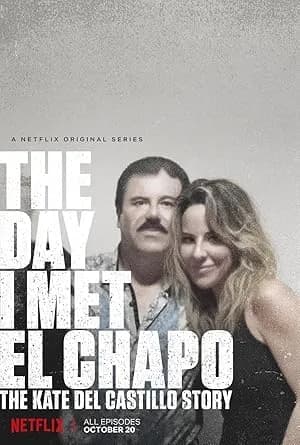
Netflix, 2017 — Kate del Castillo's account of her secret 2015 meeting with Sinaloa Cartel boss Joaquín 'El Chapo' Guzmán
Quick facts
What Is the Series About?
The Day I Met El Chapo: The Kate del Castillo Story is a three-part Netflix documentary series in which Mexican actress Kate del Castillo tells her own version of one of the most sensational organized-crime stories of the 2010s: her secret relationship with fugitive Sinaloa Cartel boss Joaquín "El Chapo" Guzmán, a clandestine meeting in the mountains of Sinaloa in 2015, and the 17-month Mexican federal investigation into her conduct that followed. Directed by Carlos Armella and released on October 20, 2017, the series blends never-before-seen footage, exclusive interviews, and contemporaneous communications to reconstruct how a single tweet sent in 2012 ultimately brought a Hollywood actress face-to-face with the world's most-wanted drug lord.
The Case
The story begins in 2012, when Del Castillo — already a major star in Mexican and American Spanish-language television — posted a tweet addressing El Chapo directly, urging him to use his power to do good rather than harm. The message went viral and, according to Del Castillo, caught the attention of Guzmán himself. By 2014, lawyers representing the cartel leader had made contact with the actress, opening a channel of private communication that would eventually be monitored by investigators.
The central event documented in the series is a clandestine meeting in June 2015 in Sinaloa, Mexico, where Del Castillo and actor Sean Penn traveled under extraordinary secrecy to meet Guzmán, who was at that time a fugitive from Mexican justice. The stated purpose was to develop a biographical film about Guzmán's life, with Del Castillo serving as producer. Penn subsequently published a lengthy first-person account of the meeting in Rolling Stone magazine, which brought the episode to worldwide attention.
The criminal figure at the center of the documentary is Joaquín Archivaldo Guzmán Loera, known globally as "El Chapo" — a nickname meaning "Shorty." As leader of the Sinaloa Cartel, he was described by ABC News as the world's biggest drug kingpin, responsible for trafficking vast quantities of narcotics into the United States and across the globe. Guzmán had a long history of jailbreaks and recaptures: he had escaped from a maximum-security Mexican prison in 2001 and again in 2015, shortly before his meeting with Del Castillo and Penn. He was on the run at the time of that encounter.
On September 24, 2015, an anonymous email to Mexican federal authorities alleged that Del Castillo had been in contact with Guzmán to arrange the movie meeting. That tip opened a formal investigation involving wiretaps, undercover detectives, tax audits, witness statements, and reported cooperation with the United States Drug Enforcement Administration. Prosecutors assessed possible charges including organized crime participation and concealment. Meanwhile, the communications trail left by Del Castillo and Penn's contact with Guzmán reportedly helped Mexican authorities pinpoint his location. On January 8, 2016, El Chapo was recaptured in Los Mochis, Sinaloa — a capture that BBC reporting linked in part to intelligence gathered from the actresses's communications network with the cartel.
After reviewing more than 200 pieces of evidence over approximately 17 months, the Mexican prosecutor closed the investigation on February 19, 2017. The report concluded there was no proof Del Castillo had any criminal involvement with the cartel, and that her interest in producing a film did not itself constitute unlawful activity. No criminal charges were filed against her. By the time the Netflix series premiered in October 2017, El Chapo had been extradited to the United States and was awaiting federal trial.
Production
The series was directed by Carlos Armella and produced with the active participation of Del Castillo herself, who functions both as subject and narrator throughout the three episodes. This access-driven approach gives the documentary an unusually intimate quality: Del Castillo shares private communications, personal testimony, and footage that had not previously been made public. Netflix marketed it as Del Castillo "revealing the untold story" of her encounter with Guzmán, leaning into the first-person exclusivity of the material.
The production draws on a range of source materials — text messages, emails, recorded conversations, and on-camera interviews with Del Castillo and others with knowledge of the investigation — to reconstruct the timeline from the 2012 tweet through the closure of the legal case. The documentary does not claim to be a neutral or comprehensive account of the Sinaloa Cartel's crimes; its scope is deliberately personal, centered on Del Castillo's experience and the legal jeopardy she faced as a result of her contact with Guzmán.
Reception
Critical and public reception of the series was shaped heavily by its controversial backstory. The LA Times reported that Sean Penn and his legal representatives publicly objected to the documentary's release, with Penn's spokesman accusing the producers of "false and reckless fabrications." The dispute highlighted the fact that the series tells only one side of the story — Del Castillo's — and that Penn, a central participant in the Sinaloa meeting, had not authorized his portrayal.
Beyond the Penn controversy, the documentary drew attention because of the sheer novelty of its subject matter: the intersection of celebrity, cartel mythology, and geopolitics made the underlying story irresistible to international media. ABC News and BBC both covered the broader saga extensively, and the Netflix series served as a vehicle for Del Castillo to reclaim narrative control after years of press coverage that she felt had misrepresented her motivations and role. An IMDb rating was not confirmed in available sources at the time of publication.
The Case Today
Since the documentary's 2017 premiere, the legal landscape surrounding its central figure has changed dramatically. El Chapo was tried in a United States federal court in Brooklyn, New York, and convicted in February 2019 on all ten counts, including drug trafficking, murder conspiracy, and money laundering. He was subsequently sentenced to life in prison plus 30 years. Kate del Castillo has continued her acting career and has spoken publicly about the lasting personal and professional consequences of her association with Guzmán's name. The case remains one of the most widely discussed examples of the unpredictable ways that celebrity, media access, and organized crime can collide — and of how a single social media post can set off years of legal and personal upheaval.