Al Capone: From Prohibition's King to Alcatraz Prisoner
How Chicago's most notorious mobster built a $105 million empire—and lost it all to federal tax evasion charges
Published June 6, 2025
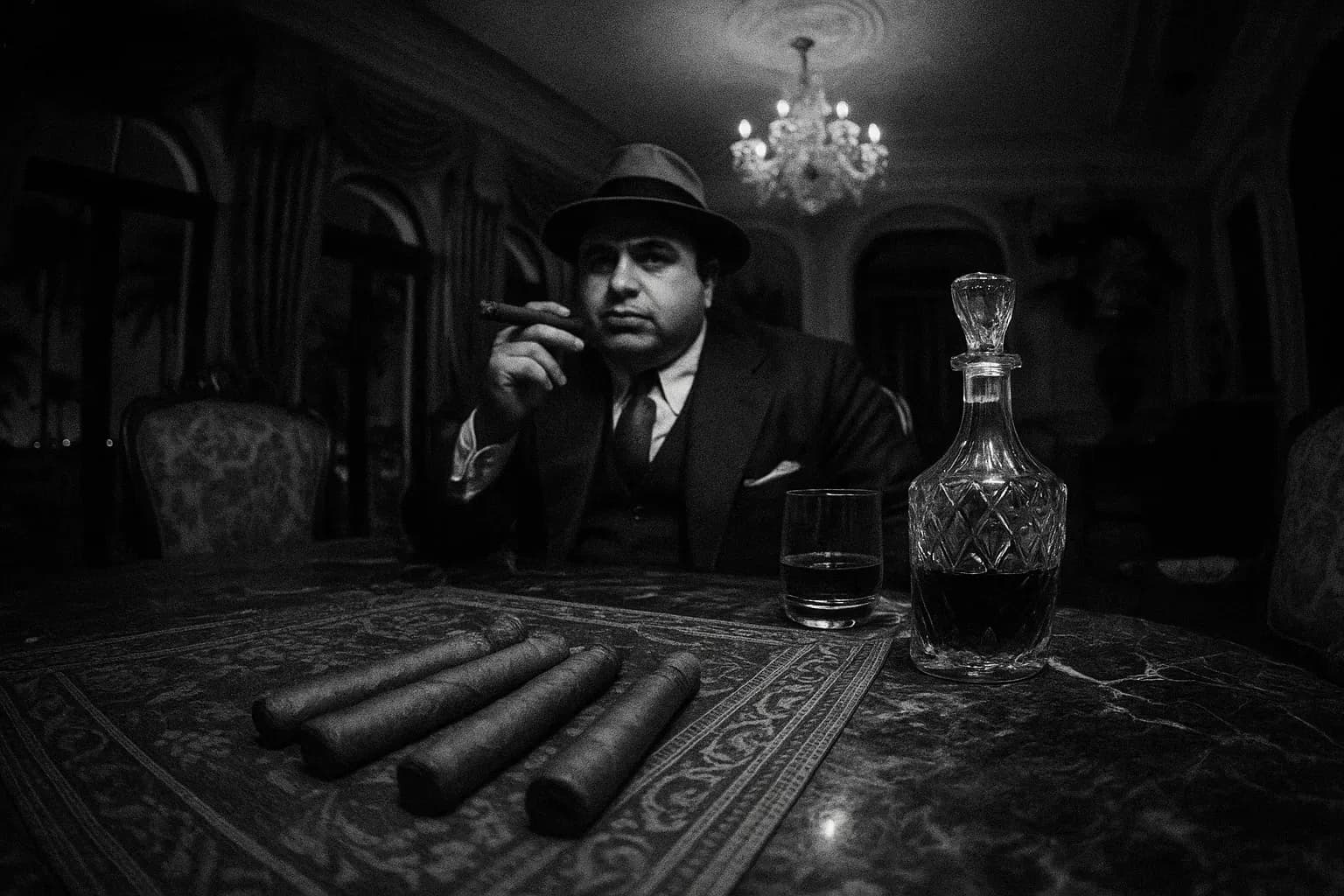
Alphonse Gabriel Capone, nicknamed "Scarface," was born on January 17, 1899, in Brooklyn to Italian immigrant parents. But it was in Chicago where he would cement his legacy as perhaps America's most infamous mobster.
Capone's early years followed a well-worn path for many organized crime figures. As a teenager, he joined the Five Points Gang in New York, working as a bouncer in illegal establishments and associating with seasoned gangsters Frankie Yale and Johnny Torrio. When Torrio relocated to Chicago, Capone followed, becoming instrumental in helping eliminate underworld competition. By 1925, after Torrio survived an assassination attempt and retired to Italy, Capone had become co-founder and boss of what became known as the Chicago Outfit—or simply the Syndicate.
Over the next six years, Capone built a criminal empire of staggering proportions. He controlled bootlegging, gambling, prostitution, and various racketeering operations across Chicago's South Side. In 1927 alone, he allegedly earned $105 million—an almost incomprehensible sum for the era. His rise was fueled by ruthlessness and an unprecedented willingness to use industrial-scale violence.
Timeline
Start year of tax evasion
The first of the five tax years (1925–1929) covered by the federal indictment against Capone. Capone failed to file and pay federal income tax.
St. Valentine's Day Massacre
The massacre took place in Chicago. Capone was strongly suspected, but was never charged for this. It was also not part of the tax evasion case.
Trial opens in Chicago
United States of America v. Alphonse Capone opens at the federal court in Chicago before Judge James H. Wilkerson.
Trial ends – Capone found guilty
After about nine hours of deliberation, the jury finds Capone guilty on five counts. He is sentenced to 11 years in prison, a $50,000 fine, plus court costs and back taxes owed.
Capone transferred to Alcatraz
Capone is transferred to the federal prison Alcatraz in San Francisco Bay, at the time one of the most secure prisons in the United States.
Capone released
Al Capone is released in November 1939 after serving a substantial part of his sentence. He withdraws from public life.
Al Capone dies in Florida
Alphonse Gabriel Capone dies on January 25, 1947, on Palm Island in Miami Beach, Florida.
The violence was systematic and brutal. During the 1920s, bombings killed as many as 100 people in Chicago. Machine-gun attacks and assassinations became Capone's calling cards. In May 1927, gunmen fired over 200 bullets into Joe Aiello's bakery on West Division Street, wounding Aiello's brother. That October, rival "Hymie" Weiss of the North Side Gang was killed. By summer 1928, Frankie Yale—Capone's former mentor—was dead, reportedly after suspicions of cheating in a liquor deal.
The most infamous incident came on February 14, 1929: the Saint Valentine's Day Massacre. Seven members of Bugs Moran's North Side Gang were machine-gunned in a garage on Chicago's North Side, allegedly over a hijacked Canadian whisky shipment. Though Capone was in Florida at the time, he was widely assumed responsible. The massacre shocked the nation and turned public opinion decisively against organized crime.
Federal authorities, unable to prove Capone's involvement in murders, pursued an unexpected strategy: tax evasion. On June 5, 1931, Capone was indicted on 22 counts of federal income tax evasion covering 1925 to 1929. Four days later, he faced additional charges of conspiracy to violate Prohibition laws spanning 1922 to 1931.
Capone's own words became his downfall. During failed tax negotiations years earlier, he had made admissions about his income that prosecutors now used as evidence. The October 1931 trial lasted weeks, but the outcome was predetermined. He was convicted on either 3 or 5 counts (sources vary), and the judge sentenced him to 11 years in federal prison, plus $50,000 in fines and court costs.
Capone's imprisonment began at the federal penitentiary in Atlanta in 1932. Later, he was transferred to Alcatraz, the newly opened maximum-security island prison in San Francisco Bay. His status as America's most celebrated criminal made him a prize inmate, though one who would eventually suffer serious health complications from untreated syphilis.
Capone was released early due to his deteriorating health condition. He died on January 25, 1947, in Miami Beach, Florida—stripped of his empire, his freedom, and his health. The man who had terrorized Chicago for nearly a decade was brought down not by rival bullets, but by bureaucratic precision. His downfall proved a watershed moment: it demonstrated that federal authorities could dismantle organized crime through financial investigation when traditional law enforcement failed.
Sources
https://en.wikipedia.org/wiki/Al_Capone
https://www.ebsco.com/research-starters/history/al-capone
https://www.britannica.com/biography/Al-Capone
Ask about this case
Answers from KrimiNyt's coverage onlyFollow this case
Get an email when a new documentary, podcast or book about Al Capone: From Prohibition's King to Alcatraz Prisoner appears, or when a verdict is reached.