Soaked in Bleach
Apple TV, Blockbuster & SF Anytime, 2015 — Kurt Cobain's death and the murder theory
Quick facts
What is the series about?
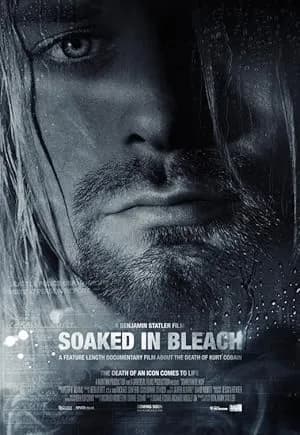
Soaked in Bleach is a 2015 true-crime docudrama directed by Benjamin Statler that investigates the circumstances surrounding the death of Kurt Cobain — the iconic frontman of Nirvana — who was found dead at his Seattle home in April 1994. Rather than accepting the Seattle Police Department's official ruling of suicide, the film builds a systematic case for an alternative theory: that Cobain was murdered. The documentary centers almost entirely on the perspective and recordings of private investigator Tom Grant, who was hired by Cobain's then-wife Courtney Love in the weeks before the body was discovered. Available on the Apple TV Store, Blockbuster, and SF Anytime, the film has become one of the most debated entries in the true-crime documentary genre.
The Case
Kurt Cobain was 27 years old when his body was found at his Seattle residence on April 8, 1994 — though the death is believed to have occurred around April 5. A fatal gunshot wound was identified as the cause of death, and a note was recovered at the scene. Seattle police conducted an investigation and ruled the death a suicide, a conclusion that has remained the official finding to this day.
However, private investigator Tom Grant has spent decades contesting this ruling. Grant was originally retained by Courtney Love to locate Cobain, who had left a drug rehabilitation facility and gone missing. During his search, Grant made extensive audio recordings of his conversations with Love and others connected to Cobain. After the body was found, Grant concluded that the evidence — including what he described as anomalies in the suicide note, questions about the level of heroin found in Cobain's bloodstream, and alleged inconsistencies in witness accounts — pointed not to suicide but to homicide.
The film does not establish a convicted perpetrator. There has been no criminal prosecution connected to Cobain's death, and the official ruling has never been formally overturned. VH1 described the film as the cinematic culmination of Grant's long-running allegation, framing the documentary as much as a product of Grant's personal crusade as an objective investigation.
The film uses a docudrama format: actors re-enact key scenes and conversations, intercut with Grant's real audio recordings, interview footage, and forensic commentary from figures who support his reading of the evidence. This hybrid approach gives the film an immediacy that a purely archival documentary might lack, though it also invites criticism about selective presentation.
Production
Soaked in Bleach was directed by Benjamin Statler, whose approach blends documentary interview techniques with dramatized re-enactments — a format that has become increasingly common in true-crime filmmaking. The film's central source is Tom Grant himself, who provided years of accumulated audio recordings, case notes, and testimony. Additional contributors include forensic experts and commentators sympathetic to the murder theory.
The production's reliance on Grant as a primary source is both its greatest asset and its most significant editorial liability. Grant's recordings are genuinely unusual primary documents — real-time audio of conversations with major figures in Cobain's inner circle — but his role as both investigator and advocate means the film never fully adopts a neutral stance. According to its Amazon listing, the film promises to reveal the events behind Cobain's death through Grant's eyes, a framing that signals its argumentative intent from the outset.
The runtime of approximately 1 hour 30 to 40 minutes positions it as a feature-length work rather than a serialized investigation, which limits how deeply individual threads of evidence can be explored.
Reception
Critical reception was sharply divided, with professional reviewers considerably cooler than general audiences. On Rotten Tomatoes, the film holds a 30% approval rating based on 10 reviews, with an average score of 4.5 out of 10. Metacritic places it at 50 out of 100 based on seven reviews, indicating mixed or average reception from the critical establishment. By contrast, audience engagement has been robust: IMDb lists the film at 7.3 out of 10, reflecting strong interest from the true-crime and Nirvana fan communities.
Variety offered one of the more nuanced professional assessments, noting that the film may be too much detail for those not already obsessed with all things Cobain, while conceding that it presents enough material to prevent easy dismissal as mere conspiracy theorizing. VH1's review positioned it more squarely as a fan-culture artifact than a rigorous journalistic investigation.
The film's most significant controversy was not critical but legal and reputational. Courtney Love's representatives pushed back against the film's allegations, and some theaters reportedly declined to screen it following legal pressure. The docudrama's willingness to frame a living person as a potential murderer — without any supporting criminal conviction or formal legal finding — made it a flashpoint for debates about the ethics of true-crime filmmaking.
The Case Today
As of the time of writing, the official ruling on Kurt Cobain's death remains suicide. No new criminal investigation has been formally opened by Seattle authorities in response to the claims made in Soaked in Bleach or by Tom Grant's ongoing advocacy. In 2014 — the year before the film's release — Seattle police briefly reviewed previously unexamined photographs from the original death scene but concluded that no new investigation was warranted.
Tom Grant continues to maintain and update his theory through his own website and public appearances. The debate over Cobain's death persists in online communities, true-crime forums, and among Nirvana fans worldwide, making it one of the most durable unsolved controversies in popular music history — regardless of what the official record states.
For viewers approaching Soaked in Bleach today, the film functions as both a document of Tom Grant's investigation and a time capsule of a particular strain of 1990s cultural mythology — one in which the circumstances of a generation-defining artist's death remain, for many, an open and deeply personal question.