Myth & Mogul: John DeLorean
Netflix, 2021 — The cocaine sting and corporate collapse that destroyed an automotive legend
Quick facts
What Is the Series About?
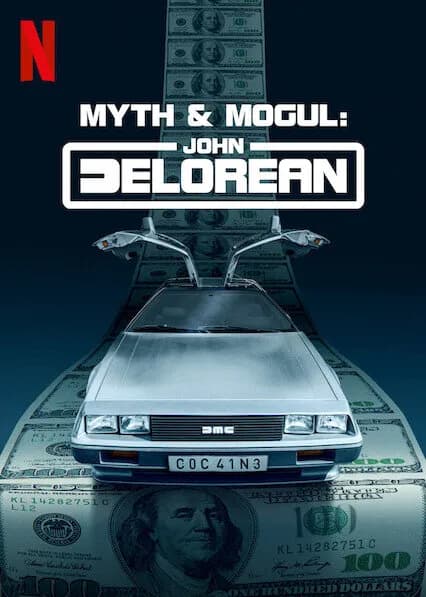
Myth and Mogul: John DeLorean is a Netflix documentary series about one of the most flamboyant and controversial figures in American automotive history. Directed by Mike Connolly and released on July 30, 2021, the three-episode series chronicles the dizzying rise and catastrophic fall of John Zachary DeLorean — former General Motors executive, founder of the DeLorean Motor Company, and the man at the center of one of the most sensational criminal trials of the 1980s. The series does not merely recount a single crime; it traces the full arc of a myth: the self-made Detroit rebel who built an iconic car, watched his empire implode, and then allegedly turned to cocaine trafficking in a last-ditch effort to save it.
The documentary weaves together two distinct but interconnected threads: the 1982 FBI undercover sting that led to DeLorean's arrest on cocaine-trafficking charges, and the subsequent investor-fraud and tax-evasion allegations tied to the collapse of DMC. Together, they form a portrait of ambition, hubris, and the blurry line between genius and criminality.
The Case
By the early 1980s, John DeLorean's empire was unraveling fast. DMC had staked its future on a single product — a gull-winged, stainless-steel sports car manufactured at a purpose-built plant in Belfast, Northern Ireland — and it was not selling. The company was drowning in debt, and DeLorean was running out of options.
It was in this context that federal authorities alleged DeLorean became entangled in a drug deal of staggering proportions. According to the FBI, undercover agents recorded DeLorean agreeing to bankroll a 220-pound cocaine operation valued at approximately $24 million. On October 19, 1982, he was formally charged with conspiracy to traffic cocaine. The arrest was accompanied by videotape evidence that appeared, on its face, to be devastating: DeLorean on camera, raising a glass of champagne and reportedly describing the cocaine as better than gold.
The trial that followed lasted five months and became one of the most publicized criminal proceedings of the decade. DeLorean did not take the stand. His defense team mounted an aggressive entrapment argument, contending that government informants had manipulated and pressured a desperate man into a situation he would never have entered on his own. After 29 hours of jury deliberation, the jury agreed. On August 16, 1984, John DeLorean was found not guilty on all cocaine-trafficking charges.
Separate charges alleging he had defrauded investors and evaded taxes in connection with the collapse of DMC also ended in acquittal. DeLorean walked away from every prosecution without a single conviction — a fact the series treats not as a triumphant vindication, but as a deeply ambiguous verdict on the man and the system that pursued him.
This was not a conventional violent-crime case; there was no named individual victim. The charges were rooted in alleged drug conspiracy and financial crime, and the legal outcome left many questions about culpability unanswered.
Production
Directed by Mike Connolly, Myth and Mogul takes a methodical, evidence-forward approach to its subject. The series draws on archival news footage, FBI surveillance recordings, and interviews with journalists, investigators, and people who knew DeLorean personally and professionally. The production situates the story across two geographies that shaped DMC's fate: the corridors of Los Angeles federal court, where the cocaine trial played out under media floodlights, and the industrial landscape of Belfast, where the dream of a revolutionary car factory was sold to a British government eager for investment in a troubled region.
The three episodes are rated TV-14 on Netflix, reflecting mature content appropriate for its subject matter — organized crime, federal sting operations, and the mechanics of corporate fraud — without crossing into gratuitous territory. The series runs under the IMDb listing tt14968268.
Reception
Critics generally praised the series as a thorough and engaging account of DeLorean's rise and fall, though some noted that the sheer volume of detail could feel overwhelming at times. The Guardian characterized the series as an examination of how DeLorean's carefully constructed public image collapsed under the weight of scandal, emphasizing the documentary's interest in the gap between myth and reality.
The Wall Street Journal framed it as a story of a car executive's crash, highlighting the dramatic contrast between DeLorean's gleaming public persona and the sordid circumstances of his arrest. The Sydney Morning Herald described it as a surprising story, noting the series' skill in underscoring the tension between DeLorean's manufactured mythology and the criminal allegations that threatened to define his legacy.
Decider praised the documentary's pacing and its willingness to complicate the audience's sympathies — DeLorean is neither straightforwardly villainous nor entirely sympathetic, and Connolly reportedly resists the temptation to resolve that ambiguity cheaply.
On IMDb, the series holds a rating of 6.8/10 (ID: tt14968268). Secondary sources cite a 100% approval rating on Rotten Tomatoes based on 7 reviews — a figure that reflects unanimously positive critical reception, though the small sample size warrants caution.
The Case Today
John DeLorean died on March 19, 2005, at the age of 80, following a stroke — nearly two decades after his final acquittal and long after the DeLorean Motor Company had passed into pop-culture legend. He never rebuilt his automotive career at scale, and the Belfast plant that was meant to be his monument closed permanently in 1982, leaving thousands of workers unemployed.
The legal cases are closed. DeLorean was never convicted of any crime. Yet the questions the documentary raises about entrapment, desperation, and the ethics of undercover law enforcement remain as relevant as ever in ongoing debates about FBI sting operations and the boundaries of government-manufactured crime.
The DeLorean DMC-12 itself endures as an object of fascination — a collector's item, a cultural artifact, and an inadvertent symbol of everything its creator promised and could not deliver. Myth and Mogul ensures that the man behind the car is remembered not just as an icon, but as a cautionary tale about the cost of building an identity entirely on myth.