Mr. Good: Cop or Crook?
Netflix, 2022 — Norway's biggest police corruption scandal involving Eirik Jensen
Quick facts
What Is the Series About?
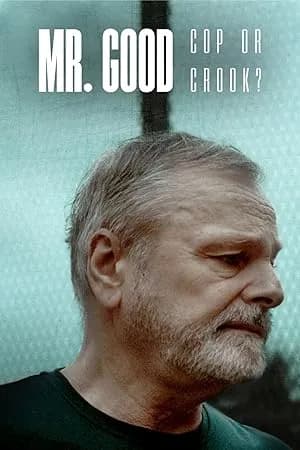
Mr. Good: Cop or Crook? is a Netflix limited documentary series about the case of Eirik Jensen, a former high-profile Oslo police detective who was convicted of drug trafficking and gross corruption and sentenced to the maximum term allowed under Norwegian law. Released on June 3, 2022, the four-part series directed by Tr Kvigassen and Agnete Riise digs into one of the most explosive law enforcement scandals in Norwegian history, asking viewers a question that still divides opinion in Norway: was Eirik Jensen a corrupt cop who betrayed his badge, or was he a dedicated undercover officer whose unconventional methods were fatally misunderstood?
Netflix describes the series as a look at Norway's top cop being suspected of drug trafficking, a framing that captures the central tension the documentary sustains across all four episodes. The series sits firmly in the tradition of true-crime documentaries that revisit legally settled cases and invite audiences to weigh the evidence for themselves.
The Case
Eirik Jensen spent decades as one of Oslo's most respected and decorated police detectives. He built much of his career working in and around Oslo's criminal underworld, cultivating informants and operating in proximity to motorcycle gangs and drug networks. It was precisely this background that would later become the centerpiece of both the prosecution's case against him and his own defense.
The key figure on the other side of the alleged conspiracy was Gjermund Cappelen, a hashish trafficker whom Jensen had known for years. According to prosecutors, the relationship between Jensen and Cappelen was far more than a detective-informant arrangement. Investigators alleged that Jensen had actively facilitated Cappelen's large-scale hashish smuggling operation into Norway, using his position and knowledge as a police insider to protect the trafficking network.
Jensen was arrested in 2013, and the case became an immediate national scandal. Criminal proceedings began in 2014, and in 2017 the Oslo District Court found him guilty on both counts: drug trafficking and gross corruption. The court sentenced him to 21 years in prison, the maximum penalty available under Norwegian law. Jensen appealed, but the conviction was upheld. At the time of the documentary's release, he remained a convicted prisoner serving that sentence.
Gjermund Cappelen, identified throughout coverage as Jensen's criminal counterpart and the source of the trafficking allegations, appears prominently in the documentary's account of the scandal. Because this is a drug-trafficking and corruption case rather than a violent crime, there is no single named victim in the conventional true-crime sense. The harm, as framed by the Norwegian justice system, was the large-scale introduction of hashish into Norway and the deep institutional betrayal represented by a senior police officer allegedly working against the very system he served.
Production
The series was directed by Tr Kvigassen and Agnete Riise and produced as a four-episode limited series for Netflix. Reviews note that the documentary follows a format familiar to seasoned true-crime viewers, including archival footage, court material, and interview segments, while centering on the unresolved tension of the Jensen case: the defense's argument that Jensen was simply an aggressive undercover operative whose relationships with criminals were professional rather than criminal.
The series draws on the extensive public record generated by what was already one of Norway's most heavily covered criminal trials. Coverage in Norwegian and international outlets had produced a substantial body of material about Jensen's career, his methods, and the allegations against him, giving the filmmakers a rich archive to work from. The documentary's value, according to several reviewers, lies in its ability to present the competing interpretations of the evidence in a way that keeps the central question genuinely open.
Reception
The series has been described by critics as a compelling but somewhat familiar entry in the Netflix true-crime canon. Reviewers acknowledged that the documentary does an effective job of dramatizing a case that had already been legally settled, which is itself part of the controversy: by revisiting a conviction that Norwegian courts had definitively upheld, the series implicitly raises questions about whether the right verdict was reached.
Norwegian and international coverage framed the documentary as a high-profile reopening of a debate that many in Norway considered closed. The case divides opinion in Norway, and the series leans into that division rather than resolving it, a creative choice that some reviewers praised for its intellectual honesty and others found frustrating.
On IMDb, the series holds a rating of approximately 6.8/10, reflecting a moderately positive but not rapturous audience response. User reviews suggest that viewers familiar with the Jensen case found the documentary a worthy summary of a complex scandal, while international audiences new to the story found it an engaging introduction to a case with genuine moral ambiguity at its core. Some critics noted that the series largely adheres to the established Netflix true-crime template without significantly innovating on the format.
The Case Today
At the time of the documentary's June 2022 release, Eirik Jensen was serving his 21-year sentence following the failure of his appeal. The case remained a touchstone in Norwegian public debate about police accountability, the ethics of undercover work, and the limits of informant relationships.
The documentary's release renewed media attention on the Jensen case in both Norway and internationally, with Netflix-news coverage describing him as one of the most fascinating and polarizing figures in modern Norwegian criminal justice. Whether viewers come away from the series believing Jensen was a corrupt insider or a wrongly convicted officer depends in large part on how much weight they assign to the defense's account of his undercover methodology.
What is not in dispute is the scale of the scandal: a senior police detective, trusted for decades to fight organized crime, standing convicted of working with it. For Norway, a country that consistently ranks among the world's least corrupt, the Jensen case remains a rare and unsettling exception.