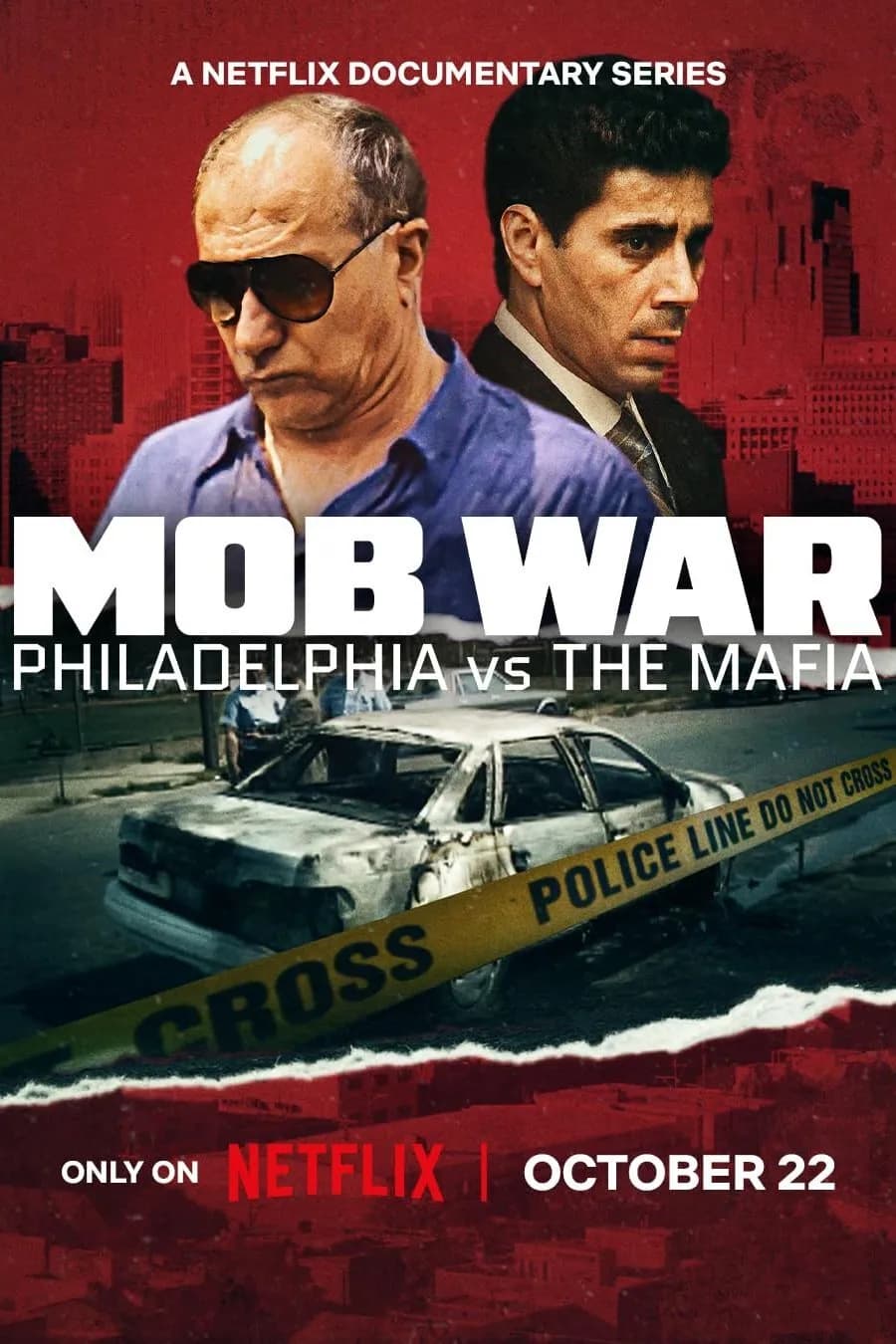
Mob War: Philadelphia vs. the Mafia
Netflix, 2025 — the 1990s Philadelphia Cosa Nostra power struggle between John Stanfa and Joey Merlino
Quick facts
What Is the Series About?
*Mob War: Philadelphia vs. the Mafia* is a three-episode Netflix docuseries about the bloody Philadelphia organized crime war of the early 1990s — a generational power struggle that turned the streets of one of America's oldest cities into a battlefield. Directed by Raissa Botterman and released on October 22, 2025, the series chronicles how the arrest of longtime Philadelphia mob boss Nicodemo "Little Nicky" Scarfo in 1986 created a dangerous vacuum, and how two rival factions — one led by the Sicilian-born John Stanfa, the other by the brash young upstart Joey "Skinny Joey" Merlino — filled it with bullets, bodies, and betrayal. Each episode runs approximately 45 minutes, and the series draws on FBI wiretap recordings, surveillance footage, and first-person accounts from law enforcement insiders.
The Case
The Philadelphia Cosa Nostra had long been one of the most volatile crime families in the United States, and Scarfo's downfall only accelerated its self-destruction. Into the void stepped John Stanfa, a Sicilian immigrant with ties to New York's Five Families who took the reins of the Philadelphia organization in the early 1990s. He was almost immediately challenged by a younger, Philadelphia-born cohort loyal to Joey Merlino, who had grown up in the mob world and had little patience for an outsider's authority.
According to Netflix's Tudum feature on the series, a sweltering August day in 1993 marked the moment those simmering tensions erupted into open, indiscriminate violence. Shootings multiplied. Michael Ciancaglini, a figure tied to the conflict, was among those killed. The war "plunged '90s Philadelphia into chaos and bloodshed," as Netflix's own synopsis puts it, and drew the sustained attention of federal law enforcement.
The FBI's response was aggressive and legally significant. Investigators secured court authorization for an extensive electronic surveillance operation that lasted approximately two years and captured more than 2,000 recorded conversations. Among the most legally controversial elements of the investigation was the placement of listening devices inside the Camden, New Jersey law offices of Salvatore Avena, an attorney representing Stanfa — a move that would later draw attention as a remarkable intrusion into spaces traditionally protected by attorney-client privilege concerns. The operation ultimately led to the indictment and arrest of Stanfa and more than 20 of his associates.
By November 1995, federal prosecutors had secured convictions against Stanfa and his co-defendants on charges including murder, extortion, gambling, and kidnapping. Stanfa was sentenced to life in federal prison. Joey Merlino, whose faction had effectively survived the war, was later prosecuted separately on federal racketeering charges and received a 14-year sentence in 2001, ultimately serving approximately 11 to 12 years.
Production
The series is directed by Raissa Botterman, who structures the three episodes to move between the mob war's street-level violence and the parallel federal investigation closing in from above. The documentary format relies heavily on archival material — including the wiretap recordings that proved decisive at trial — as well as interviews with former FBI agents and prosecutors who worked the case. Local press outlets including the Philadelphia Inquirer and PhillyVoice noted that the series also incorporates perspectives from figures close to the mob world itself, giving the production a layered, ground-up view of the conflict.
As Decider observed in its review, Botterman's series delivers the mob-related violence of early-1990s Philadelphia with directness, letting the archival record and first-person testimony carry the narrative weight. The use of actual wiretap audio — the product of that two-year surveillance operation — gives the documentary an immediacy that reconstructions alone cannot provide.
Reception
Critical reception for Mob War: Philadelphia vs. the Mafia has been broadly positive among true crime and organized crime enthusiasts, with reviewers praising its use of primary source material and its clear-eyed reconstruction of a chaotic and deadly period in Philadelphia history. Decider highlighted the series' willingness to engage with the violence directly, while local Philadelphia press framed it as a compelling and well-sourced account of a story their readership knows from lived memory.
No significant public controversy has emerged around the series itself, though the investigative methods at the heart of the real case — particularly the FBI's surveillance of a defense attorney's law office — remain a point of historical and legal interest that the documentary surfaces for modern audiences. The series carries an IMDb title ID of tt38501655; a confirmed audience rating was not available at the time of publication.
Netflix's promotional materials and the MediaPost coverage of the series both note that the production pulls no punches in its depiction of mob violence and federal overreach alike, positioning it within a broader wave of organized crime documentaries that have found large audiences on streaming platforms in recent years.
The Case Today
John Stanfa, now in his eighties, remains incarcerated in federal prison, serving the life sentence handed down in 1995. Joey Merlino was released after serving approximately 11 to 12 years of his 14-year federal sentence and has since faced additional legal scrutiny, though he has not returned to long-term imprisonment. The Philadelphia mob, decimated by the war and the subsequent federal prosecutions, never fully recovered its former power or cohesion. The story documented in Mob War: Philadelphia vs. the Mafia stands as one of the clearest examples in modern American organized crime history of how internal violence, combined with sustained federal surveillance, can destroy a criminal organization from within.
For Philadelphia, a city that lived through the shootings, the courtroom battles, and the daily news coverage of the mob war, the Netflix series offers both a historical reckoning and a reminder of how close to the surface that violence once ran.