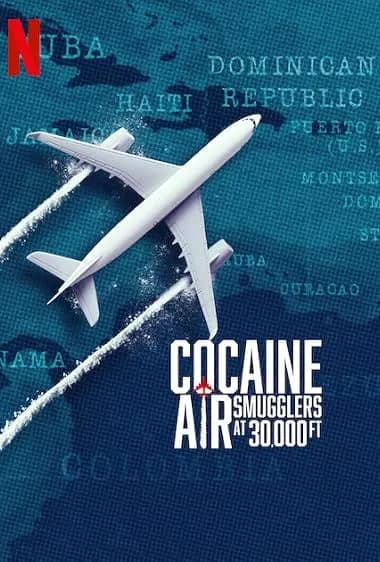
Cocaine Air: Smugglers at 30,000 Ft.
Netflix, 2025 — the true story of 700 kg of cocaine seized on a private jet at Punta Cana
Quick facts
What Is the Series About?
*Cocaine Air: Smugglers at 30,000 Ft.* is a four-part Netflix documentary series that reconstructs one of the most bizarre and politically charged drug-smuggling scandals in modern European history: the so-called Air Cocaine case. On March 20, 2013, Dominican customs officers at Punta Cana International Airport made a staggering discovery — 700 kilograms of cocaine, concealed inside 26 suitcases, loaded aboard a private Falcon 50 jet that was preparing to depart for Saint-Tropez, France. The four French nationals on board were immediately arrested. What made the story instantly extraordinary was who they were: two of the men were former French Air Force pilots, the kind of résumé that made the world ask whether an elite network — political, military, or both — was operating in the shadows.
Directed by Stéphane Rybojad and Thomas Dandois, the series premiered on June 11, 2025, and combines archival footage, court documents, and interviews to unpick a case that wound through Dominican jails, French courtrooms, a dramatic sea escape, and a final acquittal that left more questions than it answered.
---
The Case
The Seizure
The operation began on the evening of March 20, 2013, when Dominican authorities stopped a Dassault Falcon 50 private jet on the tarmac at Punta Cana International Airport. Inside the aircraft's luggage hold, officers found 26 suitcases packed with cocaine — 700 kilograms in total, a quantity with an estimated street value running into tens of millions of euros. The plane was scheduled to fly directly to Saint-Tropez, placing the cargo squarely on a route into the heart of the French Riviera.
Four French nationals were arrested on the spot:
- Pascal Fauret — a former French Air Force pilot turned civilian aviator, serving as one of the jet's two pilots.
- Bruno Odos — likewise a former French military aviator, co-piloting the aircraft.
- Nicolas Pisapia — a French passenger aboard the flight.
- Alain Castany — a French crew member and passenger.
Why the Case Became a Scandal
As People magazine's deep-dive into the true story makes clear, the case attracted ferocious media attention because Fauret and Odos simply did not fit the profile of typical narcotics smugglers. These were not career criminals or cartel foot soldiers — they were decorated veterans of the French armed forces. The immediate public and political question was not just how 700 kg of cocaine ended up on their plane, but who had put it there and whether the pilots were willing participants or unwitting couriers in a much larger operation.
Outside reporting further inflamed the controversy by raising possible links to high-level French political circles, including references that brushed against the orbit of former President Nicolas Sarkozy — allegations the documentary addresses without settling definitively.
Sentences and the Great Escape
A Dominican court handed down 20-year prison sentences to both pilots. But in 2015, before they had served their time, Fauret and Odos made a remarkable exit: according to Time magazine, the two men fled the Dominican Republic by boat, crossing the Atlantic and returning to France. Their escape sparked a diplomatic crisis and a fresh legal process on French soil.
French prosecutors pursued the case, and in 2019 a French tribunal convicted both men and sentenced each to six years in prison. The legal roller coaster had one more turn: in 2021, a French appeals court acquitted Fauret and Odos entirely, ending their criminal liability in France even as the original Dominican sentence technically remained outstanding.
The Unanswered Questions
Neither the French acquittal nor the documentary fully resolves the central mystery: who organised the operation, who loaded the 26 suitcases, and what — if anything — the pilots knew. That ambiguity is the engine that drives all four episodes of the series.
---
Production
The series was co-directed by Stéphane Rybojad and Thomas Dandois, two French documentary filmmakers. Running to four episodes, the production draws on more than a decade of accumulated material: court transcripts, news archives from the original 2013 arrest, and interviews conducted across France and the Dominican Republic. Sportskeeda's preview of the series notes that the filmmakers had access to participants willing to speak on camera about a case that upended multiple lives. The series is produced in French with English subtitles and carries Netflix's true-crime house style — methodical episode structure, talking-head interviews intercut with reconstructed sequences and archival news footage.
Netflix positioned the release as a major true-crime event for the summer of 2025, dropping all four episodes simultaneously on June 11, 2025, on the series' Netflix page.
---
Reception
Early audience and critical response has been strong. Decider gave the series a favourable review, framing it as a compulsive true-crime watch anchored by the drama of the 2013 runway arrest and the years of legal chaos that followed. UNILAD reported that viewers described the show as something that "gets crazier with every episode" — a reflection of how the case genuinely escalates in implausibility the deeper you go into it. BGR called the underlying events "so wild" they are difficult to believe, singling out the ex-military background of the pilots as the detail that elevates the story from a routine drug bust to something approaching a geopolitical thriller.
The documentary's IMDb rating was not publicly available at the time of publication (IMDb ID: tt36593582), but early viewer sentiment reported across social media skewed positive, with audiences particularly engaged by the question of whether the pilots were criminals or victims of a sophisticated frame-up.
The primary controversy surrounding the series mirrors the controversy surrounding the case itself: the disputed culpability of Fauret and Odos. Their 2021 acquittal in France did not come with a definitive explanation of who was responsible for the cocaine, meaning the documentary ends — as the legal process did — in unresolved tension.
---
The Case Today
As of the series' June 2025 release, Pascal Fauret and Bruno Odos are legally acquitted in France and are not serving prison time. The Dominican Republic's 20-year sentence remains a matter of record, but neither man has returned to face it. Nicolas Pisapia and Alain Castany's final legal statuses are less clearly documented in public reporting. No individual has ever been publicly identified and convicted as the organiser of the 700 kg shipment, and the full network behind the Air Cocaine operation — whoever loaded those 26 suitcases — remains officially unknown.
The Netflix series has reignited French public debate about the case, the judicial process, and the broader question of whether powerful interests were ever truly held accountable. For viewers encountering the Air Cocaine affair for the first time, *Cocaine Air: Smugglers at 30,000 Ft.* is both a gripping introduction and a reminder that in true crime, the most unsettling endings are sometimes the ones where nobody ends up behind bars.