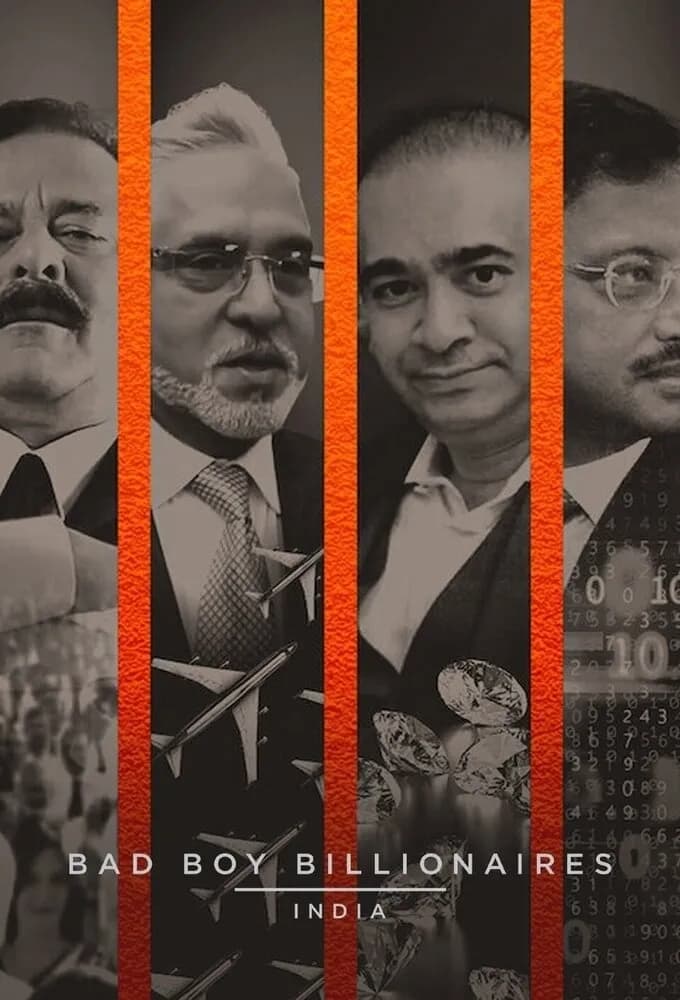
Bad Boy Billionaires: India
Netflix, 2020 — Four episodes exposing India's biggest financial fraud scandals
Quick facts
What Is the Series About?
Bad Boy Billionaires: India is a Netflix anthology documentary series that chronicles four of the most audacious financial frauds in Indian corporate history. Released in October 2020, the series profiles four powerful tycoons — Vijay Mallya, Nirav Modi, Subrata Roy, and B. Ramalinga Raju — each of whom built dazzling business empires before watching them collapse under the weight of fraud, deception, and hubris. The series won the 2021 Filmfare Award for Best Nonfiction Original and earned a 7.1/10 rating on IMDb, cementing its place as one of the most significant true crime documentary releases in South Asian streaming history.
Unlike most true crime series that focus on a single case, Bad Boy Billionaires operates as a four-part anthology — each episode a self-contained portrait of a different scandal, a different industry, and a different kind of betrayal. Together, they form a sweeping indictment of India's regulatory gaps, banking vulnerabilities, and the culture of impunity that allowed billionaires to defraud millions of ordinary citizens.
---
The Cases
Vijay Mallya — The Kingfisher Collapse
Vijay Mallya was once India's most visible playboy-businessman: the son of liquor magnate V. Mallya, he inherited United Breweries and added Kingfisher Airlines to his empire in 2005. The airline was an instant lifestyle statement — beautiful flight attendants, in-flight entertainment, celebrity endorsements. Behind the glamour, however, Mallya was allegedly siphoning 9,000 crore rupees (approximately $1.2 billion) from a consortium of over 11 Indian banks, including Union Bank of India, while the airline hemorrhaged cash.
Kingfisher ceased operations in 2012, leaving thousands of employees without wages or jobs. Mallya left India in March 2016 before authorities could detain him. India declared him a Fugitive Economic Offender in 2018 and has pursued extradition from the United Kingdom ever since. As of the series' release, Mallya remained in London, publicly denying any wrongdoing.
Nirav Modi — The Diamond Fraud
Nirav Modi was a jeweler of international renown — a man who dressed celebrities, appeared on the covers of glossy magazines, and cultivated an aura of old-world luxury. Behind the chandeliers and diamonds, however, he and associates were forging Letters of Undertaking (LoUs) at Punjab National Bank between approximately 2011 and 2016, using fraudulent documents to access overseas credit worth 14,000 crore rupees (approximately $1.8 billion).
A PNB internal audit discovered the fraud in January 2018, triggering one of India's largest-ever banking scandals. Modi fled India and was eventually located in the United Kingdom. Like Mallya, he has contested extradition proceedings from London. The victims of his fraud include PNB's depositors — millions of ordinary Indian families who trusted the public-sector bank with their savings.
Subrata Roy — The Sahara Scheme
Subrata Roy built Sahara India Pariwar into a vast conglomerate stretching from real estate to media, presenting himself as a benevolent patriarch and employing hundreds of thousands of people. But a central pillar of his empire was a financial scheme in which Sahara raised 24,000 crore rupees (approximately $3 billion) from over one million investors — mostly lower- and middle-class families across Bihar and surrounding states — through investment instruments that India's Supreme Court ultimately ruled illegal.
In 2013, the Supreme Court of India ordered Sahara to repay investors in full. Roy was arrested in 2014 and subsequently granted bail, but the legal battle over repayment dragged on for years. Many investors — who had entrusted their retirement savings and family funds to Sahara — never received full repayment. The Sahara case stands out in the series for the sheer scale of its human cost: not banks or corporations, but individual families who lost everything.
B. Ramalinga Raju — India's Enron
The fourth episode — and the most legally contentious — covers B. Ramalinga Raju, the founder of Satyam Computers, an IT company he launched in Hyderabad in 1987. By the 2000s, Satyam was a global player with clients including Microsoft and Delphi, employing over 50,000 people. In December 2008, Raju sent a letter to his board of directors confessing that he had inflated the company's cash and bank balances by $1.5 billion and fabricated revenue figures for years — a fraud so brazen it drew immediate comparisons to Enron.
The CBI filed charges in 2009. Raju was sentenced to five years in prison in 2015, though he secured stays on multiple appeals and was released on bail in 2021. The case is widely described as India's Enron, and it devastated shareholders, destroyed the savings of institutional investors, and left tens of thousands of employees in professional limbo until the company was eventually acquired by Tech Mahindra.
---
Production
The series was directed primarily by Dylan Mohan Gray, with Nick Read and Johanna Hamilton also directing segments. The production team conducted extensive interviews with former employees, banking officials, journalists, and regulators, weaving together archival footage, court documents, and on-camera testimony to reconstruct each scandal.
The series employed a dramatized-reconstruction style for key scenes, a choice that drew both praise for accessibility and mild criticism for sensationalism. The production notably did not secure interviews with the accused themselves — Mallya, Modi, Roy, and Raju all declined or were unavailable — which lent the series an adversarial but journalistically defensible posture.
One of the most remarkable aspects of the production history is the five-year delay of Episode 4. The Raju family secured a legal injunction from a Hyderabad court that prevented Netflix from releasing the Satyam episode at launch in October 2020. Only after the court vacated the injunction was the episode finally released on 31 December 2025, nearly five years after the rest of the series — itself a dramatic coda to a story about powerful men using every available lever to avoid accountability.
---
Reception
Bad Boy Billionaires: India was met with strong critical and audience response upon its release. The Times of India rated it 4 out of 5 stars, praising its impartial narrative and dramatic editing. The series holds a 7.1/10 on IMDb and approximately 71% on Rotten Tomatoes, and it won the 2021 Filmfare Award for Best Nonfiction Original.
Viewer reaction was largely enthusiastic, with many Indian viewers expressing a sense of catharsis at seeing the scandals laid out so plainly — and frustration that so many of the perpetrators remained free or abroad. The series also attracted considerable international attention, introducing global audiences to the scale of white-collar crime in one of the world's largest economies.
The legal battles surrounding the series — particularly Sahara's attempts to block broadcast and the Raju family's injunction — became part of the story itself, drawing additional media attention and inadvertently amplifying the series' reach.
---
The Cases Today
As of publication, the legal sagas at the heart of Bad Boy Billionaires: India remain largely unresolved — which is itself part of the series' implicit argument.
Vijay Mallya remains in the United Kingdom, where extradition proceedings have continued for years. He continues to publicly deny wrongdoing.
Nirav Modi is also in the United Kingdom, contesting extradition to India through prolonged court proceedings.
Subrata Roy passed away in November 2023 after a period of illness, before full repayment ordered by India's Supreme Court was completed — leaving many of his investors without resolution.
B. Ramalinga Raju was released on bail in 2021 and continues to navigate appeals. The Satyam brand was absorbed into Tech Mahindra years ago; the human wreckage of the fraud — lost jobs, evaporated savings, destroyed trust — endures.
Taken together, the four cases documented in Bad Boy Billionaires: India paint a portrait of systemic failure: regulators asleep, banks complicit or negligent, and a legal system that has struggled to deliver timely justice to millions of ordinary victims.