The Killer Clown: Inside John Wayne Gacy's 33 Murders
How a seemingly respectable Chicago contractor and children's entertainer became one of America's most prolific serial killers
Published June 6, 2025
Case Details
Quick Facts
Classification:
The case in the media
5 documentaries, series, podcasts and books covering this case
Quick facts
John Wayne Gacy murdered at least 33 young men and boys in suburban Chicago between 1972 and 1978, establishing himself as one of America's most prolific serial killers. Born on March 17, 1942, in Chicago, Gacy maintained an astonishing double life—respected contractor, community volunteer, and children's entertainer—while committing some of the era's most heinous crimes.
Gacy's criminal enterprise operated primarily from his ranch-style home in Norwood Park Township, where he lured victims under false pretenses. He typically offered young men construction work or invited them to his residence, often using a handcuff trick—claiming to demonstrate a magic illusion—to restrain them. Once incapacitated, victims were sexually assaulted, tortured, and killed through strangulation or asphyxiation.
The disposal of victims was calculated and methodical. Of the 33 confirmed murders, 26 bodies were buried in the crawl space beneath his home, three more buried elsewhere on his property, and four discarded in the Des Plaines River. The sheer scale of this hidden cemetery remained undetected for years, concealed by the very foundation of the house where neighbors and associates visited regularly.
Timeline
Birth of John Wayne Gacy
John Wayne Gacy is born in Edgewater, Chicago, Illinois.
First known victim
Gacy commits his first known murder. Over the following six years, at least 32 more will follow.
Arrest
John Wayne Gacy is arrested after police had been investigating in connection with the disappearance of Robert Piest.
Death sentence
Gacy is convicted on 33 counts of murder and sentenced to death.
Execution
John Wayne Gacy is executed at the age of 52 by lethal injection at Stateville Correctional Center.
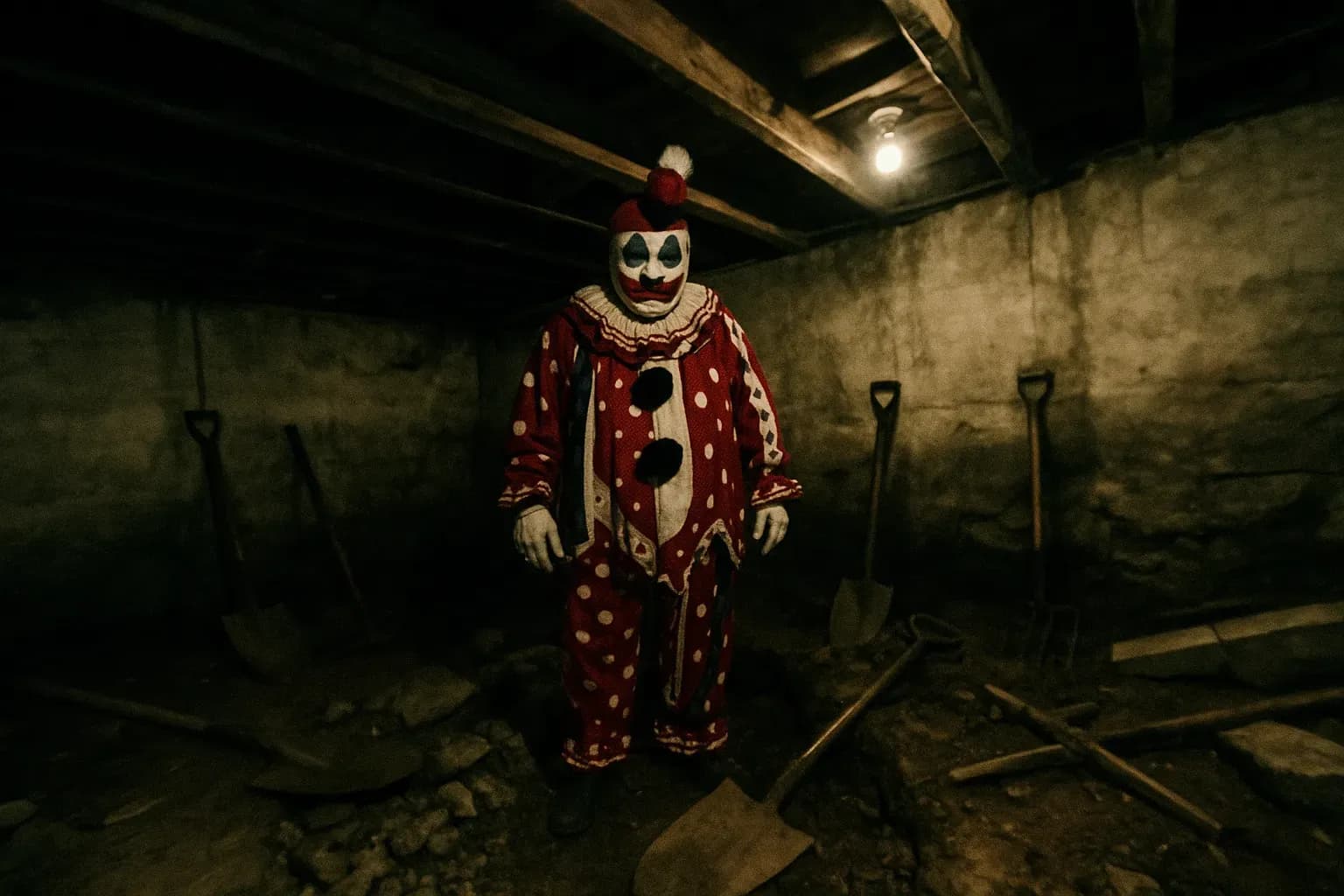
Gacy's public life provided perfect cover. He was an active member of the Jolly Joker Clown Club and regularly performed as "Pogo the Clown" and "Patch the Clown" at charitable events, fundraisers, and children's birthday parties. Colleagues and community members knew him as sociable and involved—a contractor with business interests and genuine community ties. This carefully crafted respectability shielded him from suspicion.
The investigation that would unravel Gacy's crimes began with the disappearance of Robert Piest, a 15-year-old boy, in 1978. Police connected Piest to Gacy, and a subsequent search of his property revealed the horrifying extent of his crimes. Gacy was arrested in December 1978.
His trial, which began on February 6, 1980, became a watershed moment in criminal psychology. Gacy pleaded not guilty by reason of insanity, claiming he suffered from dissociative identity disorder with multiple distinct personalities: the businessman, the politician, and the clown "Pogo." He referred to one personality as "Bad Jack," attributing the murders to this alternate self. Despite extensive psychiatric testimony from the defense, the court determined Gacy was legally sane. The evidence of premeditation, organization, and calculated victim selection proved incompatible with a genuine insanity defense.
On March 13, 1980, Gacy was convicted of 33 murders. He received the death sentence and spent 14 years on death row at Stateville Correctional Center. During his imprisonment, Gacy became a prolific artist, producing numerous clown paintings and other artwork. These pieces, created while awaiting execution, were later sold at auction—individual works commanding prices up to $25,000, a macabre aspect of his legacy that continues to disturb observers of true crime.
On May 10, 1994, Gacy was executed by lethal injection. His final words were unrepentant and crude, offering no remorse for the lives he had destroyed. His death closed one of America's darkest criminal chapters, yet the case remains a definitive study in the banality of evil—how monstrous crimes can hide behind the mask of normalcy, charm, and community standing.
**SOURCES**
https://en.wikipedia.org/wiki/John_Wayne_Gacy https://www.britannica.com/biography/John-Wayne-Gacy https://www.crimeandinvestigation.co.uk/articles/11-chilling-facts-about-john-wayne-gacy https://www.psychologytoday.com/us/blog/wicked-deeds/201405/john-wayne-gacy-the-diabolical-killer-clown https://www.biography.com/crime/john-wayne-gacy
Ask about this case
Answers from KrimiNyt's coverage onlyThe case in the media
5 documentaries, series, podcasts and books covering this case
TV series

Follow this case
Get an email when a new documentary, podcast or book about The Killer Clown: Inside John Wayne Gacy's 33 Murders appears, or when a verdict is reached.