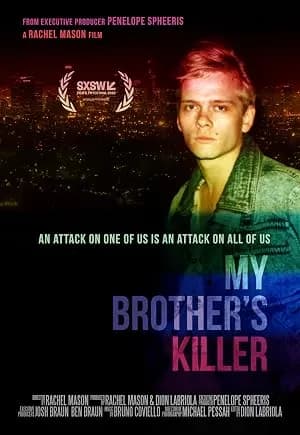
My Brother's Killer
Investigation Discovery documentary on the unsolved 1990 murder of Billy London in West Hollywood
Quick facts
What is the series about?
My Brother's Killer is a feature-length Investigation Discovery documentary that revisits the unsolved 1990 murder of William Arnold Newton, known professionally as Billy London, a 25-year-old gay adult-film performer whose dismembered remains were discovered in a dumpster in West Hollywood, California. Rather than a multi-episode series, the project is structured as a single two-hour film that reexamines decades of overlooked evidence, witness accounts and police records surrounding Newton's death.
The Case
Newton disappeared around October 29, 1990, reportedly just days before a planned meeting with his sister, and was later found murdered and dismembered in a West Hollywood dumpster, according to a contemporaneous Milwaukee Magazine account of his early life in Wisconsin. The case went cold for decades. The documentary follows director Rachel Mason as she reviews police reports, interviews people who knew Newton, and works alongside LAPD-related sources to develop new theories about what happened to him.
According to the official synopsis, the film ultimately identifies Newton's killer. However, the publicly available source material does not provide sufficiently verified detail to responsibly name the perpetrator, confirm an arrest or charging date, describe a plea or trial outcome, or state a sentence or current custody status. Milwaukee Magazine's coverage mentions a Wisconsin man named Clark Williams who was connected to Newton's early life, but nothing in the available reporting establishes that Williams was the killer or that he was ever charged or convicted. Readers should treat the documentary's investigative conclusions as distinct from any court-established verdict unless and until official records confirm otherwise.
The film situates Newton's murder within the broader context of West Hollywood's LGBTQ+ community and the gay adult-film industry of the early 1990s, an era marked by both cultural visibility and significant vulnerability for queer performers and residents.
Production
My Brother's Killer is directed by Rachel Mason, best known for the acclaimed documentary Circus of Books. For this project, Mason reportedly collaborated with Newton's family and friends, LAPD personnel, and true-crime authors and podcasters Christopher Rice and Eric Shaw Quinn, who contributed context and analysis to the renewed investigation, per the official Warner Bros. Discovery announcement. The documentary is scheduled to premiere on Investigation Discovery on December 3, 2026, from 9 to 11 p.m. ET/PT, with HBO Max named as the streaming destination at the time of the announcement. A German outlet, Quotenmeter, also reported on the premiere, describing it as an "award-winning" documentary, though the specific award is not detailed in available sources.
Reception
Ahead of its broadcast premiere, My Brother's Killer reportedly screened at the South by Southwest (SXSW) Film & TV Festival, where it drew early attention from critics. Cinefied gave the film a positive "Must-See" assessment, praising its investigation-driven structure and Rachel Mason's hands-on approach to reopening a decades-old cold case. No reliable aggregate audience score or IMDb rating has been identified for the documentary; an IMDb page titled "My Brother's Killer" refers instead to an unrelated 1958 episode of the anthology series Decoy. No specific, well-documented controversy has emerged regarding the film in available reporting, though its central claim — identifying Newton's killer — has not been independently verified against public court records.
The Case Today
More than three decades after Billy London's murder, the case remains publicly unresolved in terms of a confirmed, court-documented conviction. The documentary's premiere on Investigation Discovery in December 2026 is expected to bring renewed public attention to the case and to Newton's family's long search for answers. Until official legal records become available, the perpetrator's identity, any prosecution, and the case's final legal outcome remain unconfirmed beyond the documentary's own investigative narrative.