How Japan's Tech Giant Armed Soviet Submarines
The Toshiba-Kongsberg scandal exposed a Cold War export control failure that reshaped international security oversight
Published June 6, 2025
Quick Facts
In March 1987, U.S. and Japanese authorities revealed a troubling breach in Cold War export controls: Toshiba Machine Company, a subsidiary of the electronics giant Toshiba Corporation, had systematically violated international trade restrictions by selling advanced machine tools to the Soviet Union.
The scheme operated between 1982 and 1984, when Toshiba Machine supplied eight high-performance milling machines—specifically models like the MBP-110—along with numerical control (NC) devices and software to Soviet Technical Machinery Import Corporation. The transaction was routed through Wako Trading Co. Ltd., a dummy company controlled by the Japanese trading house Itochu Corporation, which falsely declared the equipment as a vertical lathe intended for reassembly overseas.
What made this case particularly serious was the military application. The machines were designed to mill submarine propellers with unprecedented precision. By late 1983, two MBP-110 units had been installed in Leningrad. Combined with computer technology provided by Kongsberg Vapenfabrikk, a Norwegian state-owned defense contractor, the equipment enabled Soviet engineers to manufacture nuclear-powered attack submarine propellers that operated significantly more quietly than before—a capability that alarmed U.S. military strategists.
Timeline
Illegal exports begin
From 1982, Toshiba Machine Co. begins exporting propeller milling machines, NC control units and software to the Soviet Union without the legally required permits.
Exports come to an end
The illegal exports to the Soviet Union end during 1984, after having continued for two years.
Japanese police search Toshiba Machine premises
On April 30, 1987, Japanese police search the company's premises as part of the investigation into the illegal exports.
Two former executives arrested
On May 27, 1987, Hiroaki Tanimura (former deputy head, engineering department) and Ryuzo Hayashi (former head, Material Procurement Department) are arrested.
Tokyo District Court hands down verdict
On March 22, 1988, Toshiba Machine Co. is fined 2 million yen. Tanimura receives a 10-month suspended sentence, Hayashi a 1-year suspended sentence. The company does not appeal.
The violation of Coordinating Committee for Multilateral Export Controls (CoCom) regulations was not accidental. According to verified accounts, in March 1980, Toshiba's president met with an export sales manager who explicitly indicated that breaching CoCom restrictions might be necessary to close the Soviet sale. When export applications were submitted to Japan's Ministry of International Trade and Industry (MITI), they contained material falsifications claiming no sale to Communist bloc countries or military end-users.
The conspiracy unraveled in late 1986 when Hitori Kumagai, an employee at Wako Trading, became an informant to U.S. government investigators. In March 1987, American officials notified Japan's Director of Cabinet Security Office, Atsuyuki Sasa, triggering media reports in both nations.
Japanese authorities moved swiftly. On April 30, 1987, police searched Toshiba Machine premises. By May 27, two company executives were arrested and charged with violating Japan's Foreign Exchange Law for submitting false export license applications. Criminal charges proceeded through the Japanese justice system, holding wrongdoers accountable.
The scandal exposed systemic weaknesses in Japan's export oversight. MITI reviewed approximately 200,000 export applications annually with only 30 inspectors—a ratio that made thorough vetting nearly impossible. Some accounts suggest inspectors even advised companies on evasion methods, though Toshiba Corporation's leadership maintained the parent company had no prior knowledge of its subsidiary's actions.
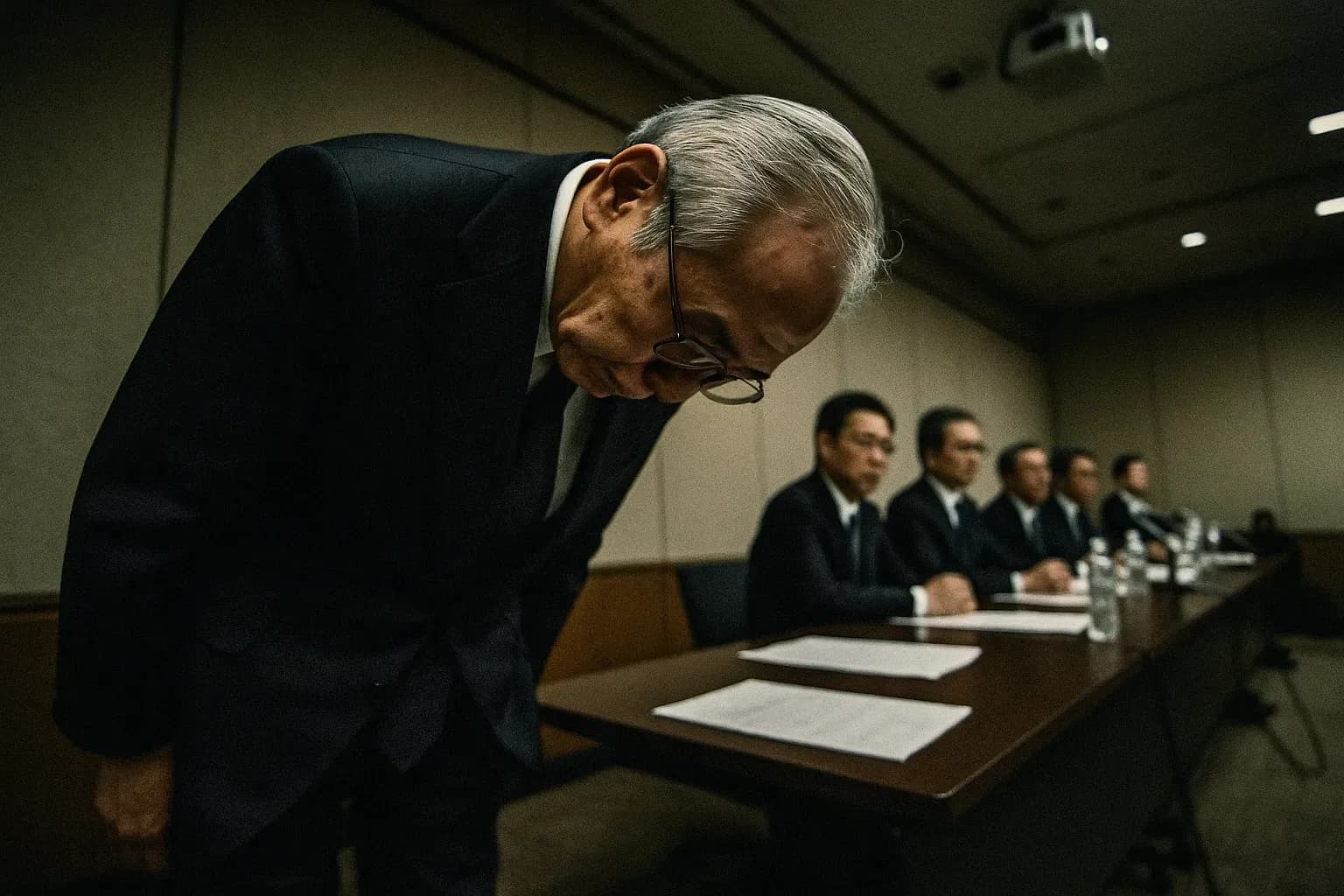
Toshiba Corporation's response was severe by Japanese corporate standards. The company's chairman and president both resigned—considered the highest form of apology in Japanese business culture. On July 20, 1987, Toshiba took out advertisements in major U.S. newspapers issuing a public apology for the subsidiary's conduct. The corporation implemented broad corrective measures to prevent future violations.
The Toshiba-Kongsberg scandal became a turning point in Cold War technology controls. It demonstrated how determined competitors could exploit regulatory gaps and that even major corporations operating under international law could prioritize sales over national security. The incident prompted stricter enforcement mechanisms, enhanced inter-agency coordination between Japanese and U.S. authorities, and more rigorous scrutiny of dual-use technology exports—reforms that extended far beyond Japan's borders.
For defense analysts, the case represented a significant Soviet advantage in submarine stealth technology achieved through a brief window of vulnerability in the Western export control system. The machines themselves symbolized an era when advanced manufacturing could swing geopolitical balance if inadequately protected.
Sources: - https://www.asianometry.com/p/toshibas-big-technology-export-scandal - https://en.wikipedia.org/wiki/Toshiba%E2%80%93Kongsberg_scandal - https://tradetalkspodcast.com/podcast/176-the-cold-war-scandal-over-export-controls/ - https://blogs.law.ox.ac.uk/business-law-blog/blog/2021/09/toshiba-incident-and-its-implications
Ask about this case
Answers from KrimiNyt's coverage onlyFollow this case
Get an email when a new documentary, podcast or book about How Japan's Tech Giant Armed Soviet Submarines appears, or when a verdict is reached.