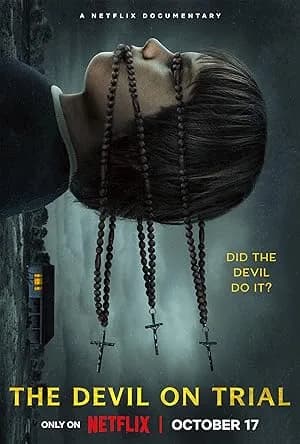
The Devil on Trial
Netflix, 2023 — the 1981 'Devil Made Me Do It' murder case in Brookfield, Connecticut
Quick facts
What Is the Series About?
The Devil on Trial is a Netflix documentary film about the 1981 murder of Alan Bono in Brookfield, Connecticut — a case that became one of the most extraordinary in American legal history because defendant Arne Cheyenne Johnson claimed he was demonically possessed when he killed the man. Directed by Christopher Holt and released on October 17, 2023, the 81-minute, TV-MA film examines the crime, the sensational trial, and the enduring controversy over whether the possession narrative was genuine, manufactured, or exploited. It is widely described as a retelling of the only known U.S. murder trial in which demonic possession was formally raised as a legal defense.
The Case
On February 16, 1981, Arne Cheyenne Johnson, then 19 years old, stabbed his landlord Alan Bono, 40, with a pocketknife during an argument at a party in Brookfield, Connecticut. Johnson was a tenant of Bono's, and by all initial accounts the killing appeared to be a straightforward homicide. Police arrested Johnson shortly after the attack, and the case might have remained a local news item were it not for what came next.
Johnson's defense team, with the involvement of renowned paranormal investigators Ed and Lorraine Warren, mounted an unprecedented legal argument: that Johnson had been involuntarily possessed by a demonic entity at the time of the killing and therefore could not be held criminally responsible for his actions. The Warrens had previously been involved with the Glatzel family — specifically the alleged possession of David Glatzel, the younger brother of Johnson's girlfriend — and claimed that a demon had transferred from David to Arne in the period before the murder.
According to TIME magazine, the case drew national media attention because it was presented as the first time in American legal history that demonic possession had been used as a murder defense. The presiding judge, Robert Callahan, rejected the possession argument and barred it from being presented to the jury as a formal defense. The trial proceeded on conventional legal grounds.
On November 24, 1981, after approximately 15 hours of deliberation, the jury returned a verdict of guilty on the charge of first-degree manslaughter. Johnson was sentenced to 10 to 20 years in prison. As reported by What to Watch, he was released by 1986, having served roughly a quarter of his maximum term.
The Participants and Their Stories
The documentary does not limit itself to the courtroom. It explores the wider cast of characters whose lives were upended by the case — including members of the Glatzel family, whose accounts of David Glatzel's alleged possession form the origin story of the demonic narrative. Global News notes that the Glatzel siblings' accounts have remained contested over the decades, with some family members later becoming estranged over what actually happened and how events were characterized publicly.
Ed and Lorraine Warren — already famous for their alleged investigations of the Amityville house and the Perron family haunting in Rhode Island — are central figures in the film. Their role in coaching or encouraging the possession defense has remained a source of skepticism for critics and legal observers alike. The documentary examines whether their involvement served the interests of justice, faith, or something else entirely.
Production
The Devil on Trial was directed by Christopher Holt and produced for Netflix. The film runs 81 minutes and carries a TV-MA rating, reflecting its mature subject matter. Holt structured the documentary around first-person testimony, archival materials, and contemporary interviews, allowing participants — including members of the Glatzel and Johnson families — to speak directly about events that shaped and in some cases scarred their lives.
The production had access to accounts from people directly involved in the case, lending the film an intimacy that distinguishes it from purely archival true crime documentaries. The choice to let the Glatzel family speak on camera is notable given how contested their story has remained for more than four decades.
Reception
The Guardian described the case as still shrouded in controversy and unsettling speculation, a phrase that captures the tone of much of the critical response to the film. Reviewers broadly praised the documentary's willingness to sit with ambiguity — neither fully endorsing nor dismissing the possession claims — while keeping the human cost of Alan Bono's death in focus.
Social media discussions following the October 17, 2023 premiere renewed longstanding debates about the Warrens' methods and credibility, with many viewers expressing skepticism that demonic possession played any genuine role in the killing. Others, particularly those with religious convictions sympathetic to the Warrens' worldview, found the film a compelling account of spiritual warfare intersecting with the American legal system.
The film is listed on IMDb under title ID tt28810493 with a runtime of 1 hour 21 minutes. A verified numerical star rating was not available from primary sources at the time of publication.
The Case Today
Arne Cheyenne Johnson was released from prison by 1986. The verified sources consulted for this article do not confirm his current status beyond that date. Alan Bono remains the largely forgotten center of this story — the 40-year-old man who was killed during an argument, whose death became subsumed in a national debate about the supernatural that had little to do with who he was in life.
The case retains its place in American legal history as the only known murder trial in which demonic possession was formally advanced as a defense. Whether that distinction reflects a genuine collision between faith and law, or a cynical legal strategy dressed in theological language, remains a question the documentary raises without fully resolving — which may be precisely the point.