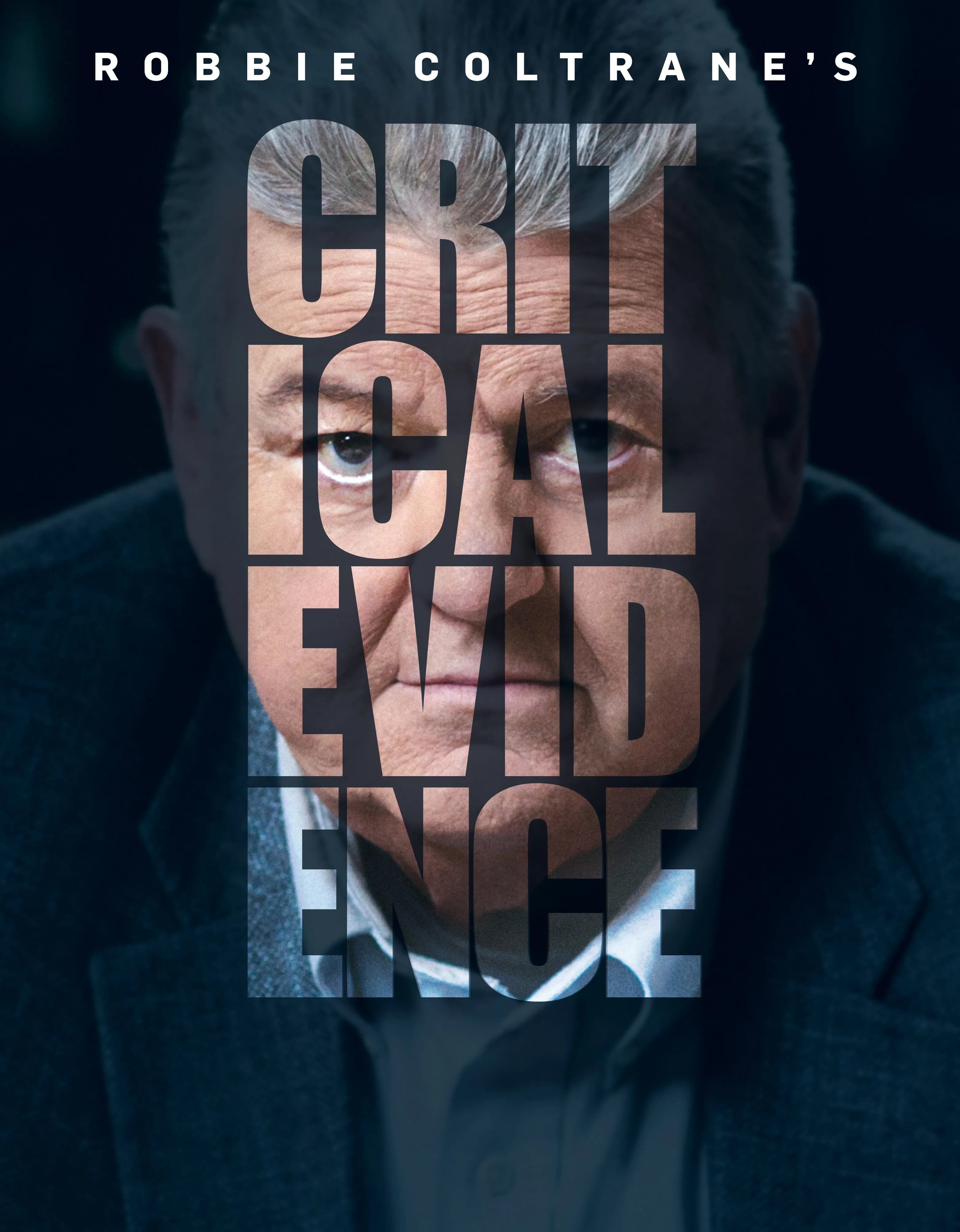
Robbie Coltrane's Critical Evidence
Crime+Investigation / Pluto TV, 2016 — eight unsolved British murder cases cracked by forensic breakthroughs
Quick facts
What Is the Series About?
Robbie Coltrane's Critical Evidence is an eight-part British documentary series hosted by actor Robbie Coltrane that examines eight baffling real-life murder cases investigated by British police — many of which began with no suspect, no leads and, in some instances, no body. The central premise of each episode is the same: a seemingly unsolvable homicide is eventually cracked not by a lucky tip or a confession, but by a single, pivotal piece of critical evidence, often forensic in nature. The series premiered in the United Kingdom on Crime+Investigation and is also available on Pluto TV, Inside Crime (FAST) and Apple TV.
Coltrane, an RTS award-winning actor best known for his role as Fitz in the long-running British drama Cracker, serves as the series' guide and narrator. He is not presented as a criminal psychologist or forensic expert, but as a storyteller — someone who can sit with the weight of these cases and communicate their human cost to a broad audience. Each episode runs approximately 42 minutes.
The Cases
The series covers eight distinct murder cases. Three have been highlighted in official promotional and press materials.
Karen Price — Little Miss Nobody
In 1981, fifteen-year-old Karen Price disappeared in Wales. For eight years her fate was unknown. When skeletal remains were discovered in 1989, investigators faced an identification problem that conventional methods could not solve. The breakthrough came through the work of forensic artist Richard Neave, who performed a ground-breaking facial reconstruction from Karen's skull — a technique that was, at the time, at the very frontier of forensic science. The reconstruction generated the public recognition needed to put a name to the remains. Karen's case is widely cited as one of the most significant early uses of forensic facial reconstruction in British criminal investigation. The murder itself remained unsolved at the time of the documentary, with no perpetrator publicly named and no trial having taken place.
Suzanne Pilley
On 4 May 2010, thirty-eight-year-old Suzanne Pilley vanished in Edinburgh, Scotland. The subsequent investigation centred quickly on her husband, David Pilley, 43, a former Royal Navy serviceman. Despite the fact that Suzanne's body was never recovered — and has not been found to this day — prosecutors built a case on circumstantial evidence and forensic analysis. David Pilley was arrested in 2010 and convicted of murder in 2012, receiving a life sentence with a minimum tariff of 17 years. He remains incarcerated. The Pilley case is a striking example of how modern forensic and investigative techniques can secure a murder conviction in the complete absence of a victim's remains.
Joseph Kappen — A Posthumous Reckoning
Perhaps the most remarkable case in the series involves Joseph Kappen, a man from Clydach in South West Wales. In April 1973, three teenage girls — Paula Willoxx (15), Sandra Cross (14) and Shirley Banks (15) — were murdered in the area. The crimes went unsolved for nearly 27 years. Kappen was long suspected but never charged. He died in 1998, aged 49, apparently beyond the reach of justice. Then, in 2013, advances in DNA technology allowed investigators to match semen samples preserved from the 1973 crime scenes to Kappen's exhumed remains. The result was a posthumous conviction — a formal legal declaration of guilt that brought a measure of closure to the families of three girls murdered four decades earlier.
Production
The series was produced for Crime+Investigation and A+E Networks, the transatlantic broadcasting group that operates the true crime genre channel in the United Kingdom. Filming on the first cases began in 2016, with the series making its UK debut in early 2018. The production company and director have not been publicly named in available sources. The series carries the IMDb identifier tt6745002.
The format is built around archival footage, re-enactments, and interviews with investigators and forensic specialists directly involved in the original cases. Robbie Coltrane's role is that of host and narrator rather than investigator — his presence lends the series cultural weight and accessibility without misrepresenting his credentials. The series page on Apple TV lists each episode at approximately 42 minutes.
The title's emphasis on critical evidence is not incidental: the series is deliberately structured around the forensic or investigative turning point in each case — the one piece of evidence without which a conviction, or even an identification, would have been impossible. This gives the series an educational dimension alongside its narrative one, illustrating how forensic science has transformed British policing over the past five decades.
Reception
No major published critical reviews or aggregated viewer scores are available in public sources for this series. IMDb lists the title under identifier tt6745002 but records no public user rating. Promotional materials from Crime+Investigation describe individual episodes as compelling and extraordinary, language typical of the channel's marketing but consistent with the subject matter. The series has been noted — by the RTS and by A+E Networks — for its focus on forensic innovation and the artistry of detective work rather than on violence or sensationalism. No controversies relating to the production, its subjects, or its host have been reported in available sources.
The Cases Today
Of the three prominently featured cases, two have been formally resolved through the courts. David Pilley remains imprisoned for the murder of Suzanne Pilley; her body has never been found. Joseph Kappen was posthumously convicted in 2013 and is deceased; his victims' families received a formal legal acknowledgement of guilt four decades after the murders. The case of Karen Price was identified thanks to Richard Neave's facial reconstruction, though the murder itself remained unsolved at the time of broadcast, with no perpetrator publicly identified.
Robbie Coltrane, who hosted the series, passed away on 14 October 2022 at the age of 72. His death prompted widespread tributes across the UK entertainment industry, and Critical Evidence stands as one of his later significant television projects — a reminder that his range extended well beyond the fictional roles for which he is most celebrated.