Wild Wild Country
Netflix, 2018 — The Rajneeshpuram cult, bioterrorism, and the collapse of a commune in Oregon
Quick facts
What Is the Series About?
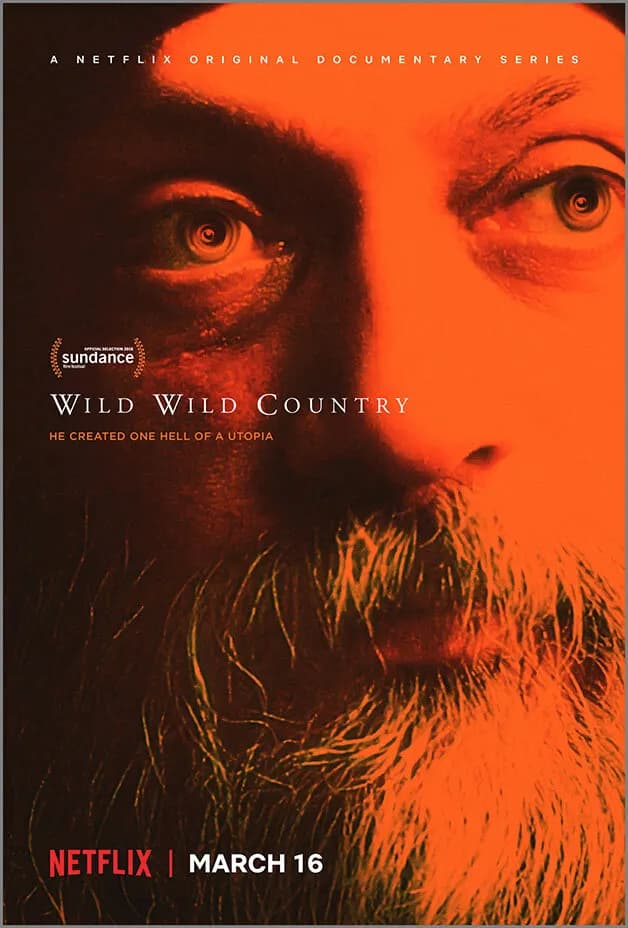
Wild Wild Country is a six-part Netflix documentary series directed by brothers Chapman Way and Maclain Way, released on March 16, 2018. It tells the story of Bhagwan Shree Rajneesh — also known as Osho — an Indian guru who led a religious movement that established a sprawling commune called Rajneeshpuram on a remote ranch in Wasco County, Oregon, during the early 1980s. What began as a utopian spiritual experiment rapidly escalated into one of the most audacious criminal enterprises in American history, involving bioterrorism, attempted murder, illegal wiretapping, immigration fraud, and a brazen plot to manipulate a local election. The series draws heavily on archival footage and firsthand interviews with former commune members, law enforcement officials, and local Oregon residents, delivering a portrait of idealism curdling into fanaticism.
The Case
The Rajneesh movement arrived in Oregon in 1981, when Bhagwan and his thousands of followers — known as sannyasins — purchased a 64,000-acre ranch and set about constructing their own city from scratch. Their presence immediately generated fierce resistance from Wasco County locals and the town of Antelope, whose residents were deeply unsettled by the sudden influx of red-clad devotees and the commune's aggressive expansion.
At the center of the commune's power structure stood Ma Anand Sheela, also known as Sheela Silverman, Bhagwan's personal secretary and the primary architect of its increasingly criminal operations. As tensions with local authorities escalated, Sheela and a circle of inner-circle members devised plans to neutralize their opponents by any means necessary. The most shocking of these was the deliberate contamination of salad bars at ten restaurants in The Dalles, Oregon, using Salmonella typhimurium bacteria. More than 750 people became violently ill in what investigators would later confirm was the largest bioterrorism attack ever carried out on U.S. soil. The scheme's intended purpose was to incapacitate enough local voters to swing a Wasco County election in favor of Rajneeshee-backed candidates.
The commune's criminal conduct did not stop there. According to reporting from Vanity Fair and other outlets, investigators also uncovered what was described as the largest case of illegal wiretapping ever recorded in the United States, along with plots of attempted murder targeting individuals inside and outside the commune, immigration fraud, and an elaborate conspiracy to maintain Bhagwan's control over the organization.
In 1985, the commune collapsed under the weight of federal and state investigations. Bhagwan Shree Rajneesh was deported from the United States. Sheela, who had fled to Europe, was extradited and subsequently pleaded guilty to charges including conspiracy, wiretapping, and attempted murder. She received a 20-year prison sentence but served approximately two years before her release, and paid a $400,000 fine. The wider network of sannyasins who carried out the poisoning and other crimes faced varying legal consequences, though sources available do not provide a complete accounting of every participant's legal outcome.
No individual victims of the salmonella attack have been named in the primary sources used for this article. The documented toll stands at more than 750 people sickened — ordinary restaurant patrons in a small Oregon city who had no involvement in the conflict between the commune and local authorities.
Production
Directors Chapman Way and Maclain Way spent considerable time assembling an extraordinary archive of footage — much of it shot by the Rajneeshees themselves, who documented their commune's daily life with unusual thoroughness. This internal archive, combined with interviews conducted decades after the events, gives the series an unsettling intimacy. Viewers see Bhagwan addressing his followers, watch Sheela at press conferences displaying a combative wit, and hear Oregon locals describe their mounting alarm as the commune grew in size and confidence.
The series benefits from willing on-camera participation by former commune members, including Sheela herself, who remains a polarizing and unapologetic figure. Her interviews are among the most discussed elements of the documentary — she is articulate, charismatic, and shows little remorse, a combination that generated significant debate about how documentary filmmakers should handle subjects who committed serious crimes. NPR noted that the series brought back a decades-old news story with renewed urgency, underlining how its themes of religious freedom, political power, and communal violence remain relevant.
Reception
Critical reception to Wild Wild Country was overwhelmingly positive upon its March 2018 release. Reviewers across major outlets described the series as jaw-dropping, riveting, and unlike anything previously produced about the Rajneesh movement. The Atlantic and other publications praised the richness of the archival material and the complexity with which the Way brothers handled a subject that could easily have been reduced to simple cult-and-villain storytelling.
ABC News Australia highlighted the series' documentation of what authorities described as the largest bioterror attack in U.S. history and the largest illegal wiretapping case ever recorded, framing the documentary as essential viewing for understanding how organized groups can weaponize ideology against democratic institutions.
A persistent critical debate surrounded the series' handling of its subjects — specifically whether the filmmakers gave Sheela and other former commune members too sympathetic a platform. Some critics argued that allowing charismatic perpetrators to narrate their own story risks a subtle rehabilitation of figures who caused serious harm. Others countered that the format's strength lies precisely in this tension: by letting all sides speak, the Ways created a documentary that implicates the viewer in the same processes of belief and persuasion that made Rajneeshpuram possible. People magazine covered viewer reactions that veered between outrage and a disturbing sympathy for commune members, reflecting the series' ability to complicate easy moral judgments.
The series holds the IMDb title ID tt7768848, though a specific aggregate rating figure was not available in the verified sources used for this article.
The Case Today
Bhagwan Shree Rajneesh — who later rebranded himself as Osho — died in 1990, five years after his deportation from the United States. His movement did not die with him; the Osho International Foundation continues to operate, and his teachings remain influential in meditation and wellness communities worldwide, a fact that continues to generate controversy given the documented crimes committed in his name and, many argue, under his direction.
Ma Anand Sheela, having served her short sentence, settled in Switzerland, where she has operated care homes for adults with disabilities. She has given numerous interviews over the decades and has never offered a complete accounting of her role in the commune's crimes, consistently deflecting or minimizing her responsibility for the most serious charges. Her re-emergence as a public figure following Wild Wild Country's release sparked renewed debate about justice, redemption, and the gap between legal punishment and moral accountability.
The salmonella attack's more than 750 victims have largely remained anonymous in public reporting. For the communities of Wasco County and The Dalles, the events of the 1980s left a lasting mark — the Netflix series prompted a new wave of local reflection, with NBC Chicago and other outlets documenting how people who lived through the events responded to seeing them dramatized for a new global audience. For many of them, the documentary's popularity was a bittersweet reminder that the country is only now reckoning with what they experienced firsthand more than thirty years ago.