November 13: Attack on Paris
Netflix, 2018 — three-part documentary on the coordinated ISIS terror attacks that killed 130 in Paris
Quick facts
What Is the Series About?
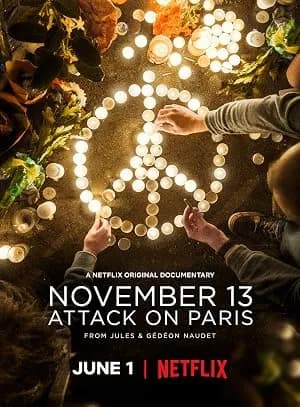
November 13: Attack on Paris is a three-part Netflix documentary series directed by Gédéon Naudet and Jules Naudet, released on June 1, 2018. It chronicles the coordinated ISIS terrorist attacks of 13 November 2015 in Paris and Saint-Denis, France — the deadliest attacks on French soil since World War II. Rather than focusing on the perpetrators, the series centres on the experiences of survivors, police officers, ambulance crews, firefighters, and government officials who lived through one of Europe's worst modern terrorist atrocities. Former President François Hollande is among those interviewed, making the documentary a rare combination of street-level testimony and high-level political perspective.
The series was previewed at the 9/11 Memorial & Museum in New York City, underscoring its framing as a document of collective trauma and resilience rather than a conventional true-crime investigation.
---
The Case
On the evening of Friday, 13 November 2015, a coordinated cell of ISIS-linked Islamist militants carried out a series of near-simultaneous attacks across Paris and the northern suburb of Saint-Denis. The assault unfolded in three waves:
Stade de France: Three suicide bombers detonated explosives outside the national football stadium in Saint-Denis, where a France–Germany international friendly was being played in front of 80,000 spectators, including President Hollande.
Cafés and restaurants: Gunmen opened fire on crowded terraces in the 10th and 11th arrondissements of Paris, targeting establishments including Le Carillon, Le Petit Cambodge, La Belle Équipe, and the Bonne Bière. The attacks were designed to cause maximum civilian casualties in the heart of Parisian social life.
Bataclan concert hall: The bloodiest phase of the attack took place at the Bataclan theatre, where an American rock band, Eagles of Death Metal, was performing to a sold-out crowd. Three gunmen stormed the venue, killing 90 people and holding survivors hostage for several hours before French police stormed the building.
In total, 130 people were killed and hundreds more were injured across all sites. The attacks were claimed by ISIS and were planned partly from safe houses in Belgium. The cell included both French and Belgian nationals who had travelled to Syria for training.
The sole surviving attacker, Salah Abdeslam, fled to Belgium after the attacks. He was captured in Brussels in March 2016 following one of the largest manhunts in European history. The subsequent trial — involving 20 defendants — was the largest terrorism prosecution in French history. In June 2022, Abdeslam was convicted and sentenced to life imprisonment without the possibility of parole, the most severe sentence available under French law.
---
Production
The Naudet brothers — Gédéon and Jules — are best known internationally for their documentary 9/11 (2002), which captured the September 11 attacks from the perspective of New York City firefighters. Their approach to November 13 follows a similar methodology: privileging the testimony of those who were present over analytical narration or reconstruction.
According to the official Netflix trailer, the series was structured across three episodes, each building on layered first-hand accounts to reconstruct the chronology of the night and its immediate aftermath. The directors reportedly conducted around 40 interviews over an eight-month period, speaking with survivors, police officers, ambulance staff, firefighters, and political figures including former President François Hollande. That access — particularly to senior officials willing to speak candidly about the failures and successes of the emergency response — gives the series a depth unusual for documentary coverage of terrorist attacks.
The series is available to stream on Netflix and is also listed on Apple TV for rental or purchase in selected markets.
---
Reception
November 13: Attack on Paris carries a tracked IMDb rating of 8.2/10, reflecting strong audience engagement with its eyewitness-driven format. Viewers have consistently noted the emotional power of hearing survivors describe their experiences in their own words, with the multi-site structure of the attacks lending the series an almost unbearable tension as accounts from different locations converge.
IndieWire praised the documentary for its grounded, testimony-led approach, noting that the Naudets resisted sensationalism in favour of human witness. The series was positioned not as an investigation into the attackers' ideology or planning — those aspects are largely absent — but as a record of how ordinary people and emergency professionals responded to catastrophe in real time.
No significant controversy has been attached to the series itself. The subject matter is inherently painful and politically charged, but critics and viewers have generally agreed that the Naudets handled the material with appropriate gravity. The decision to focus on victims and responders rather than perpetrators was widely seen as a deliberate and respectful editorial choice.
---
The Case Today
The legal proceedings arising from the 13 November 2015 attacks concluded in their main phase with the June 2022 verdict. Salah Abdeslam received a life sentence without parole — an outcome described by survivors' groups as a measure of justice, though many have spoken publicly about the ongoing psychological toll of the attacks and the trial process itself.
The Bataclan concert hall reopened in November 2016, exactly one year after the attacks, with a concert by Sting. It continues to operate as a live music venue. Memorial plaques have been placed at all attack sites across Paris and Saint-Denis.
The broader political consequences of the attacks — including France's extended state of emergency, shifts in counterterrorism legislation, and ongoing debates about radicalisation — remain live issues in French public life. The series stands as a primary audiovisual record of how the city experienced that night, and its value as a historical document is likely to grow over time.