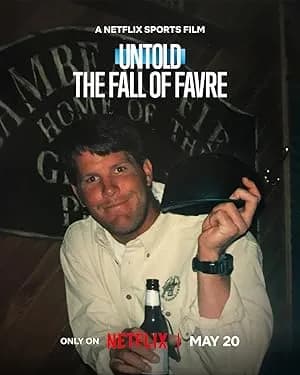
Untold: The Fall of Favre
Netflix, 2025 — Brett Favre's sexting allegations and Mississippi welfare-funds scandal
Quick facts
What Is the Series About?
Untold: The Fall of Favre is a Netflix sports-true-crime documentary that examines two separate but equally damaging controversies surrounding Brett Lorenzo Favre, one of the most celebrated quarterbacks in NFL history. Released on May 20, 2025, and running 1 hour and 4 minutes, the film is a single feature-length documentary — not a multi-episode series — directed by Rebecca Gitlitz. It sits within Netflix's ongoing Untold documentary strand, which focuses on underreported or misremembered chapters in sports history.
Rather than covering a single murder or kidnapping case, the film takes aim at Favre's post-glory legacy through the lens of two episodes of alleged misconduct: the 2008 sexting and sexual harassment allegations made by Jenn Sterger, and his alleged involvement in the massive Mississippi welfare-funds diversion scandal that became a full-blown public reckoning after a 2022 state audit. Together, as Netflix's official Tudum page frames it, the two cases form the backbone of what the film argues is a pattern of entitlement from a man accustomed to being shielded by fame.
The Case
The Jenn Sterger Allegations (2008)
In 2008, while playing for the New York Jets, Brett Favre allegedly sent unsolicited explicit messages and images to Jenn Sterger, who was working at the time as a Jets employee and field reporter. Sterger is the primary named victim in this portion of the documentary, and her account is presented centrally by Time magazine's coverage of the film, which includes interview material from Sterger herself.
The allegations remained largely private until they surfaced publicly, prompting the NFL to open a formal investigation in 2010. According to Sportskeeda's detailed case overview, forensic analysis of the materials could not conclusively establish Favre's identity as the sender. The league nonetheless fined Favre $50,000 for failing to cooperate fully with investigators. No criminal charges were filed in connection with the Sterger matter, and no criminal conviction exists on record.
The Mississippi Welfare-Funds Scandal
The second and arguably more consequential controversy examined in the documentary involves the alleged diversion of Mississippi welfare funds — money drawn from the federal Temporary Assistance for Needy Families (TANF) program and intended for low-income Mississippi residents — toward projects that included a volleyball facility at the University of Southern Mississippi. The Guardian's review of the documentary connects Favre's role in this episode directly to the film's broader argument about unchecked privilege.
According to MSN's summary of the documentary's revelations, seven people were charged federally in connection with the welfare-funds diversion; six of those individuals pleaded guilty. One federally charged defendant named in the sourced materials is Jake VanLandingham. Crucially, Brett Favre himself was not criminally charged. Time's reporting confirms that Favre has denied wrongdoing throughout, and a civil lawsuit brought by the Mississippi Department of Human Services was described as ongoing at the time of the documentary's release.
The alleged diversion scheme predates the 2022 audit that ignited widespread public attention, but the audit is identified as the moment the scandal became impossible to contain or ignore.
Favre's Response
Favre has consistently denied wrongdoing in both matters. According to Awful Announcing's coverage cited in the research materials, Favre claimed he was not properly contacted in the lead-up to the documentary's production and objected to how his story was framed. He remains unconvicted in any criminal court as of the documentary's release.
Production
The film was directed by Rebecca Gitlitz and produced under the Untold documentary banner on Netflix — a strand that has previously tackled figures and events ranging from college basketball scandals to Olympic controversies. The production leans heavily on archival footage, contemporaneous news reporting, and on-camera interviews, most notably with Jenn Sterger, whose willingness to speak publicly adds significant weight to the film's first act.
The documentary's 64-minute runtime is deliberately lean, choosing depth over exhaustiveness. Rather than cataloguing every allegation, Gitlitz structures the film around the arc of Favre's public image — the celebrated champion whose Hall of Fame credentials were progressively overshadowed by questions of character. USA Today's review described Favre as a star "drowning in scandal," a phrase that captures the documentary's largely unsparing editorial posture.
Notably, Favre himself is not a participant in the film, having reportedly taken issue with the production's approach. His absence allows the documentary to build its case without direct rebuttal, a creative and ethical choice that has drawn both praise and criticism from reviewers.
Reception
Untold: The Fall of Favre holds an IMDb rating of 6.0/10 (IMDb ID: tt36557720), which places it in the middle tier of sports documentaries — respected but divisive. Critical reception has been generally favorable among those who view the film as a necessary accountability exercise, while some sports commentators have questioned whether the documentary gives Favre adequate opportunity to respond to the allegations it presents.
The Guardian praised the film for its willingness to connect Favre's personal misconduct to systemic failures — the networks of enablers, PR infrastructure, and institutional loyalty that allowed a superstar to avoid meaningful consequences for years. USA Today's coverage framed the film as an unflinching look at how celebrity can insulate the powerful from accountability. DM Talkies' recap highlighted the documentary's effective use of the welfare scandal to illustrate how Favre's alleged misconduct extended far beyond private messages into matters of genuine public harm.
Controversy has followed the release, with Favre's camp pushing back publicly on the documentary's framing and its alleged failure to seek his participation in good faith. That dispute has itself generated additional news coverage, inadvertently amplifying the film's reach.
The Case Today
As of the documentary's May 2025 release, Brett Favre has not been criminally charged in either the Sterger matter or the Mississippi welfare-funds case. The civil lawsuit filed by the Mississippi Department of Human Services against parties connected to the welfare scandal — including Favre — was reported as ongoing. Six of the seven federally charged defendants in the welfare case had pleaded guilty, but Favre's own legal exposure remains confined to the civil arena.
Jenn Sterger, whose allegations date back to 2008, has used the documentary's release as an opportunity to speak more openly about her experience, with Time magazine providing one of the more in-depth platforms for her account. Her story — delayed, doubted, and ultimately unresolved in any formal legal sense — reflects a broader cultural reckoning with how allegations of workplace sexual harassment by powerful athletes are handled.
Favre, now retired from professional football, continues to dispute the characterizations presented in the film. His NFL legacy — which includes a Super Bowl championship, multiple MVP awards, and a record consecutive-games-started streak — remains officially intact, though the documentary makes clear that his public reputation has been significantly and perhaps permanently complicated by these two controversies.