Pepsi, Where's My Jet?
Netflix, 2022 — The bizarre civil lawsuit over a Harrier jet in a soda commercial
Quick facts
What Is the Series About?
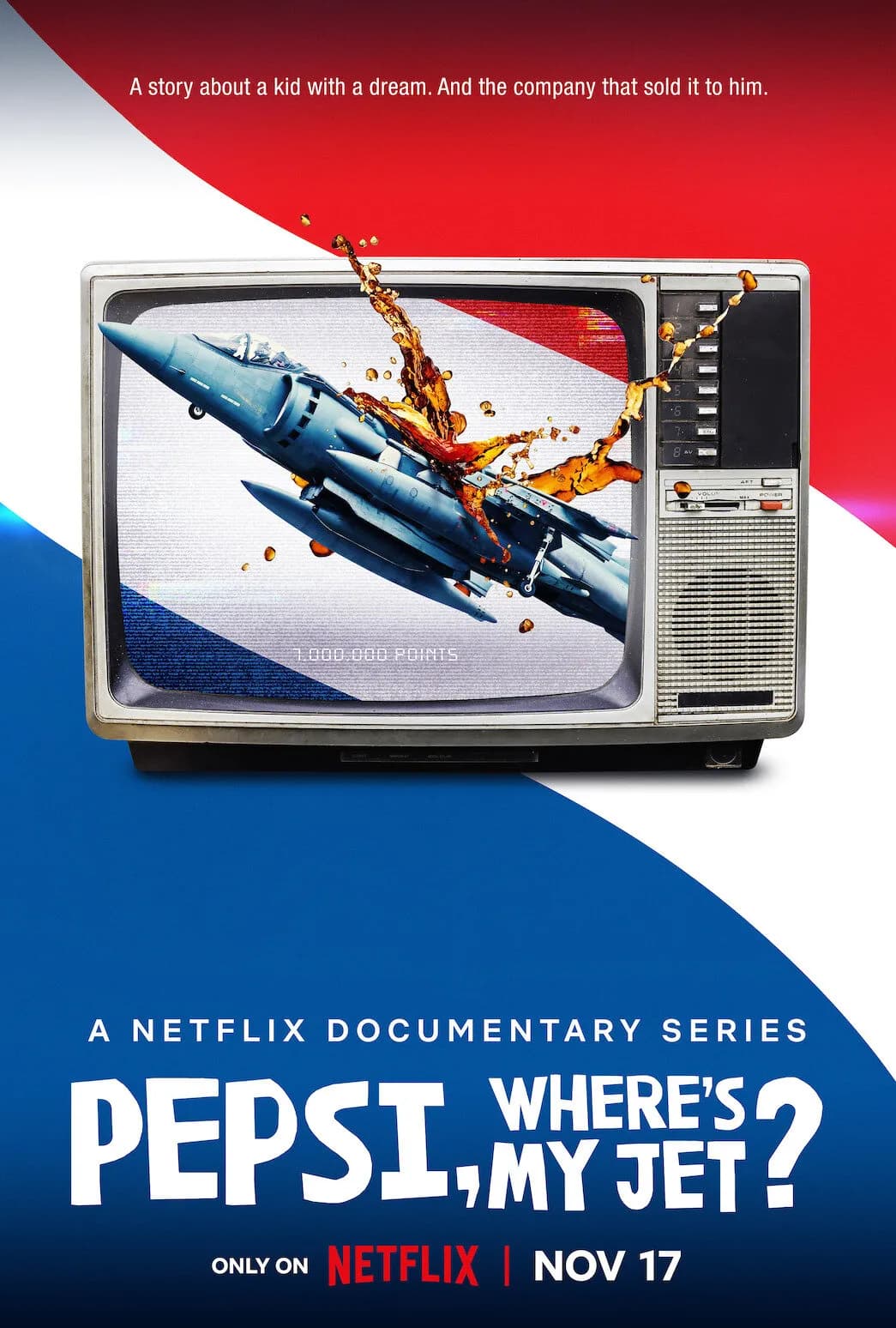
Pepsi, Where's My Jet? is a four-episode Netflix docuseries directed by Andrew Renzi and released on November 17, 2022. Unlike the majority of true-crime productions, it covers no murder or violent offense. Instead, it reconstructs one of the most absurd legal disputes in American advertising history: *Leonard v. PepsiCo, Inc.*, a civil lawsuit in which a young man argued — in federal court — that a soda company owed him a $33 million military fighter jet because it appeared in a television commercial.
The series blends archival footage, talking-head interviews, and re-creations to tell the story of how a 30-second TV spot set off a years-long legal battle, challenged the boundaries of advertising law, and turned an obscure contract-law question into a pop-culture phenomenon.
---
The Case
In the mid-1990s, PepsiCo launched its "Pepsi Stuff" loyalty promotion, encouraging consumers to collect Pepsi Points printed on packaging and redeem them for branded merchandise. To advertise the campaign, the company aired a comic television commercial in which a teenager arrives at school piloting a AV-8 Harrier II jump jet — a vertical-takeoff military aircraft used by the U.S. Marine Corps — with a caption reading "HARRIER FIGHTER 7,000,000 PEPSI POINTS."
Most viewers laughed. John Leonard did not.
Leonard, then approximately 20 or 21 years old, decided to take the ad at face value. Together with his associate Todd Hoffman, who provided financial backing, Leonard set about acquiring 7 million Pepsi Points. Because points could also be purchased directly at ten cents apiece, the pair assembled the required total and mailed a formal redemption request to PepsiCo — complete with a check for the remaining balance.
Pepsi refused, calling the jet's appearance in the ad an obvious joke. Leonard sued.
The case, widely known as the Pepsi Points Case, was litigated in the United States federal court system. In August 1999, the U.S. District Court ruled decisively in PepsiCo's favor. The presiding judge found that the commercial was not a binding contractual offer — a legal concept requiring clarity, seriousness, and definite terms — but rather an obvious piece of humorous advertising, sometimes described in coverage as "puffery." No reasonable person, the court held, could have genuinely believed a soft-drink company was offering a $33 million combat aircraft in exchange for soda-can labels.
Pepsi prevailed. Leonard received nothing. The case became a staple of first-year contracts courses at American law schools.
---
Production
Director Andrew Renzi approached the material not simply as a legal curiosity but as a story about ambition, advertising power, and who gets to control a narrative. Entertainment Tonight's exclusive trailer coverage framed the series as a chronicle of a "wild 90s soda scandal," emphasizing the era's specific brand of unchecked corporate advertising bravado.
According to reporting by IndieWire, the production gained access to key figures connected to the case and unearthed behind-the-scenes context — including a notable backstory involving Judge Judy — that had not previously been part of the public record. The four-episode structure allows Renzi to dedicate meaningful screen time to both the cultural context of 1990s advertising and the granular mechanics of how a civil lawsuit over a TV commercial actually unfolds.
The series uses the case as a lens to examine a broader question: when corporations speak in the language of fantasy and aspiration, where does marketing end and a legally enforceable promise begin?
---
Reception
Critical and audience reception for Pepsi, Where's My Jet? was largely positive, with reviewers consistently highlighting the documentary's capacity to make a dry contract-law dispute feel genuinely suspenseful and entertaining. Trade and entertainment outlets noted that the absurdity of the central premise — a court seriously debating whether PepsiCo owed someone a Harrier jet — gives the series a built-in hook that Renzi exploits effectively.
National World's coverage contextualized the real story behind the documentary and noted viewer fascination with the gap between what most people remember (a kid tried to scam Pepsi) and what the series actually argues (that the ad was misleading enough to invite the dispute in the first place).
One of the documentary's most discussed contributions to the conversation is its rehabilitation — or at least complication — of John Leonard's image. For decades, the case was popularly remembered as a cautionary tale about a gullible or opportunistic young man. The series pushes back on that framing, inviting viewers to ask whether PepsiCo's advertising team bore any responsibility for creating an ad ambiguous enough to generate a real legal challenge.
Viewer reactions on social media and review platforms centered on two recurring themes: disbelief that the case was real, and genuine debate over whether the original commercial should have carried clearer disclaimers. The IMDb rating for the series (tt23022276) had not been independently verified at the time of publication.
---
The Case Today
Leonard v. PepsiCo, Inc. remains a landmark case in American advertising and contract law, regularly assigned in law school curricula as an example of the legal doctrine distinguishing offers from invitations to treat, and of the limits of literal interpretation in commercial speech.
PepsiCo, Inc. continues to operate as one of the world's largest food and beverage corporations. John Leonard and Todd Hoffman have re-entered the public eye through the Netflix series, which gave both men a platform to revisit events that defined a significant chapter of their lives more than two decades earlier.
The Harrier jet, for its part, was never delivered.