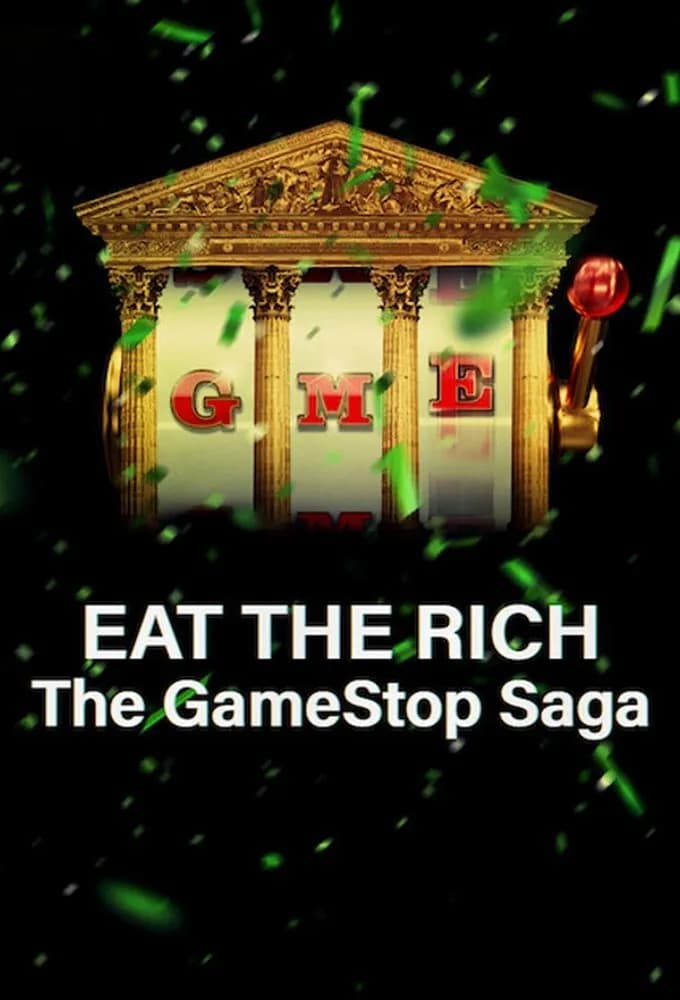
Eat the Rich: The GameStop Saga
Netflix, 2022 — the 2021 GameStop short squeeze that shook Wall Street
Quick facts
What Is the Series About?
Eat the Rich: The GameStop Saga is a three-episode Netflix documentary series directed by Theo Love that chronicles the extraordinary financial market event of January 2021, when a loosely organized community of retail investors on Reddit's wallstreetbets forum drove the share price of GameStop to stratospheric heights, inflicting massive losses on the hedge funds that had bet heavily against the stock. Released on September 28, 2022, the series examines how an online community armed with smartphones and discount trading apps briefly turned Wall Street's own tools against it, and what happened when the establishment pushed back.
Unlike most entries in the true-crime genre, this is not a story built around a murder, fraud conviction, or traditional criminal offense. It is a story about money, power, and the moment the internet decided it wanted a seat at the table — and it is told with the energy and pace of a financial thriller.
The Case
The saga begins with a simple, if audacious, idea: GameStop stock was among the most heavily shorted securities on the U.S. market, meaning that large hedge funds had borrowed shares and sold them, betting the price would fall so they could buy them back cheaper and pocket the difference. Users on wallstreetbets identified this vulnerability. If enough retail investors bought shares and options simultaneously, the resulting price spike would force short sellers to cover their positions — buying back shares at inflated prices to limit their losses — which would push the price even higher. The strategy, known as a short squeeze, is not inherently illegal. What made the GameStop episode historic was its scale and its explicitly anti-establishment framing.
In the final days of January 2021, GameStop's share price rocketed from roughly $20 to nearly $500. Hedge funds, most notably Melvin Capital, suffered losses reported in the billions. The event was framed by its retail-investor participants as a David-vs.-Goliath moment: ordinary people with small accounts taking on billion-dollar firms that had been shorting a company for profit.
The controversy sharpened dramatically on January 28, 2021, when trading app Robinhood abruptly restricted the ability of its users to buy GameStop shares, while still allowing them to sell. The decision immediately generated accusations that Robinhood — which markets itself to everyday investors — was in fact protecting its institutional counterparts. Robinhood's leadership argued the restrictions were required by clearinghouse collateral requirements, but the explanation did little to quell public fury. The company's ties to Citadel Securities, a major market maker that also had financial relationships with some of the affected hedge funds, became a focal point of suspicion.
Because the series covers a market event rather than a criminal prosecution, there is no perpetrator, no victim list, and no verdict in the conventional sense. The Rotten Tomatoes listing and supporting sources confirm no criminal trial is documented. The series instead maps the collision between three groups: the retail traders who orchestrated the squeeze, the hedge funds that were squeezed, and the platforms and institutions caught in the middle.
Production
The series was directed by Theo Love and produced for Netflix, which positions it in the platform's expanding catalog of financial and cultural documentary content. According to the Netflix Media Center, the series takes a notably humorous and lively approach to the material — a deliberate editorial choice that distinguishes it from drier financial journalism.
Each of the three episodes runs approximately 36 to 40 minutes, for a total runtime of around 109 minutes. The series draws on interviews with participants from multiple sides of the story, including retail traders who became prominent figures in the wallstreetbets community, market analysts, and media personalities. Television personality Jim Cramer appears in the series and is portrayed in a light that CNN's reviewer described as somewhat ridiculous, reflecting the broader cultural mockery he faced during the squeeze after his confident predictions failed to anticipate the Reddit-driven surge.
The production benefits from the unusual circumstance that the primary actors in this story — the retail traders — were extraordinarily public about their actions in real time, posting their trades, positions, and reactions on Reddit and social media. This creates a rich archive of contemporaneous documentation that few documentary subjects can match.
Reception
Critical reception for Eat the Rich: The GameStop Saga has been mixed to positive. The series holds an IMDb rating of 6.4/10 based on viewer scores, reflecting an audience that largely appreciated the storytelling but felt the series did not push deeply enough into the structural questions the events raised.
CNN praised the documentary for its three-episode format and noted that it largely avoids taking sides, presenting the retail traders sympathetically without fully exonerating Robinhood or demonizing the hedge funds. This even-handedness was seen by some reviewers as a strength — allowing viewers to draw their own conclusions — and by others as a missed opportunity to deliver sharper accountability journalism.
Esquire, reviewing the series as part of the broader wave of post-saga streaming coverage, framed it as the inevitable documentary treatment of one of the defining financial media stories of the early 2020s. The outlet noted the story's natural cinematic qualities: clear protagonists and antagonists, a ticking clock, and a dramatic reversal of fortune.
The series generated conversation among viewers already familiar with the saga, particularly around Robinhood's role and whether the platform's decision to restrict trading constituted a betrayal of its stated mission. For audiences encountering the story for the first time, the series was widely credited as an accessible and engaging entry point.
The Case Today
Since the series aired, the GameStop story has continued to evolve in the public consciousness. Melvin Capital, one of the hedge funds most severely affected by the short squeeze, announced in May 2022 that it would wind down its operations — a coda to the saga that arrived just months before the Netflix series premiered. GameStop itself pivoted its corporate strategy under the direction of activist investor Ryan Cohen, attempting to reinvent itself as a technology company.
Robinhood's reputation never fully recovered from the January 2021 controversy. The company went public in July 2021 in an IPO that was met with considerable skepticism, and its stock price declined sharply in the months that followed. The regulatory questions raised by the episode — about payment for order flow, clearinghouse requirements, and the power of retail investing platforms — remain active topics of discussion in financial policy circles.
On the cultural side, the wallstreetbets community has remained a significant force in online financial discourse, and the GameStop squeeze is now widely cited as a landmark moment in the democratization — or, depending on one's view, the gamification — of retail investing. Whether it represented a genuine challenge to financial power structures or a brief, chaotic anomaly that ultimately changed little remains a subject of genuine debate, one that Eat the Rich: The GameStop Saga presents with honesty and without easy resolution.