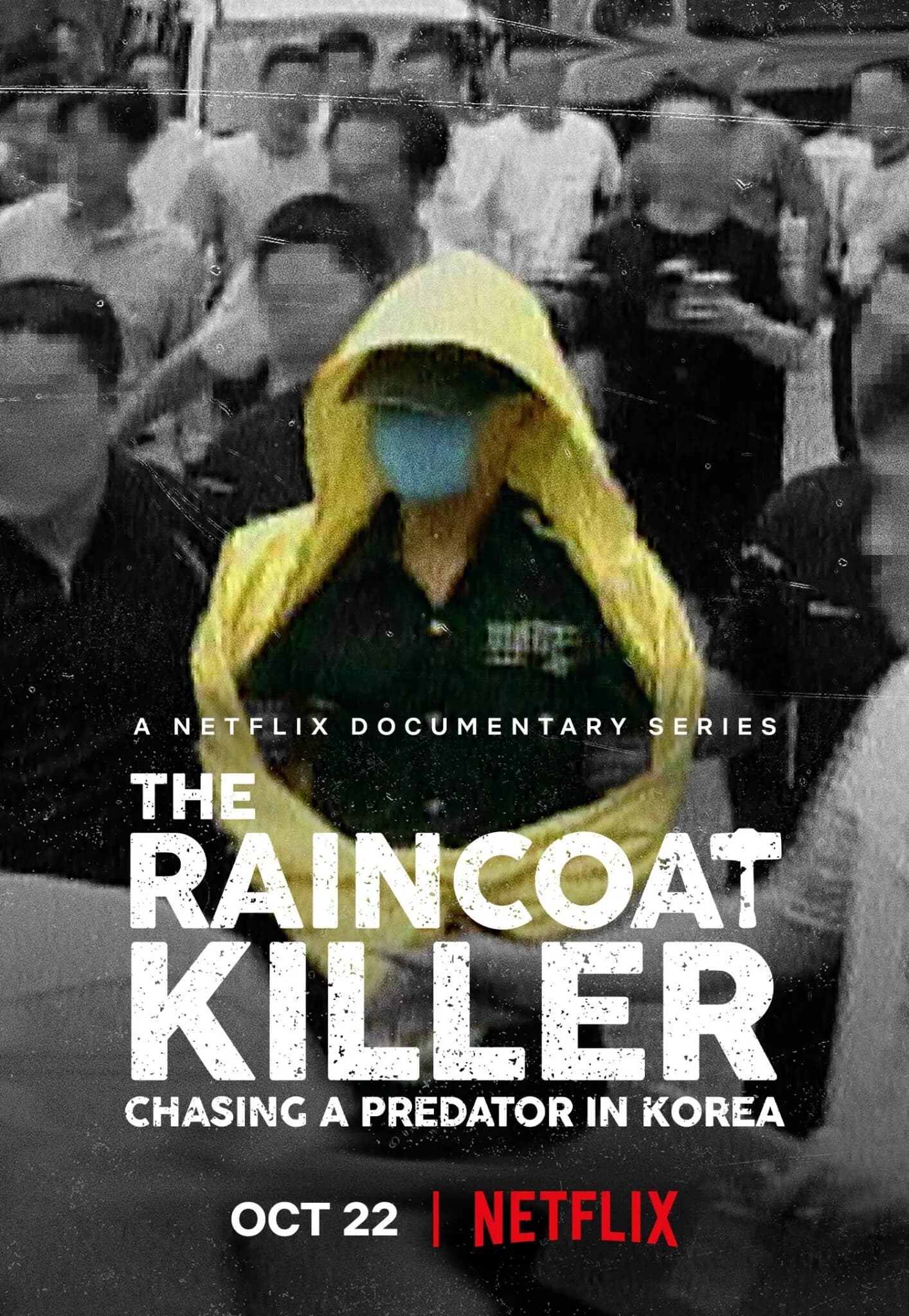
The Raincoat Killer: Chasing a Predator in Korea
Netflix, 2021 — The true story of South Korean serial killer Yoo Young-chul and his 20 murders
Quick facts
What Is the Series About?
*The Raincoat Killer: Chasing a Predator in Korea* is a three-part Netflix documentary series released on October 22, 2021, that chronicles one of South Korea's most disturbing and consequential serial murder cases. The series follows the crimes, arrest, and trial of Yoo Young-chul (유영철), a Seoul-based serial killer who murdered at least 20 people between September 2003 and July 2004. Known in the press as the Raincoat Killer or Raincoat Man, Yoo's case shocked an entire nation, exposed critical gaps in South Korean law enforcement, and sparked a fierce national debate over capital punishment that continues to this day.
The documentary weaves together police interviews, forensic details, and psychological profiling to reconstruct how a single man was able to carry out dozens of murders across a major world capital before being caught — and how a seemingly routine missing persons report ultimately unraveled the entire case.
---
The Case
Yoo Young-chul was born on April 18, 1970, in South Korea. A convicted sex offender prior to his killing spree, he began murdering in earnest in September 2003. His victims fell into two distinct groups: wealthy elderly senior citizens, who were targeted in what initially appeared to be robberies gone wrong, and sex workers and prostitutes, whom he lured and killed with a hammer. His use of a raincoat during murders — to avoid leaving trace evidence — earned him his chilling nickname.
The first wave of killings, concentrated between September and November 2003, focused on affluent elderly residents of Seoul. Yoo would force his way into their homes and beat them to death. He then shifted his pattern, targeting sex workers in a separate but equally methodical campaign of violence. Across both phases, his weapon of choice remained the same: a hammer.
Beyond murder, Yoo Young-chul is also a self-confessed cannibal, a detail that added a uniquely disturbing dimension to the case and drew intense international media attention once it became public.
The investigation that finally brought Yoo down did not begin with the elderly victim murders. It was a report about missing sex workers that led investigators to Yoo's door. Under interrogation, he confessed — though detectives initially struggled to corroborate the full scope of what he claimed to have done. Ultimately, he was linked to 20 confirmed murders. One additional case was later dismissed after it was determined to have been committed by a different serial killer, Jeong Nam-gyu, a detail that underscored the complexity and confusion that surrounded the investigation.
Yoo Young-chul was tried at the Seoul Central District Court and sentenced to death on December 13, 2004. In a moment that stunned observers in the courtroom, he reportedly thanked prosecutors for the sentence. He currently remains detained at the Seoul Detention Center, as South Korea has maintained a de facto moratorium on executions since 1997, meaning the sentence has not been carried out.
The case became a flashpoint in South Korea's ongoing national conversation about capital punishment. Whether the death penalty serves as a deterrent, whether it is just, and whether the state should exercise the ultimate sanction — all of these questions were thrust into the public sphere by Yoo's sentencing.
---
Production
The series was directed by John Choi and Ro and produced for Netflix as a three-episode true crime documentary. Released on October 22, 2021, it forms part of Netflix's expanding slate of international true crime content, which has increasingly looked beyond American cases to explore high-profile crimes from Asia, Europe, and Latin America.
The filmmakers draw on interviews with investigators and forensic experts, reconstructing the police procedural elements of the hunt for Yoo as well as the psychological dimensions of his crimes. A notable structural choice is the series' emphasis on psychological profiling — an approach that, as some critics noted, comes at the expense of narrative pacing. The documentary attempts to answer not just what Yoo did, but why, situating his crimes within the broader context of South Korean society and the pressures that shaped him.
The series is available to stream globally on Netflix.
---
Reception
On IMDb, The Raincoat Killer: Chasing a Predator in Korea holds a rating of 6.4/10 based on approximately 3,300 ratings — a respectable but not exceptional score for a true crime documentary of this type.
Viewer reactions have been broadly positive. Many describe the series as a "great documentary" and a "very interesting true crime story", particularly praising its willingness to give an international audience access to a case that had previously received almost no coverage outside South Korea. For Western viewers especially, the series offered a rare window into the Korean criminal justice system and the cultural context surrounding violent crime in Seoul.
Criticism has focused primarily on production quality. Some reviewers described the documentary as a "poorly made" effort that leans too heavily on psychological profiling segments, resulting in a narrative that feels rushed in places and uneven overall. The balance between procedural detail and psychological analysis was seen by some as poorly calibrated, with the most dramatic elements of the case occasionally underdeveloped.
The broader controversy attached to the series is not about the filmmaking itself but about the case at its center: the death penalty sentence handed to Yoo Young-chul and the national debate it ignited. South Korea has not executed anyone since 1997, and Yoo's case — with its extreme brutality and Yoo's own apparent acceptance of the death penalty — brought renewed urgency to an unresolved moral and legal question.
---
The Case Today
As of the time of publication, Yoo Young-chul remains alive and detained at the Seoul Detention Center. His death sentence stands, but South Korea's de facto moratorium on capital punishment means he has not been executed. The case remains a reference point in South Korean legal and criminological discourse, cited in debates about violent crime, policing, and the ethics of the death penalty.
The Netflix documentary has introduced his crimes to a new generation of true crime viewers worldwide, ensuring that the full horror of the Raincoat Killer case — and the systemic failures that allowed it to unfold — remains part of the public record.
For those wishing to explore further, Netflix's official overview of the series is available via the Netflix newsroom, and the full Wikipedia entry on Yoo Young-chul provides additional case documentation.