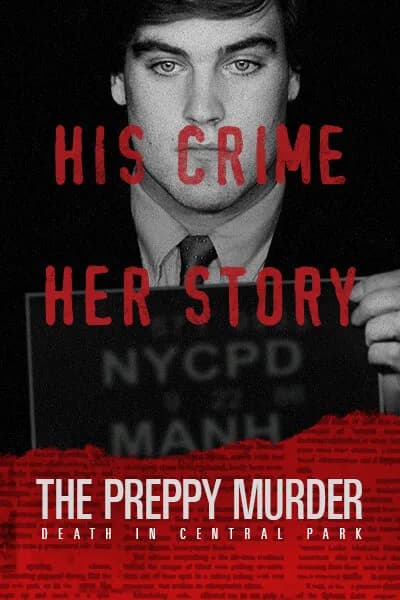
The Preppy Murder: Death in Central Park
Viaplay/AMC, 2019 — Five-part documentary on the 1986 killing of Jennifer Levin by Robert Chambers
What Is the Series About?
*The Preppy Murder: Death in Central Park* is a five-part documentary mini-series that revisits one of the most sensational criminal cases in New York City history: the 1986 murder of 18-year-old Jennifer Levin by Robert Chambers in Central Park. Directed by Ricki Stern and Annie Sundberg and premiering on November 13, 2019 on AMC and SundanceTV, the series does more than recount the facts of the killing — it systematically dismantles the victim-blaming narrative that dominated media coverage at the time and reframes Levin's story on her own terms.
The documentary unfolds across five episodes, tracing the arc from the night of the crime through the police investigation, the courtroom drama, and the long cultural aftermath. It incorporates evidence that was ruled inadmissible during the original trial, giving contemporary viewers a more complete picture of what prosecutors believed happened in Central Park that August morning.
---
The Case
In the early hours of August 26, 1986, Jennifer Levin — an 18-year-old who had been socializing with friends at Dorrian's Red Hand, a popular Upper East Side bar — left with Robert Chambers, a tall, handsome private-school alumnus from one of Manhattan's wealthier families. Hours later, her body was found in Central Park, just behind the Metropolitan Museum of Art. She had been strangled to death.
Chambers was quickly identified as the last person to be seen with Levin. When confronted by police, he offered a defense that would define the tabloid frenzy that followed: he claimed that Levin had died accidentally during consensual rough sex, and that he had acted in self-defense against her advances. The claim was met with widespread skepticism by prosecutors and investigators, but it proved devastatingly effective as a media strategy.
The New York tabloid press — particularly the New York Post and the Daily News — seized on the case with relentless intensity. Rather than focusing on Chambers's actions, much of the coverage turned its lens on Levin herself: her social life, her clothing, her choices. The case became, as reviewers of the documentary have noted, a landmark early example of institutionalized victim-blaming in American media.
The murder trial, which began in 1987, lasted nine weeks and gripped the country. It was widely described at the time as a trial of the century — a designation later eclipsed by the O.J. Simpson case. The jury ultimately deadlocked, failing to reach a verdict on the murder charge. Rather than face a retrial, Chambers entered a plea bargain, pleading guilty to first-degree manslaughter and burglary. He was sentenced to 5 to 15 years in prison.
Chambers was released in 2003 after serving his full sentence. He did not remain free for long. In 2008, he was handed a 19-year prison sentence on drug charges, with his earliest possible release date reported as 2024.
---
Production
The series was directed by Ricki Stern and Annie Sundberg, an established documentary partnership known for tackling socially charged subjects. Their approach in The Preppy Murder goes beyond conventional true-crime reconstruction. According to coverage surrounding the premiere, the filmmakers gained access to materials and testimony that had been excluded from the original trial — offering viewers context that the jury in 1988 never heard.
The production was designed as a deliberate corrective to the way the case had been covered in real time. Rather than sensationalizing the murder or centering Chambers's charisma and social pedigree — as much of the 1980s press had done — Stern and Sundberg foreground Jennifer Levin's humanity, her relationships, and the injustice of how her reputation was weaponized after her death. Interviews with those who knew both Levin and Chambers, as well as journalists, legal figures, and social commentators, give the five-part structure a cumulative emotional weight.
The series premiered on November 13, 2019, on AMC and SundanceTV in the United States, and is available on Viaplay in Scandinavian markets.
---
Reception
*The Preppy Murder: Death in Central Park* holds a rating of **6.9/10** on IMDb, based on viewer scores. Critical reception was broadly positive, with reviewers praising the documentary's commitment to recontextualizing the case through a modern lens while acknowledging the emotional difficulty of the material.
Writing for *Decider*, critics noted that the series earns its place in the crowded true-crime documentary landscape by doing something more than simply rehashing a famous case — it interrogates why the case unfolded the way it did, and what the media's handling of it revealed about class, gender, and power in 1980s New York.
A review in *The Michigan Daily* described the documentary as "carefully" reopening an infamous case, commending it for balancing factual rigor with emotional sensitivity. The use of previously inadmissible evidence was highlighted as a particularly significant editorial decision, one that shifts the viewer's understanding of what prosecutors had believed all along.
The broader reception framed the documentary as part of a cultural reckoning — arriving in the post-#MeToo moment — that gave new urgency to questions the original trial had failed to properly address: Who was believed? Whose reputation was protected? And what does justice look like when tabloid narratives have already rendered a verdict?
---
The Case Today
As of the series's release in 2019, Robert Chambers remained incarcerated on the drug conviction handed down in 2008, with his earliest possible release date reported as 2024. His original manslaughter conviction for the killing of Jennifer Levin had long been served, meaning the legal system's continued hold on him stemmed entirely from his post-prison conduct.
Jennifer Levin's family has continued to speak publicly about the case over the years, advocating for her memory to be treated with the dignity that was largely denied to her by the press in 1986 and 1987. The documentary series represents one of the most sustained attempts in mainstream media to restore that dignity — to tell the story of her death not as a tabloid curiosity, but as a human tragedy with systemic dimensions that remain relevant decades later.
The case continues to be cited in discussions of victim-blaming, media ethics, class privilege in the American legal system, and the historical treatment of women in high-profile criminal trials.