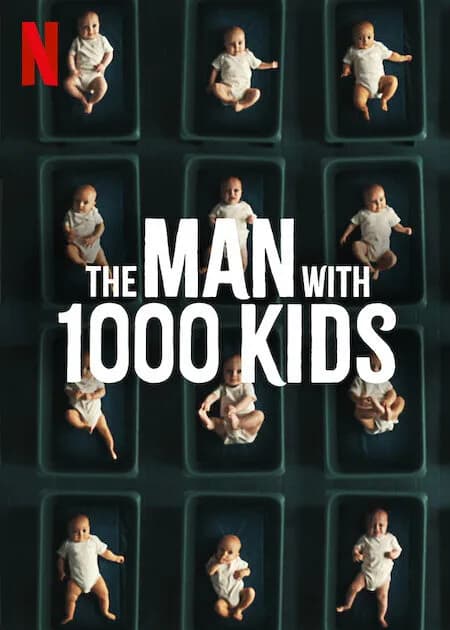
The Man with 1000 Kids
Netflix, 2024 — the fertility fraud case of Dutch sperm donor Jonathan Jacob Meijer
Quick facts
What Is the Series About?
The Man with 1000 Kids is a Netflix documentary series about Jonathan Jacob Meijer, a Dutch sperm donor accused of systematically deceiving fertility clinics, sperm banks, and private families in order to father a staggering — and still disputed — number of children across the Netherlands and beyond. Directed by Josh Allott and released on July 3, 2024, the three-episode limited series examines how one man allegedly exploited gaps in fertility regulation, the trust of vulnerable families, and the unregulated corners of online sperm donation to create what investigators and recipient families describe as an unprecedented case of reproductive deception.
The title's central claim — that Meijer fathered roughly 1,000 children — remains contested. Estimates cited in the series and surrounding coverage range from approximately 550 (Meijer's own public figure) to 500–600, up to 1,000, and as high as 3,000 in the documentary's more speculative moments. What is not in dispute is that the number dramatically exceeded what Dutch fertility guidelines permit for a single donor.
---
The Case
Jonathan Jacob Meijer is a Dutch YouTuber, musician, and content creator who began donating sperm, ostensibly out of altruism, while still in his twenties. Dutch fertility rules strictly limit the number of families a single donor may help — guidelines designed precisely to prevent large sibling groups from forming unknowingly and to protect the genetic diversity of future generations. Meijer allegedly circumvented those limits by donating both through licensed sperm banks and through private, informal arrangements facilitated online, telling each institution or family that he had helped only a small number of others.
Recipient families, many of whom connected through Facebook groups, began to piece together the true scale of Meijer's donations when children from different families started appearing in DNA matching databases and the numbers simply did not add up. The documentary features testimony from these families — including a woman named Vanessa, who used Meijer's donation in 2015 as a single woman seeking to conceive — and traces the grassroots investigation that eventually forced a legal confrontation.
According to Time magazine's coverage of the true story, the case spans multiple countries. Families who used Meijer's donations have been identified in the Netherlands, the United States, Australia, Mexico, Germany, Ukraine, and elsewhere, illustrating how digital platforms allowed a single donor to reach far beyond any one jurisdiction's regulatory reach.
The legal outcome, as documented in available sources, is a Dutch civil court order banning Meijer from donating sperm to new parents, with a financial penalty of €100,000 for each future violation. No criminal conviction resulting in a prison sentence has been documented in the sources available to this publication. This is, at its core, a fertility fraud and civil litigation case, not a conventional criminal prosecution — a distinction the series itself grapples with, given the profound harm families describe experiencing without a clear criminal remedy.
Meijer has consistently denied the most serious characterizations of his conduct. He has argued publicly that the "1,000 children" figure is exaggerated or misleading and has called the documentary "sensationalising and misleading." His precise donor count and the full scope of his reach remain unverified, in part because the global, decentralized nature of his donations makes a definitive audit extraordinarily difficult.
---
Production
The series was directed by Josh Allott and produced for Netflix as a three-part limited documentary. It draws on interviews with recipient mothers and families, as well as archival footage and Meijer's own extensive online presence as a YouTuber and content creator — a dimension of the case that adds an unusual layer, given that Meijer documented much of his public life on camera even as his private donor activities allegedly spiraled far beyond any disclosed limit.
The production benefits from the families' own organized documentation: the women who discovered the truth about Meijer had, by the time filming began, already assembled significant evidence through DNA registries, social media cross-referencing, and direct confrontations with Meijer himself. The documentary essentially follows that investigative arc from discovery to legal action. The filmmakers do not appear to have secured a direct on-camera interview with Meijer for the series, though his public statements and YouTube content are incorporated.
The series is catalogued on IMDb under title ID tt27712032 as a TV Mini Series with a U.S. release date of July 3, 2024.
---
Reception
CNN's review of the series described the documentary as a disturbing and alarming account of fertility fraud, noting the visceral impact of hearing directly from affected families. Broader critical and audience reception was characterized by a mixture of horror, fascination, and frustration — horror at the scale of the alleged deception, and frustration at the limited legal tools available to the families seeking accountability.
The series taps into a growing public conversation about the almost complete absence of enforceable international regulations governing sperm donation, a regulatory vacuum that cases like Meijer's have thrown into sharp relief. Reviewers repeatedly noted that the documentary is unsettling precisely because the harm it documents — psychological, familial, and genetic — does not fit neatly into existing criminal categories in most jurisdictions.
The contested offspring count has itself become a focal point of controversy. The title's claim of "1,000 kids" is widely acknowledged, even by sources sympathetic to the families, as an unverified upper estimate rather than a confirmed figure. This ambiguity has given Meijer grounds to push back publicly, even as it does not materially alter the core allegation that he far exceeded allowable donor limits and actively misled the families and institutions he worked with.
---
The Case Today
As of the series' release in July 2024, Jonathan Jacob Meijer remains subject to the Dutch civil court order restricting his donation activities. He has not, according to sources available to this publication, faced criminal prosecution. He continues to dispute the documentary's framing and the accuracy of its central numerical claim.
The families featured in the series, and the broader network of families who have since identified Meijer as their donor through DNA databases, continue to grapple with profound questions about identity, kinship, and the rights of donor-conceived children. The case has become a flashpoint for advocates pushing for stricter international regulation of sperm donation, mandatory limits on donor family counts, and greater transparency in both clinic-based and private donation arrangements.
The Guardian's pre-release coverage noted that the Meijer case is not entirely unique — other prolific donors have been identified in the Netherlands and elsewhere — but that its scale and the organized response of the affected families make it the most prominent and legally consequential example to date. Whether the civil penalty imposed by Dutch courts proves an effective deterrent, or whether legislative reform will follow, remains to be seen.