SanPa: Sins of the Savior
Netflix, 2020 — The dark truth behind Italy's most controversial drug rehabilitation commune
Quick facts
What Is the Series About?
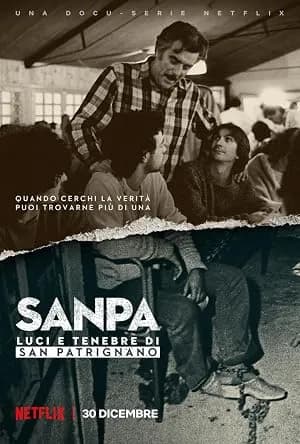
SanPa: Sins of the Savior is a Netflix documentary limited series that examines one of the most polarizing stories in modern Italian history: the rise and dark legacy of San Patrignano, a drug rehabilitation commune founded in 1978 by Vincenzo Muccioli in Coriano, near Rimini, Italy. The five-episode series — directed by Cosima Spender and released on December 30, 2020 — traces how an institution once celebrated as a miracle cure for heroin addiction became the center of criminal investigations, violence allegations, and a murder trial that shook Italian society.
The series takes its name from the commune itself: San Patrignano, or SanPa as it was commonly known. It unfolds against the backdrop of Italy's catastrophic heroin epidemic of the 1980s, a public health crisis that left hundreds of thousands of young Italians addicted and families desperate for answers. Into that vacuum stepped Muccioli — a charismatic, self-styled savior who promised to cure addicts without methadone, without state oversight, and without conventional medicine. For years, he was embraced as a hero. Then the bodies and the bruises started to tell a different story.
The Case
At the heart of SanPa is the 1989 killing of Roberto Maranzano, a resident of the San Patrignano commune who was beaten to death inside a slaughterhouse on the community's grounds in Coriano. The murder exposed what critics had long suspected: that beneath the commune's image of redemption lay a regime of physical coercion, confinement, and systematic violence against the very people it claimed to be saving.
The killing triggered criminal proceedings that ultimately implicated Muccioli and others connected to San Patrignano. According to IMDb's coverage of the series, the case included allegations of aiding and abetting the murder of Maranzano, and the documentary's final episodes show Muccioli — by then visibly exhausted and broken — as the trials reached their conclusion. The series examines both the legal fallout and the broader moral controversy over whether Muccioli's methods, however brutal, could be justified by the lives he claimed to have saved.
Vincenzo Muccioli remains the central figure throughout the narrative. Netflix's own synopsis describes him as a man who cared for the addicted but against whom charges of violence began to mount — a formulation that captures the series' central tension. He was never a licensed physician or therapist; his methods were built on total personal authority, communal isolation, and, according to testimony examined in the documentary, physical restraint and punishment. Muccioli died in 1995, before the full weight of legal accountability could be established. Available sources do not confirm a definitive verdict or sentence against him personally, and readers seeking precise legal outcomes are encouraged to consult Italian court records or contemporary Italian investigative reporting.
The Maranzano murder was not an isolated allegation. The documentary presents it as the most visible manifestation of a culture of violence that former residents describe as endemic to life inside SanPa. Witnesses and survivors interviewed in the series recount beatings, chaining of residents, and a climate of fear maintained in the name of rehabilitation. The commune operated largely outside state regulation for years, a fact that the series frames as a systemic failure as much as a personal one.
Production
SanPa: Sins of the Savior was directed by Cosima Spender and holds the distinction of being the first Italian original documentary series produced by Netflix, as confirmed by Netflix's official press materials. That distinction alone gave the project cultural weight before a single episode aired.
Spender's approach blends archival footage — including television interviews with Muccioli at the height of his fame — with new testimony from former residents, journalists, lawyers, and others who witnessed San Patrignano's story from the inside and outside. The archive material is particularly striking: it shows Muccioli as he was once seen by much of the Italian public, a warm and passionate figure surrounded by grateful young people. The contrast with what the documentary subsequently reveals gives the series much of its unsettling power.
The production is structured as a five-episode limited series, with each episode building the case against the myth of Muccioli methodically, allowing viewers to understand how a community built on genuine goodwill — and genuine results, its defenders argue — could also be a place where a man was beaten to death in a slaughterhouse.
Reception
The series generated wide debate across Italy and was described by observers as a surprising success for Netflix in the Italian market. Within days of its December 30, 2020 premiere, SanPa reached No. 2 on Netflix's most-watched list in Italy — a remarkable performance for a domestic documentary series dealing with decades-old events.
The reception was not merely statistical. The documentary reignited a long-running and deeply felt Italian controversy over Muccioli's legacy, the legitimacy of San Patrignano's treatment model, and the question of whether ends can justify means in addiction medicine. Supporters of the commune — and San Patrignano still operates today under different leadership — pushed back against what they characterized as an unfair portrait, while survivors and critics welcomed the series as long-overdue accountability journalism.
The IMDb page for the series carries the identifier tt13731400. While a verified numeric IMDb rating is not available from current sources, the volume of viewer engagement and critical commentary surrounding the series speaks to its impact. Internationally, SanPa introduced a generation of non-Italian viewers to a case that had been, until its Netflix release, largely unknown outside Italy.
The Case Today
San Patrignano continues to operate as a rehabilitation community in Coriano, Italy, and has undergone significant changes in governance and public accountability since Muccioli's death in 1995. The community has in recent years positioned itself as a reformed institution — one that maintains the founder's emphasis on work and communal living while distancing itself from the coercive practices documented in the series.
Vincenzo Muccioli's legacy remains fiercely contested in Italy. For some, he was a flawed visionary whose methods, however brutal, rescued thousands of people whom the state had abandoned. For others, he was a cult-like authoritarian who used the suffering of addicts to build a personal empire, and whose community was the site of a murder. SanPa: Sins of the Savior does not fully resolve that argument — but it ensures the question cannot be avoided.