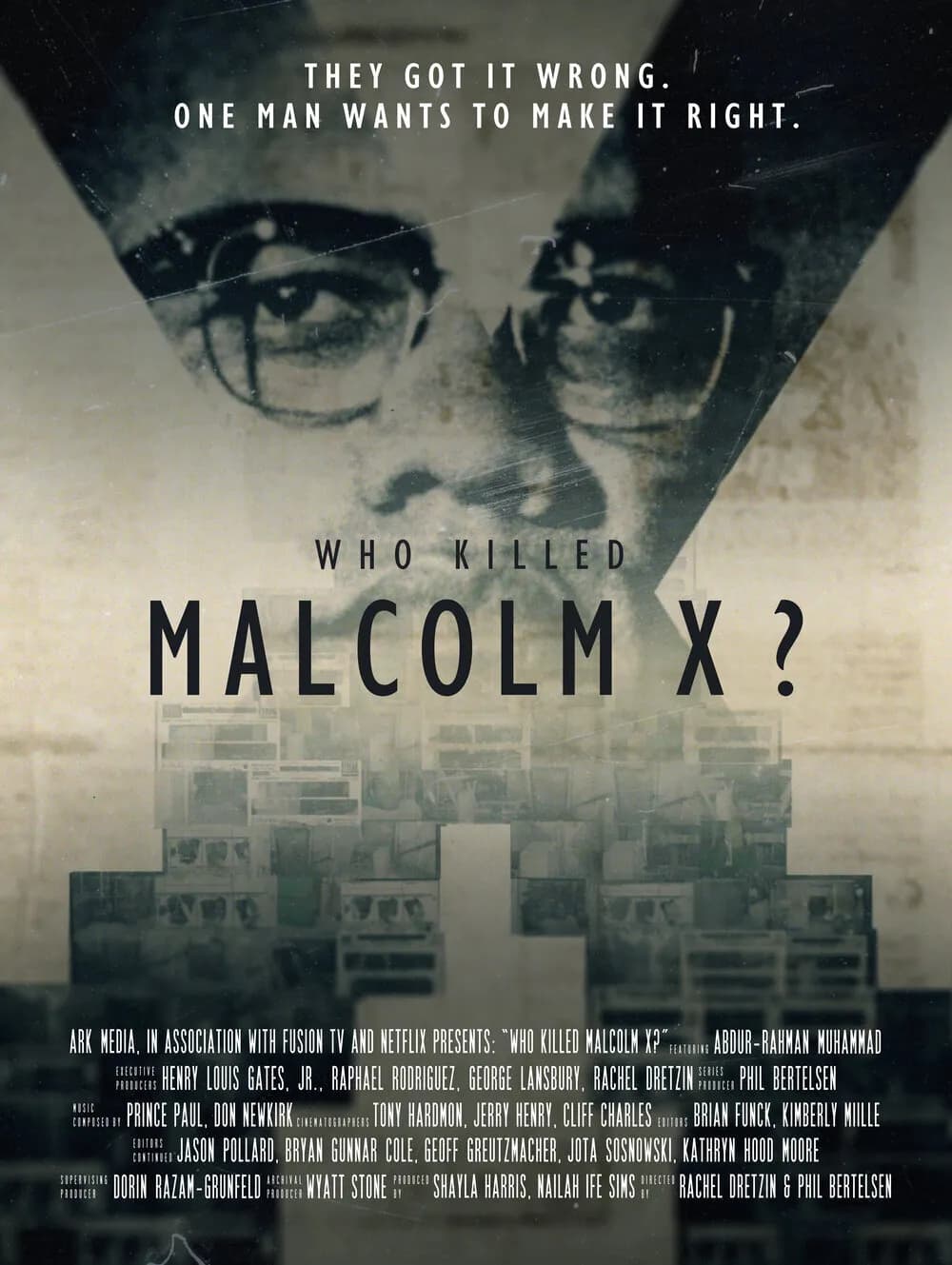
Who Killed Malcolm X?
Netflix, 2020 — Six-part documentary revisiting the 1965 assassination of Malcolm X and the wrongful convictions that followed
Quick facts
What Is the Series About?
*Who Killed Malcolm X?* is a six-part documentary miniseries on Netflix that investigates the February 21, 1965 assassination of civil-rights leader Malcolm X and raises a deeply uncomfortable question: were the men imprisoned for his murder actually guilty? Directed by Rachel Dretzin and Phil Bertelsen and released on February 7, 2020, the series centers on the tireless investigative work of researcher Abdur-Rahman Muhammad, who spent decades examining evidence, court records, and witness accounts that he believes point to a miscarriage of justice. What began as a niche historical inquiry became, after the series reached Netflix's global audience, a catalyst for one of the most significant wrongful-conviction exonerations in American legal history.
The Case
On the afternoon of February 21, 1965, Malcolm X — born Malcolm Little on May 19, 1925 — took the stage at the Audubon Ballroom in the Washington Heights neighborhood of Manhattan, New York City. At approximately 3:10 p.m., he was shot multiple times in front of a crowd of several hundred supporters. He was pronounced dead at the age of 39. The killing shocked the nation and robbed the civil-rights movement of one of its most electrifying and controversial voices.
Three men were convicted of first-degree murder in March 1966: Muhammad A. Aziz (then known as Norman 3X Butler), Khalil Islam (then Thomas 15X Johnson), and Thomas Hagan (also known as Talmadge Hayer). All three received life sentences. The conviction was widely accepted at the time, but cracks in the case appeared almost immediately. According to CBS News, the Netflix documentary presents evidence that police botched the investigation and that key leads were never properly pursued.
The most explosive piece of pre-existing evidence was Hagan's own 1977 affidavits, in which he admitted his involvement but explicitly stated that Aziz and Islam were not present at the shooting and played no role in the assassination. He named other men as his true co-conspirators. Despite these sworn statements, no court acted on them for more than four decades.
The series also identifies William X. Bradley — referred to in some reporting as Almustafa N. Shabazz — as the likely real shooter, based on Abdur-Rahman Muhammad's research. This is presented as the documentary's investigative claim and has not been established as a criminal-court finding.
Both Aziz and Islam served approximately 20 years in prison before being released on parole. Islam died in 2009, his conviction still on his record. Aziz lived to see partial justice: in November 2021, a Manhattan judge vacated both men's convictions following a comprehensive review by prosecutors and defense lawyers. The Los Angeles Times reported that Abdur-Rahman Muhammad was present at the exoneration proceedings, an extraordinary moment for a private citizen whose independent research had driven official action. In 2022, New York City and New York State agreed to pay a combined $36 million to the families of Aziz and Islam as compensation for the decades of wrongful imprisonment.
Production
The documentary is co-directed by Rachel Dretzin and Phil Bertelsen, both experienced non-fiction filmmakers. The series is built around the investigative journey of Abdur-Rahman Muhammad, a Washington, D.C.-based historian and walking-tour guide who became obsessed with the assassination case over several decades. Muhammad's approach is methodical: he cross-references the Hagan affidavits with membership records of the Nation of Islam, tracks down individuals connected to the case, and maps the organizational rivalries that he believes motivated the killing.
The six-episode structure allows the series to move through layers of the case — the political context of Malcolm X's break with the Nation of Islam, the night of the shooting, the trial, the suppressed evidence, and the modern-day investigation — without feeling rushed. Each episode functions as both a history lesson and an active detective story, with Muhammad as the audience's guide through a labyrinth of institutional failure and potential cover-up.
Reception
Critical and public reception to Who Killed Malcolm X? was strongly positive, and its real-world impact set it apart from most documentary series in the true-crime genre. NPR reported shortly after the February 2020 premiere that the Manhattan district attorney's office was prompted to reexamine the evidence — an almost immediate institutional response to a streaming documentary. The Guardian described the series as so successful that it directly helped reopen the official inquiry into the murder.
Viewers responded with a combination of outrage at the original investigation's failings and admiration for Muhammad's persistence. The series provoked widespread discussion about police conduct in the 1960s, the treatment of Black defendants in American courts, and the degree to which political surveillance by federal agencies may have influenced the outcome of the case. The major controversy the documentary generated was not about its filmmaking but about its central argument: that two innocent men spent two decades in prison while the real perpetrators walked free, and that official institutions knew or should have known.
The series holds an IMDb title page under tt10948316, though a specific aggregated rating was not available at time of publication.
The Case Today
The exoneration of Muhammad A. Aziz and the posthumous exoneration of Khalil Islam in November 2021 represent the most concrete outcome of the documentary's impact. Deadline reported that the joint prosecutorial and defense review concluded the original investigation had been fundamentally compromised. The $36 million settlement that followed in 2022 was one of the largest wrongful-conviction payouts in New York State history.
No one has been criminally charged in connection with the roles described in the Hagan affidavits. William X. Bradley, the man identified in the documentary as the likely shooter, died without ever being prosecuted for the crime. Thomas Hagan, the only man who admitted participation, was paroled in 2010 after serving more than four decades.
The assassination of Malcolm X remains, in a strict legal sense, an unsolved case — the only person who admitted guilt named accomplices who were never charged, and the men originally convicted have been cleared. What Who Killed Malcolm X? accomplished was not to close the case but to force America's legal system to honestly confront how it had been handled in the first place.