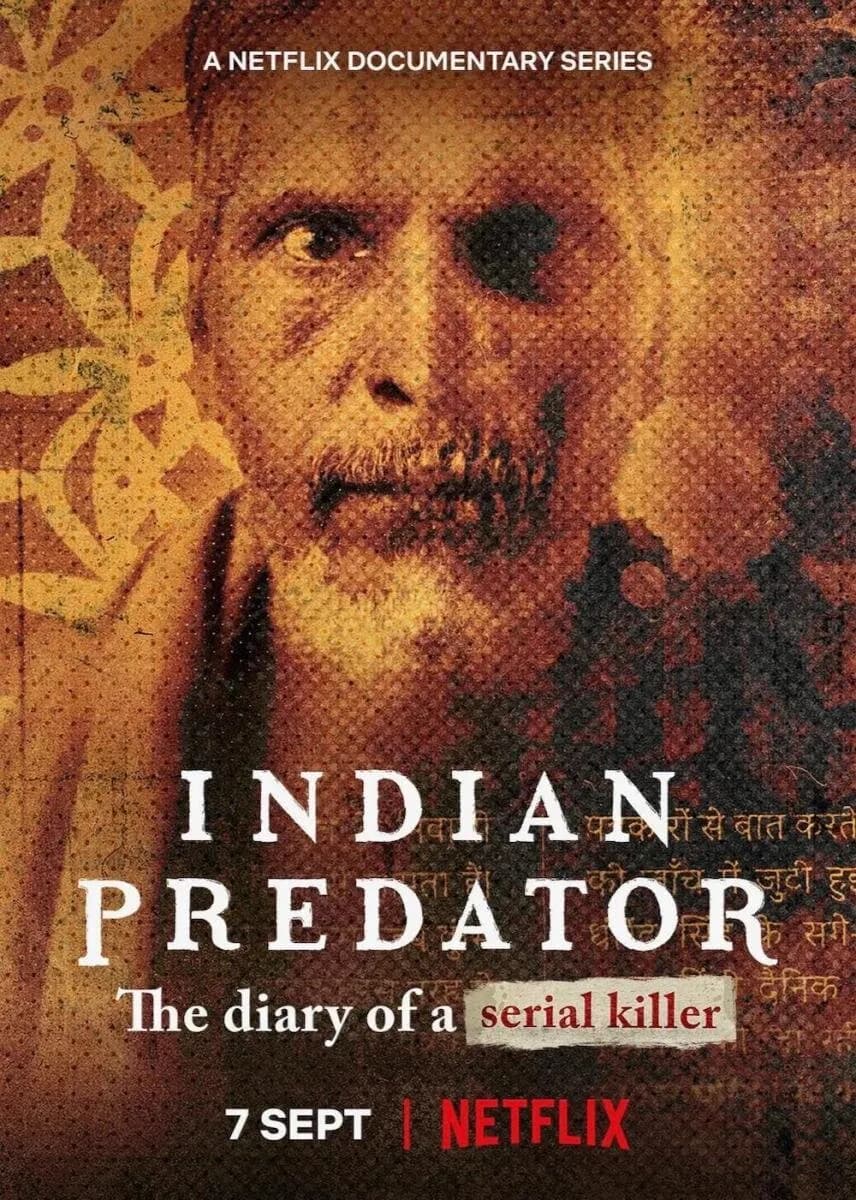
Indian Predator: The Diary of a Serial Killer
Netflix, 2022 — The case of Raja Kolander, alleged cannibalistic serial killer from Uttar Pradesh
Quick facts
What Is the Series About?
Indian Predator: The Diary of a Serial Killer is a Netflix true crime documentary series that examines the real case of Raja Kolander — also known by his birth name, Ram Niranjan — an alleged cannibalistic serial killer from rural Uttar Pradesh, India. Released on September 7, 2022, it is the second installment of the Indian Predator anthology, produced by India Today Originals. Spanning three episodes, the series reconstructs Kolander's crimes through archival footage, interviews with investigators, and excerpts from the chilling diary that gave investigators their most damning evidence.
The case stands out not only for its brutality but for the eerie paper trail Kolander left behind — a handwritten notebook, quickly dubbed Raja ki Diary (Raja's Diary) by the press, that listed the names of 13 victims alongside the journalist whose murder first brought Kolander to the attention of police.
---
The Case
Raja Kolander was a farmer from the Kol community living on a farmhouse in rural Prayagraj (the region historically known as Allahabad), Uttar Pradesh. By the time investigators caught up with him in 2001, he had allegedly been killing for years — a fact that authorities only began to grasp after a single high-profile disappearance forced the issue into the open.
The Journalist and the Investigation
The unraveling of Kolander's alleged killing spree began with the disappearance and mutilation of Dhirendra Singh, a journalist from Uttar Pradesh. Singh's body was discovered in Madhya Pradesh, bearing signs of extreme violence — mutilation that investigators described as involving decapitation and the severing of genitals. Authorities spent months probing the case before Kolander himself confessed, claiming that Singh had been romantically involved with his wife and that the murder was an act of revenge.
The confession opened a much darker door. A raid on Kolander's farmhouse recovered human skulls and bones, as well as the notorious diary listing 13 names beyond Dhirendra Singh — suggesting that Singh was far from the first victim. Kolander confessed to murdering more than 15 people in total, and allegations emerged that he had consumed the brains of his victims — an accusation that would follow him through the trial and into the cultural memory of the case, despite never being proven in court.
Perpetrator Profile
Born Ram Niranjan, Kolander was a member of the Kol community, a historically marginalized group in Uttar Pradesh. He lived a seemingly unremarkable rural life before his arrest shattered that image entirely. His crimes — if the diary's account is accepted — involved serial murder carried out over an extended period, with his farmhouse serving as both a residence and, allegedly, a site of disposal for human remains.
Notably, despite his earlier confession, Kolander denied all allegations after his formal arrest, a contradiction the documentary series examines in detail. His wife, Phoolan Devi, was also implicated and is serving a life sentence. His brother-in-law, Vakshraj Kol, was similarly convicted.
Trial and Verdict
Kolander was arrested in 2001, but the legal process moved slowly — a reality common in complex Indian criminal cases of that era. It took over a decade for him to be formally charged and convicted specifically in connection with Dhirendra Singh's murder. On November 30, 2012, the court sentenced Kolander and Vakshraj Kol to life imprisonment, classifying the case as one of the rarest of rare — the legal standard in India reserved for crimes of exceptional depravity. Kolander is currently serving his sentence in a jail in Unnao, Uttar Pradesh, having previously been held in facilities in Naini and Lucknow.
The cannibalism charges, despite featuring prominently in public discourse and media coverage, were never proven in court, leaving that dimension of the case in a gray zone between allegation and established fact.
---
Production
The series is produced by India Today Originals, the digital production vertical of India Today TV, one of India's most prominent news organizations. The production draws on India Today's own journalistic resources and archives, giving the series a more reportorial tone than many Western true crime documentaries. While the director is not prominently credited in available public sources, the production's connection to a major Indian news institution lends it an air of institutional credibility.
The series originally aired in Hindi, Kolander's native language and the dominant language of Uttar Pradesh, and was subsequently dubbed into English, Spanish, French, and other languages for international Netflix audiences. The decision to keep the original Hindi-language testimony intact — with subtitles or dubbing layered over — preserves the authenticity of witness and investigator accounts, a choice that reviewers noted as one of the series' strengths.
The three-episode structure moves efficiently through the discovery of Singh's murder, the investigation and arrest, and the decade-long trial — a pacing that avoids the bloat that plagues many true crime series.
---
Reception
On IMDb, The Diary of a Serial Killer holds a rating of 6.2 out of 10 based on approximately 2,300 ratings — a modest but respectable score for a foreign-language documentary series on a global platform.
Critical reception was generally more positive than the first Indian Predator installment, The Butcher of Delhi, which had been poorly received. Decider's review recommended the series as a "STREAM IT" title, describing it as a stronger, more psychologically engaging entry in the anthology. The series was praised for its restraint — notably, the first episode refrains from explicit gore, allowing the psychological and investigative dimensions of the case to drive the narrative rather than shock value.
Viewer reactions on platforms like Reddit described the series as "riveting," "dark," and a "mind game," with multiple users noting that the case genuinely shocked communities in rural Prayagraj even decades after the crimes occurred. The series appears to have succeeded in bringing a case that remained largely regional in its notoriety to an international audience.
The primary controversy surrounding the series mirrors the controversy surrounding the case itself: the unproven cannibalism allegations. Critics and viewers alike have pointed out that the series presents these claims with varying degrees of editorial caution, and that Kolander's post-arrest denial of all charges — despite his earlier confession — raises questions about what the documentary is able to definitively establish versus what it implies.
---
The Case Today
As of the series' release in 2022, Raja Kolander remains incarcerated at a jail in Unnao, Uttar Pradesh, serving his life sentence. His wife, Phoolan Devi, is similarly imprisoned for life. No successful appeals or significant legal developments have been reported since the 2012 sentencing.
The full names of the 13 victims listed in Kolander's diary — beyond Dhirendra Singh — have never been publicly disclosed in available media coverage, leaving their identities unknown to the general public. This absence haunts the case: the diary promises an accounting of lives taken, but the full human toll remains partly obscured, a detail the series acknowledges without resolving.
The Indian Predator anthology on Netflix continues to serve as one of the few platforms bringing regional Indian true crime cases to a global audience, and The Diary of a Serial Killer remains its most discussed and critically regarded installment.