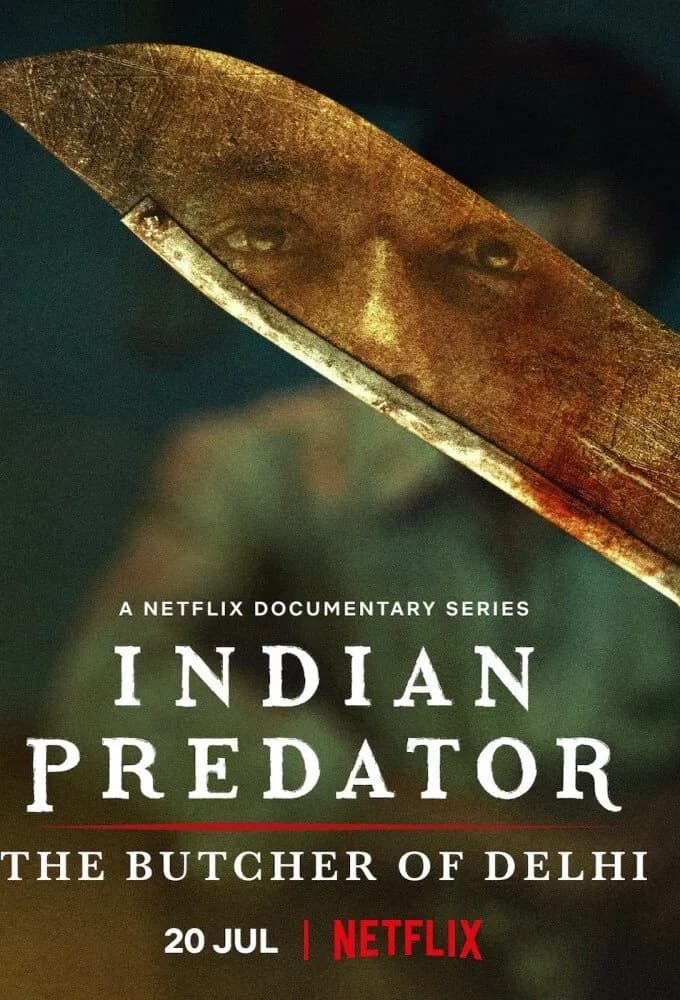
Indian Predator: The Butcher of Delhi
Netflix, 2022 — The serial killer who beheaded victims and taunted police outside Tihar Jail
Quick facts
What Is the Series About?
Indian Predator: The Butcher of Delhi is a Netflix true crime documentary series about Chandrakant Bachan Shetty, a Delhi taxi driver and former soldier who beheaded at least four victims between 2006 and 2007 and left their mutilated bodies outside Tihar Jail — India's most infamous prison — along with handwritten notes challenging the police to catch him. Directed by Ayesha Sood and released on July 20, 2022, the three-episode limited series reconstructs one of the most chilling and audacious serial murder cases in modern Indian criminal history. The series combines archival footage, police interviews, and expert analysis to paint a portrait of a killer driven by a deep, consuming grudge against the system.
The Case
Chandrakant Bachan Shetty — also identified in records as Chandrakant Dhanaji Shetty — was approximately 50 years old at the time of his crimes, a veteran taxi driver operating in Delhi with a history as a former soldier. What made his killings uniquely brazen was not merely their brutality, but the theatrical defiance with which he announced them. After beheading his victims, Shetty transported the bodies to Tihar Jail, one of Asia's largest prisons, and left them at its gates alongside taunting notes directed at Delhi Police. The notes were not the ramblings of a disorganized mind — they were calculated provocations from a man who claimed a deeply personal grudge against law enforcement and the broader machinery of the Indian justice system.
At least four victims were confirmed, though full victim names have not been publicly disclosed in most available sources due to privacy and sensitivity concerns. The first known victim — an adult male described in some reports as "a stranger" — was found beheaded outside Tihar Jail in 2006, setting off a citywide panic and a major police investigation. The murders continued into 2007, with Shetty reportedly selecting victims who were vulnerable and unlikely to be immediately missed, a pattern common among organized serial offenders.
Delhi Police launched an intensive manhunt after the first discovery. Investigators eventually traced Shetty through his documented history with police, his background as a former soldier, and physical evidence collected at the scenes. He was arrested and subsequently tried for murder. The trial court convicted him and handed down a death sentence — a reflection of the case's extreme nature and public impact. However, the Delhi High Court later overturned the death sentence and commuted it to life imprisonment, citing evidentiary concerns during the appellate review. His conviction for murder was upheld. As of the latest available reports, Chandrakant Bachan Shetty remains imprisoned in Tihar Jail — the very institution outside whose walls he once deposited the bodies of his victims.
Production
The series was directed by Ayesha Sood, who structured the three-episode arc to move from the discovery of the first body through the police investigation and into the psychological profile of Shetty himself. Sood drew on interviews with investigators, legal professionals, and crime experts to reconstruct the timeline of events and explore the motivations behind the killings. The documentary leans into the psychological dimension of the case — attempting to understand how a former soldier with a stated grudge against the system transformed that resentment into a string of brutal, highly public murders.
The production is part of Netflix India's broader investment in the true crime documentary format, which has grown significantly in popularity across South Asian audiences. Indian Predator: The Butcher of Delhi sits alongside other entries in the Indian Predator anthology, each examining a different high-profile serial killer case from India's criminal history.
Reception
On Rotten Tomatoes, the series holds a 60% score for Season 1, reflecting a mixed but generally watchable response from critics. On IMDb, it carries a rating of 6.1/10 based on approximately 2,900 ratings — a modest score that nonetheless reflects a solid niche audience within the true crime genre.
Viewer reactions have been divided along familiar true crime lines. Positive responses praised the series for its riveting storytelling, its willingness to engage with the psychological darkness of the case, and its unflinching depiction of a killer who operated not in the shadows but in open, theatrical defiance of law enforcement. The setting — crimes committed literally at the gates of India's most notorious prison — gave the series an almost mythological quality that resonated with audiences.
Negative reactions, meanwhile, focused less on the documentary itself and more on what it revealed: namely, the apparent limitations of Delhi Police in tracking a killer who was actively taunting them. Discussions on Reddit's r/netflix community included criticism of police competence, with some viewers noting that high-profile cases in India frequently escalate to CBI involvement precisely because of perceived shortcomings at the local police level. No major censorship controversies were reported in relation to the series.
The Case Today
Chandrakant Bachan Shetty remains incarcerated in Tihar Jail, serving a life sentence following the Delhi High Court's commutation of his death penalty. The case continues to generate discussion in Indian true crime circles, particularly around questions of judicial procedure and the evidentiary standards that led to the overturning of his capital sentence.
The release of the Netflix series in 2022 reignited public interest in the case and brought it to an international audience unfamiliar with the specifics of Indian criminal proceedings. For many viewers outside India, the documentary served as an entry point not only into this particular case but into the broader social and institutional context of crime, policing, and justice in Delhi. The image of a killer leaving beheaded bodies at the gates of Tihar Jail — and taunting police in writing to catch him — remains one of the most viscerally disturbing episodes in the city's modern criminal history.