House of Secrets: The Burari Deaths
Netflix, 2021 — The mass death of 11 family members in Delhi that shocked India
Quick facts
What Is the Series About?
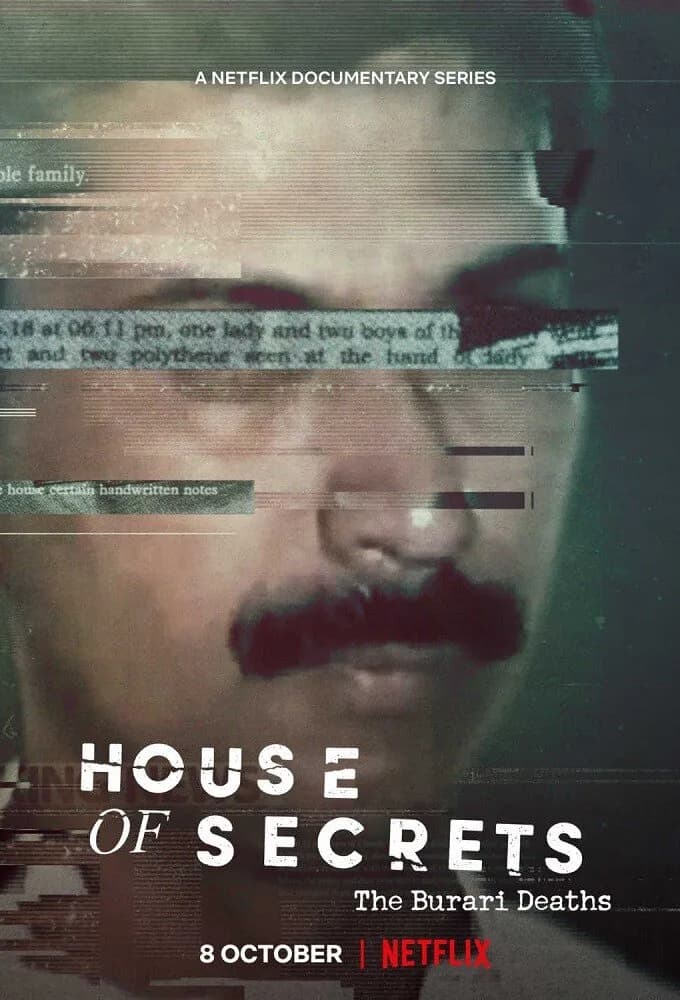
House of Secrets: The Burari Deaths is a three-part Netflix documentary series that investigates one of modern India's most disturbing and debated criminal cases: the simultaneous death of 11 members of the Chundawat family in their Burari home in North Delhi on the night of 30 June 2018. Directed by Leena Yadav and Anubhav Chopra and released globally on 8 October 2021, the series examines the official police conclusion of mass suicide, the extraordinary evidence found inside the home, and the profound sociological and psychological questions the case continues to raise. Each of the three episodes runs approximately 45 minutes, and the series carries a TV-MA rating on Netflix.
The documentary does not offer easy answers. Instead, it layers witness testimony, expert analysis, police interviews, and media archive footage to construct a portrait of a family living under extraordinary psychological pressure — and to ask how eleven people, across three generations, could come to participate in a single fatal act.
---
The Case
On the morning of 1 July 2018, neighbors of the Chundawat family in the Burari area of North Delhi raised the alarm after noticing that the family's shops had not opened. When police entered the family's first-floor home, they found all 11 members dead. Ten of the victims were found hanging from an iron grill in the home's main room. The eleventh, 75-year-old matriarch Bhagwati Chundawat, was found strangled on the floor nearby.
The victims, whose family name is also recorded as Bhatia in some official documents, were:
- Lallan Chundawat, 80 — grandfather and patriarch
- Bhagwati Chundawat, 75 — grandmother, found on the floor
- Pranav Chundawat, 47
- Ramesh Chundawat, 45
- Suresh Chundawat, 43
- Nirmal Chundawat, 41
- Anita Chundawat, 39
- Vikram Chundawat, 35
- Rajesh Chundawat, 33
- Parween Chundawat, 25
- Arun Chundawat, 12 — the youngest victim
The ages of the deceased ranged from 12 to 80 years, representing three distinct generations of a single extended family.
The initial reaction from Delhi Police was to treat the scene as a mass murder. The victims had been found bound at the wrists, blindfolded, and in several cases gagged — circumstances that appeared inconsistent with voluntary suicide. National media descended on the neighborhood within hours, and the story became a sensation across India and internationally.
The investigation took a decisive turn when detectives discovered a handwritten diary inside the home running to approximately 1,500 pages. The diary contained meticulous religious instructions spanning a decade, culminating in directions for a final collective ritual. Investigators concluded that the diary had been written under the influence of a distorted spiritual belief system, possibly centered on instructions the family believed were transmitted from a deceased ancestor. Police determined that all 11 family members had willingly participated in the ceremony, which was intended — at least in the belief framework the diary described — as a path to moksha, or spiritual liberation.
Delhi Police officially ruled the deaths a mass suicide. No external perpetrator was identified, no criminal charges were filed, and no trial took place. The Central Bureau of Investigation (CBI) was not called in, and the case was formally closed. The official suicide verdict remains contested by segments of the public and by some commentators who argue that the bound, gagged, and blindfolded state of many victims is incompatible with a fully voluntary act.
---
Production
The series was created and directed by Leena Yadav and Anubhav Chopra, both experienced Indian filmmakers. Yadav is best known for her feature work on socially engaged Indian cinema, while Chopra has a background in documentary storytelling. Netflix India announced the project in March 2021, signaling an expansion of the platform's investment in Indian true crime content.
The production draws on a range of primary and secondary sources: interviews with neighbors and community members who knew the Chundawat family, conversations with Delhi Police officers involved in the investigation, commentary from psychiatrists and sociologists, and extensive archival news footage from the weeks following the discovery. The creators notably chose not to sensationalize the crime scene itself, instead using the family's own world — their neighborhood, their shop, their relationships — as the primary lens.
The three-episode structure allows the series to move methodically: the first episode establishes the discovery and the initial shock; the second excavates the family's history and the origins of the religious practice described in the diary; and the third grapples with the wider question of how collective psychological influence can override individual survival instinct across an entire multigenerational household.
---
Reception
House of Secrets: The Burari Deaths holds a rating of 7.4 out of 10 on IMDb, based on approximately 14,000 user votes (IMDb ID: tt14167390). Viewer responses have consistently described the series as "disturbing," "inquisitive," and a "mind game," with praise directed at its willingness to explore the sociological and psychological dimensions of the case rather than reducing it to shock value.
Critical reception has been generally positive, with reviewers noting the series' unusual tonal restraint for the genre. Several observers highlighted the documentary's handling of the family as a unit — resisting the temptation to identify a single villain — as one of its more thoughtful choices. Reddit discussions among true crime communities have been extensive, with many users expressing the view that the official suicide ruling leaves critical questions unanswered, particularly regarding the physical restraints found on the victims.
The series has not been without controversy. Critics of the broader media response to the Burari deaths — including the "media circus" that surrounded the 2018 discovery — questioned whether a documentary format risked perpetuating the same sensationalism. Some viewers also expressed discomfort with the documentary's framing of the religious ritual, arguing that it raised complex questions about the intersection of faith, mental health, and susceptibility to cult-like influence that the series does not fully resolve. Others felt that the absence of surviving family members willing to speak on camera created inevitable gaps in the narrative.
Despite these criticisms, the series is widely credited with bringing renewed international attention to a case that had, by 2021, faded from the global news cycle.
---
The Case Today
The Burari deaths case remains officially closed. Delhi Police have not reopened the investigation, no new evidence has emerged that would alter the suicide ruling, and the CBI has not been called in at any point. The 1,500-page diary remains the central piece of evidence supporting the official conclusion.
In the years since the documentary's release, the case has continued to generate academic and journalistic interest. Scholars of religion, psychiatry, and group psychology have cited the Burari case as a compelling and tragic illustration of shared delusional belief systems and the dynamics of closed, high-control family environments. The case has been discussed in academic contexts as a window into how spiritual authority can be constructed and weaponized within intimate domestic settings — without any external cult leader, formal organization, or identifiable moment of coercion.
For the residents of the Burari neighborhood, the case left a lasting mark. The family's property remained a subject of local unease for years after the deaths. No surviving close relatives have spoken publicly at length about the case.
The question of whether the Burari deaths were truly a voluntary mass suicide — or something more coercive and more sinister — remains, for many observers, genuinely unresolved. That ambiguity is precisely what makes House of Secrets: The Burari Deaths one of the most unsettling true crime documentaries produced in India to date.