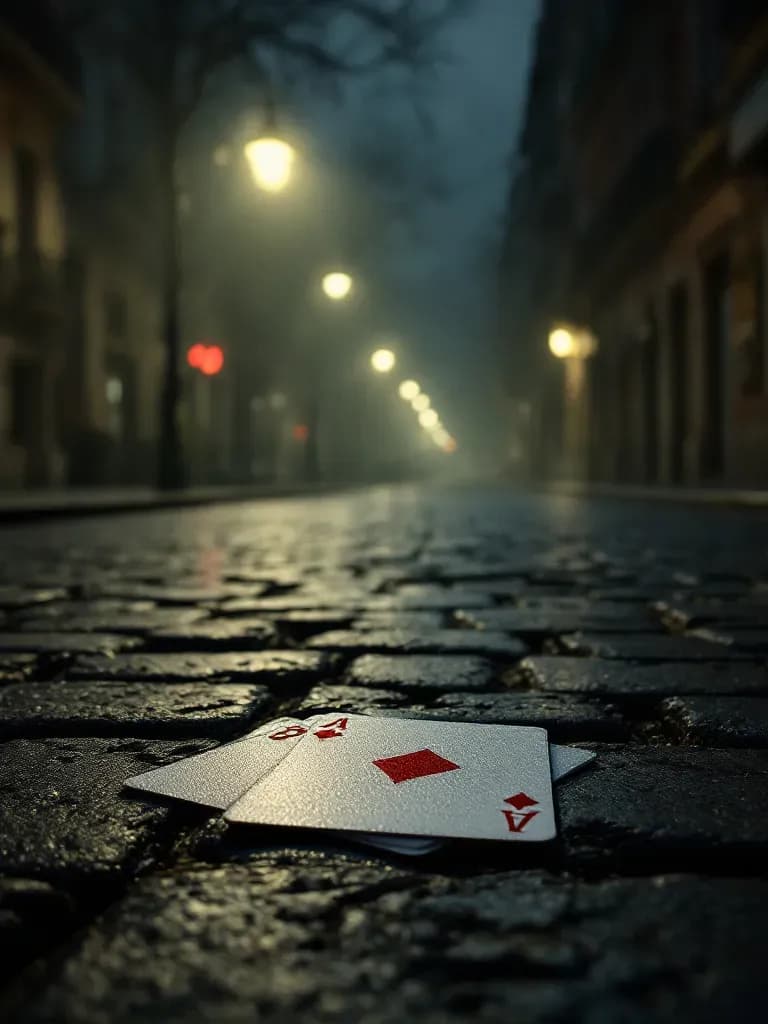
The Card Killer — Spain's Playing Card Serial Shooter
Madrid, Spain, 2003 — Solved. Alfredo Galán Sotillo convicted of six murders.
Published July 29, 2026
The Case
The Card Killer case — known in Spain as el caso del asesino de la baraja — is one of the most chilling serial murder cases in modern Spanish history. Between January and March 2003, a lone gunman stalked the streets of Madrid and its surrounding municipalities, shooting victims apparently at random and leaving playing cards from the traditional Spanish deck at or near the crime scenes as a deliberate, taunting signature. The perpetrator, Alfredo Galán Sotillo, was a former Spanish Army corporal who had served in the Balkans. His arrest, confession, and eventual conviction brought a rare sense of closure to a case that had gripped Spain for months — but the prospect of his potential release around 2028 continues to generate controversy.
The Crime
The attacks began on 4 January 2003 and continued through 18 March 2003, a period of roughly ten weeks during which residents of Madrid and nearby areas lived under a shadow of fear. Galán used a pistol to carry out what investigators and media alike described as random shootings — victims appeared to have no connection to one another or to the shooter, which made profiling and prevention extraordinarily difficult for law enforcement.
What set the case apart from other shooting sprees, and what gave Galán his now-infamous nickname, was his habit of leaving playing cards near his victims as a deliberate calling card. The cards were drawn from the baraja española, the traditional Spanish deck, distinct from the French-suited decks more familiar to international audiences. Some sources report that the card left consistently was the Four of Cups (cuatro de copas), while others suggest the card choice varied across incidents — this detail has never been fully resolved in publicly available reporting, and the exact pattern remains a point of minor dispute among accounts of the case.
Timeline
First shooting
Alfredo Galán Sotillo carries out his first known attack in the Madrid area, marking the beginning of a months-long shooting spree that would terrorize the Spanish capital.
Final attack
The last confirmed attack in the series takes place, bringing the total toll to six dead and three wounded. Spanish police intensify their manhunt.
Galán turns himself in
Alfredo Galán Sotillo surrenders to police in July 2003, reportedly after boasting about the murders. His confession and related evidence become central to the prosecution's case.
Conviction and sentencing
The Audiencia Provincial de Madrid convicts Galán of six counts of murder, three counts of attempted murder, and illegal weapons possession, sentencing him to 142 years and 3 months in prison.
Projected earliest release
Under Spain's maximum custodial limit of 25 years, Galán is widely reported to become eligible for release around 2028, a prospect that has drawn significant public debate.
By the time the attacks ended, six people were dead and three others had survived their wounds. The victims were ordinary people — targeted, as far as investigators could determine, for no reason other than proximity and opportunity. This apparent randomness deepened public anxiety and made the investigation exceptionally complex.
The Victims
The case claimed six lives and left three people with serious injuries. While the full roster of victims — their names, ages, and circumstances — has been documented in Spanish court records and contemporaneous Spanish-language journalism, a complete, independently verified list is not available in the English-language sources consulted for this article. What is confirmed is that the victims were diverse in age and background, united only by the tragic circumstance of crossing paths with Galán during his months-long spree. The three survivors, whose testimonies would prove important to the investigation and prosecution, faced long physical and psychological recoveries.
For a publication-grade account of each individual victim, Spanish court records from the Audiencia Provincial de Madrid and contemporaneous reporting from outlets such as El País and El Mundo remain the authoritative primary sources.
Investigation
The investigation into the playing card shootings was led by the Spanish National Police and was, by all accounts, one of the most intensive manhunts Spain had seen in years. The randomness of the attacks — no apparent motive, no prior relationship between shooter and victim, shifting locations across a large metropolitan area — presented investigators with few conventional leads.
The breakthrough came not from forensic work or surveillance, but from Galán himself. According to reporting on the case, he turned himself in to police in July 2003 after having boasted about the murders. This extraordinary development — a serial killer essentially walking into a police station — brought the active phase of the investigation to a swift conclusion, even as the subsequent legal proceedings would take nearly two more years to resolve.
Galán's background added a layer of grim irony to the case. He was a former Spanish Army corporal who had been deployed in the Balkans as part of international peacekeeping operations — a soldier trained by the state to use lethal force, who subsequently turned that training on the civilian population he had ostensibly served. Investigators and psychologists who examined him noted that he showed little remorse and appeared to relish the notoriety the killings had generated.
The playing cards themselves, far from being a random quirk, were understood as a form of communication — a signature intended to create a public identity and ensure that each new attack would be linked to the same perpetrator. Whether Galán intended this as a form of personal branding, a taunt directed at police, or something else entirely, he has never fully explained in terms that satisfied investigators or the public.
Trial and Verdict
Alfredo Galán Sotillo was tried before the Audiencia Provincial de Madrid, Spain's provincial court for serious criminal matters in the capital. The trial drew extensive national media coverage and proceeded against a backdrop of intense public interest.
On 9 March 2005, the court delivered its verdict: guilty on all major counts. Galán was convicted of six murders, three attempted murders, and illegal possession of weapons. The sentence handed down was 142 years and 3 months in prison, accompanied by a civil damages award of €609,182 to be paid to the victims and their families.
The length of the sentence — 142 years — reflected the gravity of the crimes under Spanish law, but it carried a significant caveat well understood by Spanish legal observers: Spain caps the actual time any individual may spend in prison at 25 years for a single criminal case, regardless of the nominal sentence. This meant that Galán, despite being nominally condemned to more than a century of imprisonment, would in practice serve a maximum of 25 years.
This aspect of Spanish sentencing law attracted considerable criticism in the wake of the verdict, with victims' families and public commentators arguing that it failed to reflect the true enormity of six murders. The debate over Spain's maximum custodial limits — which has also arisen in other high-profile cases, including The Paracuellos de Jarama Murders and The Alcàsser Murders — has continued in the years since.
Today
Alfredo Galán Sotillo remains imprisoned as of the time of publication. Under Spain's 25-year maximum custodial rule, he is widely reported to be eligible for release around 2028, a prospect that periodically resurfaces in Spanish media and prompts renewed debate about sentencing reform and the rights of victims' families.
The case has attracted sustained international attention in recent years, primarily through the Netflix documentary The Playing Card Killer (El crimen de la baraja), which brought the story to a global audience and introduced many viewers outside Spain to the details of the shootings, the investigation, and the controversy surrounding Galán's eventual release date. The documentary has been praised for its depth of reporting and criticized in some quarters for the degree of attention it affords to the perpetrator.
The case is also examined in the Evidence Locker True Crime podcast, episode 58, which provides a detailed audio account of the timeline, the investigation, and the trial. Additional video coverage is available through several independent true crime channels.
The Card Killer case occupies an uncomfortable place in Spanish cultural memory — a reminder that randomized, signature-driven violence is not exclusively a phenomenon of American or Northern European crime history, and that the gap between a soldier's training and civilian carnage can be disturbingly narrow. For the families of the six people killed between January and March 2003, the approach of 2028 is not an abstraction. It is a countdown.
The Alcàsser Murders and José Enrique Abuín Gey — The Chickpea Case represent other landmark Spanish criminal cases that similarly tested the limits of the country's justice system and prompted public demands for sentencing reform.
Ask about this case
Answers from KrimiNyt's coverage onlyFollow this case
Get an email when a new documentary, podcast or book about The Card Killer — Spain's Playing Card Serial Shooter appears, or when a verdict is reached.