Rédoine Faïd: Two Spectacular Prison Escapes in France
The French convict who blew his way out of one prison and was airlifted from another — and won't be eligible for release until 2060
Published June 6, 2025
Classification:
Quick Facts
French national Rédoine Faïd, born 10 May 1972, carried out two of the most audacious prison escapes in modern European history — one in 2013 and one in 2018 — both of which severely tested French authorities and drew widespread international attention. At the time of both escapes, Faïd was already serving sentences for armed robbery, which formed the legal basis for his imprisonment.
The 2013 escape from Sequedin
On 13 April 2013, Faïd broke out of the Maison d'arrêt de Lille-Sequedin in northern France. The escape was meticulously planned. He used explosives to breach the prison's security and took four prison guards hostage to force his way out. Once outside, he set fire to the getaway car in Lille before switching vehicles to make it harder for investigators to track him. BBC described the incident at the time as one of the most dramatic jailbreaks in recent French history.
French authorities launched an intensive manhunt. After roughly six weeks on the run, Faïd was arrested on 29 May 2013 in Pontault-Combault in the Seine-et-Marne department, bringing the first escape to an end.
Timeline
Rédoine Faïd is born
Rédoine Faïd is born on 10 May 1972 as a French citizen.
Escape from Sequedin prison with explosives
On 13 April 2013, Faïd blasts his way out of Maison d'arrêt de Lille-Sequedin, takes four officers hostage and burns the getaway car in Lille.
Faïd arrested in Pontault-Combault
On 29 May 2013, Faïd is arrested in Pontault-Combault, Seine-et-Marne, after nearly a month and a half on the run.
Verdict for 2013 escape: 10 years in prison
On 14 March 2017, the Cour d'assises du Nord sentences Faïd to 10 years in prison for the escape from Sequedin prison.
Helicopter escape from Réau prison south of Paris
On 1 July 2018, armed accomplices fly Faïd out of Réau prison in a hijacked helicopter.
Verdict for 2018 escape: 14 years in prison
A court in Paris sentences Faïd in October 2023 to an additional 14 years in prison for the helicopter escape. Earliest possible release is 2060, according to Le Monde.
The 2018 helicopter escape from Réau
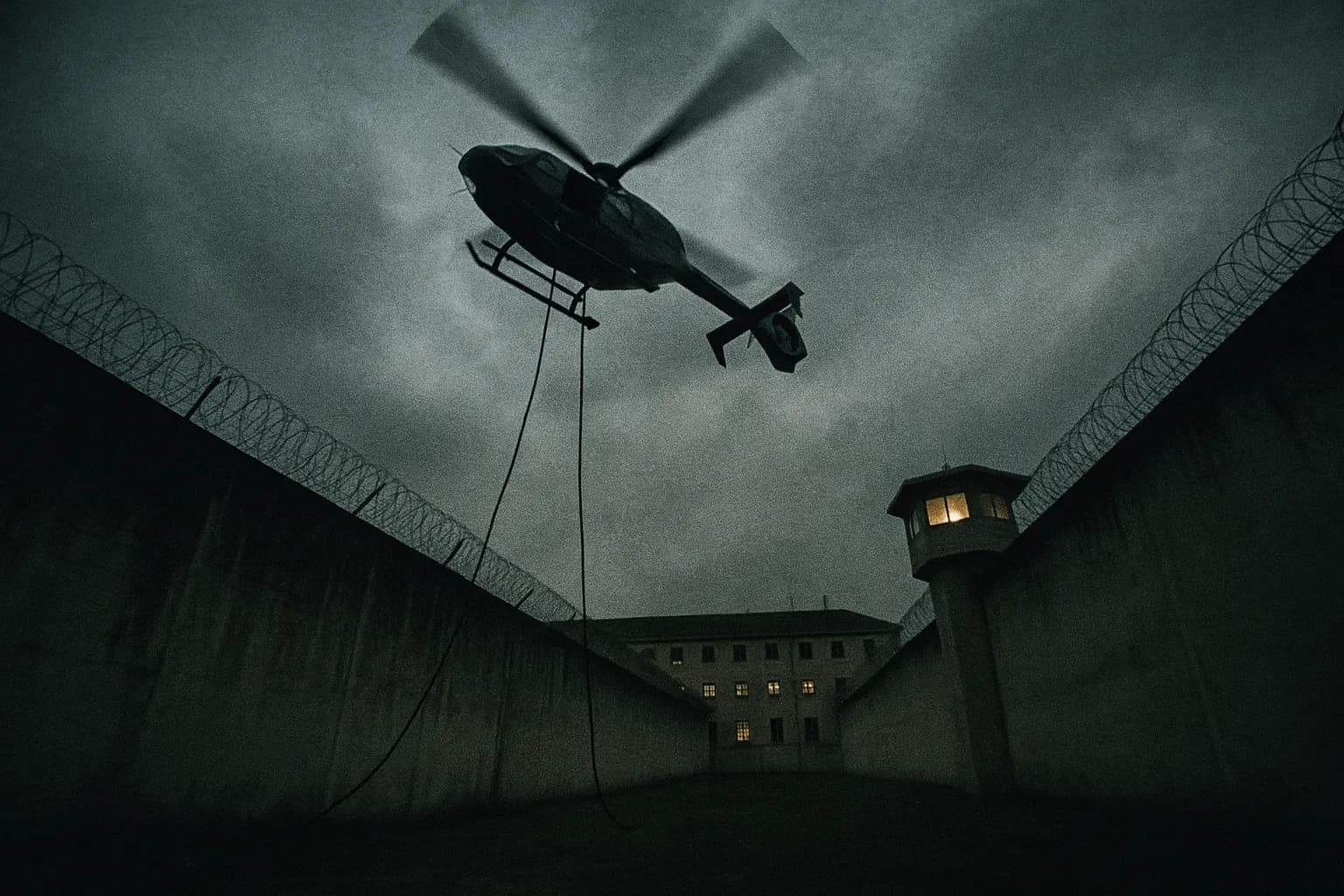
Five years later, on 1 July 2018, France faced an even more shocking escape. Armed accomplices hijacked a helicopter and landed it in the courtyard of the prison in Réau, south of Paris. Faïd was picked up and flown away. Al Jazeera reported on the events as they unfolded, describing the escape as unprecedented in recent European criminal history.
French authorities launched another large-scale manhunt following the helicopter escape.
Verdicts and sentencing
For the 2013 Sequedin escape, the Cour d'assises du Nord convicted Faïd on 14 March 2017 and sentenced him to 10 years in prison. The court found him guilty of offences related to the escape, including the use of explosives and the taking of four prison guards as hostages.
For the 2018 helicopter escape, a Paris court handed down a further sentence of 14 years in October 2023. According to Le Monde, Faïd will not be eligible for release before 2060 at the earliest, unless the sentence is appealed or reduced. His underlying convictions for armed robbery remained the legal framework within which both escapes took place.
Where the case stands today
As of the most recent available information from Le Monde, Rédoine Faïd remains incarcerated. Barring a successful appeal or reduction of sentence, he will not be eligible for release until 2060. His two escapes have left a lasting mark on the French debate around prison security, and both incidents are still among the most widely discussed in modern European criminal history.
Ask about this case
Answers from KrimiNyt's coverage onlyFollow this case
Get an email when a new documentary, podcast or book about Rédoine Faïd: Two Spectacular Prison Escapes in France appears, or when a verdict is reached.