Oklahoma City Bombing: Timothy McVeigh's Deadly Revenge
America's deadliest domestic terror attack kills 168
Published June 6, 2025
Quick Facts
# Oklahoma City Bombing: Timothy McVeigh's Deadly Revenge
**Timothy James McVeigh** detonated a massive truck bomb outside the **Alfred P. Murrah Federal Building** in **Oklahoma City, Oklahoma** on April 19, 1995, killing 168 people and injuring 684 others in what remains the deadliest act of domestic terrorism in United States history.
The bombing, carried out with assistance from accomplice **Terry Nichols**, targeted the nine-story federal office building during morning business hours, destroying much of the structure and claiming the lives of 19 children attending a daycare center on the second floor.
Timeline
Bomb explodes outside Murrah Federal Building
At approximately 9:02 a.m. on April 19, 1995, an ANFO bomb detonates in a rented Ryder truck. 168 people are killed, including 19 children. Hundreds are injured.
McVeigh arrested north of Oklahoma City
About 90 minutes after the explosion, Timothy McVeigh is stopped by a police officer for a traffic violation and arrested while armed. His identity is quickly linked to the bombing case.
McVeigh sentenced to death
Timothy James McVeigh is found guilty in federal court and sentenced to death for his responsibility for the bombing on April 19, 1995.
McVeigh executed
On June 11, 2001, Timothy James McVeigh is executed by federal authorities in the US – the first federal execution in the country in nearly four decades.
Nichols sentenced to life in prison
Terry Lynn Nichols, McVeigh's accomplice, is convicted in federal court and sentenced to life in prison for his role in planning and carrying out the bombing.
What Happened
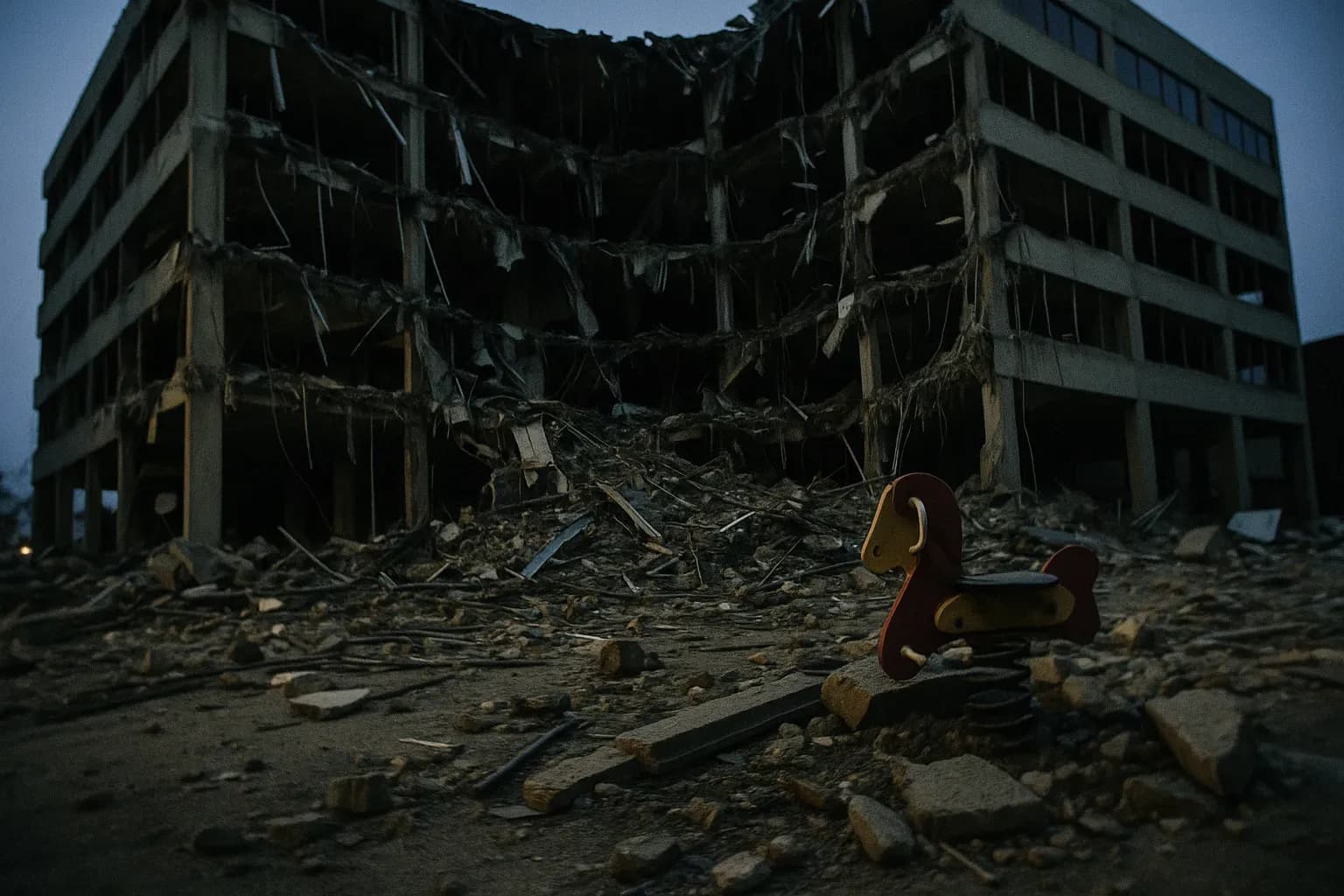
At 9:02 a.m. on April 19, 1995, a rented Ryder truck packed with approximately 4,800 pounds of explosives detonated in front of the Alfred P. Murrah Federal Building in downtown Oklahoma City. The blast was so powerful it destroyed or damaged more than 300 buildings within a 16-block radius.
The Alfred P. Murrah Federal Building housed numerous federal agencies, including the Social Security Administration, the Drug Enforcement Administration, and the Bureau of Alcohol, Tobacco, and Firearms. The America's Kids daycare center, located on the building's second floor, was caring for children of federal employees when the explosion occurred.
Of the 168 people killed, 19 were children under the age of six. The blast injured an additional 684 people, many suffering severe injuries from falling debris, shattered glass, and the building's partial collapse. The explosion left a crater more than 30 feet wide and 8 feet deep where the truck had been parked.
Rescue workers and volunteers worked around the clock for weeks, searching through rubble for survivors and recovering remains. The last survivor was pulled from the wreckage 15 hours after the explosion.
Investigation
Law enforcement launched one of the largest criminal investigations in American history immediately following the Oklahoma City bombing. Within 90 minutes of the explosion, an Oklahoma Highway Patrol trooper stopped Timothy McVeigh for driving without a license plate about 60 miles north of Oklahoma City. The trooper arrested McVeigh for carrying a concealed weapon.
McVeigh was still in custody on unrelated charges when investigators linked him to the bombing through the truck's vehicle identification number, which had survived the blast. He was formally identified as a bombing suspect just minutes before he was scheduled to be released from jail.
Investigators quickly identified Terry Nichols as McVeigh's co-conspirator. Nichols surrendered to authorities in Kansas and was arrested on federal charges related to the bombing.
The investigation revealed that McVeigh, a Gulf War veteran, had become radicalized by anti-government ideology. He selected April 19 as the bombing date to coincide with the second anniversary of the federal government's deadly confrontation with the Branch Davidian compound in Waco, Texas. McVeigh viewed the attack as retaliation against what he perceived as government overreach.
McVeigh and Nichols had constructed the bomb using ammonium nitrate fertilizer, nitromethane racing fuel, and other common materials. They had stolen explosives and purchased bomb-making materials in the months leading up to the attack.
Legal Proceedings
Timothy McVeigh faced trial in federal court on 11 federal offenses, including use of a weapon of mass destruction resulting in death, conspiracy to use a weapon of mass destruction, and eight counts of first-degree murder for the deaths of federal law enforcement officers.
On June 2, 1997, a jury found McVeigh guilty on all 11 counts after deliberating for four days. The same jury unanimously recommended the death penalty, which the judge imposed. Throughout his trial and imprisonment, McVeigh showed little remorse for his actions, at times referring to the children killed as "collateral damage."
Terry Nichols was tried separately in federal court and convicted of conspiracy and eight counts of involuntary manslaughter for the deaths of federal officers. He was sentenced to life in prison without the possibility of parole. In 2004, Oklahoma state prosecutors tried Nichols on 161 counts of first-degree murder for the state victims. He was found guilty and received an additional life sentence.
Michael Fortier, a friend of McVeigh who had prior knowledge of the plot but failed to alert authorities, pleaded guilty to lesser charges and testified against both McVeigh and Nichols. He was sentenced to 12 years in prison and entered the witness protection program after his release.
Current Status
Timothy McVeigh was executed by lethal injection on June 11, 2001, at the federal penitentiary in Terre Haute, Indiana. He was the first federal prisoner executed in 38 years. McVeigh declined to make a final statement but left a handwritten copy of the poem "Invictus" as his final message.
Terry Nichols remains incarcerated, serving multiple life sentences without the possibility of parole at the ADX Florence supermax prison in Colorado.
The Oklahoma City bombing case is considered solved, though some investigators and survivors have questioned whether additional conspirators were involved. The official investigation concluded that McVeigh and Nichols were the primary perpetrators.
The Oklahoma City National Memorial & Museum opened on the former site of the Alfred P. Murrah Federal Building in 2000. The memorial features 168 empty chairs representing each victim, a reflecting pool, and a survivor tree. The museum preserves the history of the attack and honors those who were killed, survived, and responded.
Media Coverage
The Oklahoma City bombing received extensive media coverage, both during the immediate aftermath and during subsequent legal proceedings. News organizations provided continuous coverage of the rescue efforts, investigation, and trials.
The case has been documented in numerous books, documentaries, and historical analyses. "The Oklahoma City Bombing & The Trial of Timothy McVeigh" provides comprehensive legal history of the prosecution. Other significant works examine McVeigh's radicalization, the investigation's scope, and the bombing's lasting impact on American security policy.
The attack prompted significant changes in federal building security nationwide and influenced how law enforcement approached domestic terrorism threats. The bombing's impact on public consciousness remained profound until the September 11, 2001, terrorist attacks.
Documentaries and investigative reports continue to examine aspects of the case, including McVeigh's motivations, the effectiveness of the investigation, and the experiences of survivors and victims' families.
Sources
1. Federal Bureau of Investigation — Oklahoma City Bombing Case Files
2. Oklahoma City National Memorial & Museum — Historical Records
3. "The Oklahoma City Bombing & The Trial of Timothy McVeigh" — Legal History Resource
4. United States Department of Justice — Official Case Documentation
5. Federal Court Records — United States v. Timothy James McVeigh
6. Contemporary News Reports — 1995-2001
Media coverage
TV series
- Oklahoma City Bombing: One Day in America(2026)
- Oklahoma City Bombing: American Terror Netflix Documentary(2026)
Ask about this case
Answers from KrimiNyt's coverage onlyFollow this case
Get an email when a new documentary, podcast or book about Oklahoma City Bombing: Timothy McVeigh's Deadly Revenge appears, or when a verdict is reached.