Jack the Ripper: London's Autumn of Terror in 1888
How five brutal murders in Whitechapel created history's most infamous unsolved case
Published June 6, 2025
Quick Facts
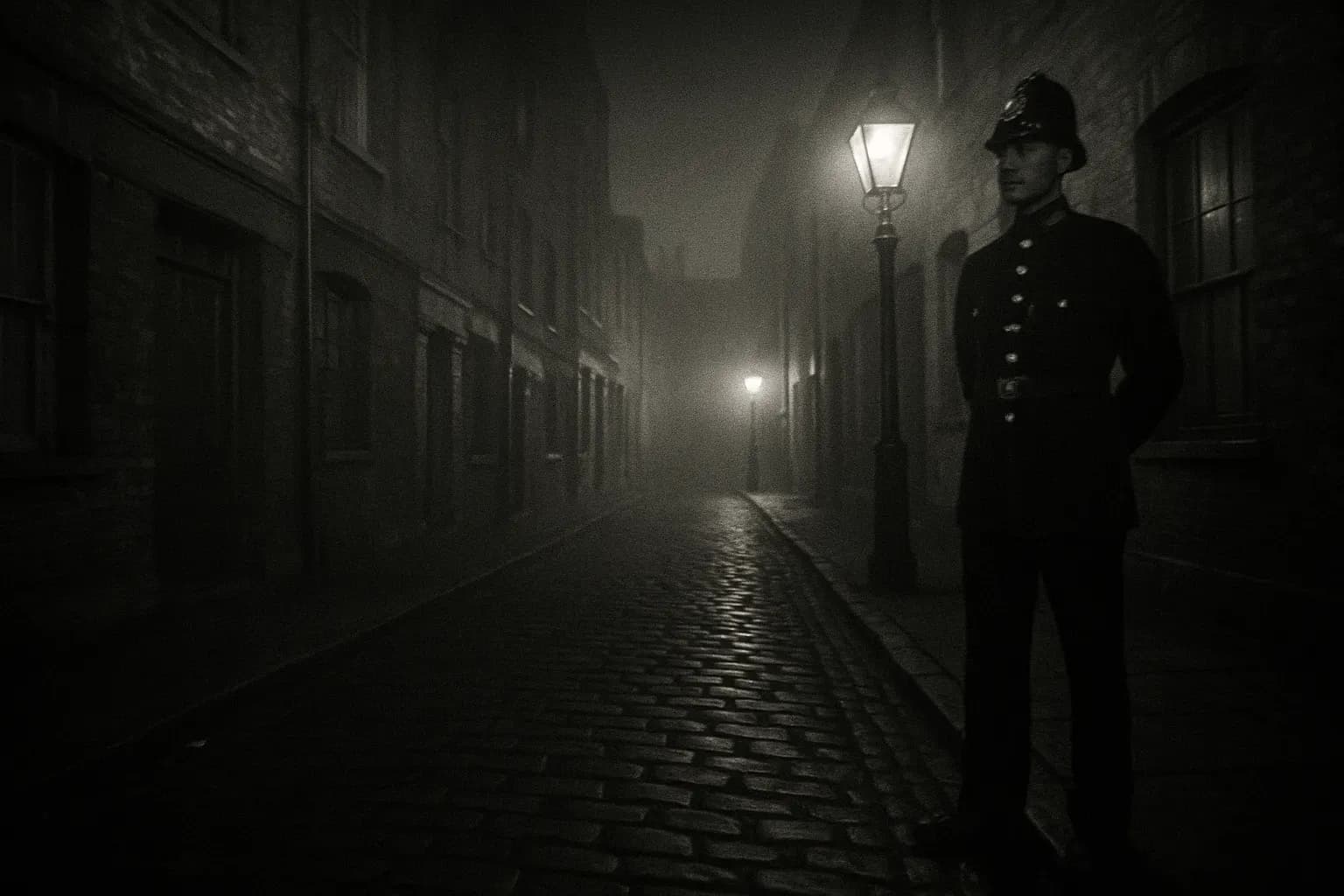
In the autumn of 1888, London's East End became the hunting ground for one of history's most notorious killers. Over just eleven weeks, an unidentified serial murderer claimed at least five victims in the impoverished streets of Whitechapel, forever earning the moniker "Jack the Ripper" and launching an investigation that would consume Scotland Yard for decades.
The terror began on August 31, 1888, with the murder of Mary Ann Nichols. Her body was discovered with her throat cut and abdominal mutilations, signaling a killer with knowledge of human anatomy. One week later, Annie Chapman was found with her throat severed and her uterus removed—a detail that would become grimly characteristic of the attacks to follow.
The violence accelerated on September 30, 1888, known as "Double Event Night." Early that morning, Elizabeth Stride was discovered in Dutfield's Yard on Berner Street with a single, precise 6-inch incision across her throat that severed her left carotid artery and trachea. Some investigators theorized the killer was interrupted. Hours later, Catherine Eddowes was found in Mitre Square with her throat cut and extensive mutilations inflicted. The two attacks, occurring within a geographical mile of one another, suggested a killer moving with terrifying purpose through the district.
Timeline
Mary Ann Nichols found dead in Buck's Row, Whitechapel
Early in the morning of 31 August 1888, Mary Ann Nichols was found murdered in Buck's Row, Whitechapel. She is considered the first of the canonical five victims.
Annie Chapman murdered in Hanbury Street, Spitalfields
On 8 September 1888, Annie Chapman was murdered in Hanbury Street, Spitalfields. She is the second of the canonical five victims.
Double murder night: Stride and Eddowes killed same night
During the night of 1 October 1888, Elizabeth Stride was murdered in Berner Street, Whitechapel, and Catherine Eddowes in Mitre Square, City of London — both on the same night.
Mary Jane Kelly murdered in Dorset Street — last canonical victim
On 9 November 1888, Mary Jane Kelly was murdered in Dorset Street, Spitalfields. She is considered the fifth and last of the canonical five victims in the Whitechapel murders.
The final canonical victim was Mary Jane Kelly, murdered on November 9, 1888. Her death proved the most brutal. Found in her rented room, Kelly's body bore the most extensive mutilations of all five victims, with multiple organs removed. The savagery of this attack seemed to mark an escalation, yet the murders then stopped entirely—though the Whitechapel murder series would continue sporadically until February 1891, with at least six additional suspected victims.
The killer's methods were chillingly consistent. All victims were prostitutes working in or near Whitechapel. The murders typically involved subduing the victim before slashing the throat, followed by abdominal mutilations performed with surgical precision. The removal of specific organs—kidneys, uterus, and other reproductive organs—suggested either medical knowledge or deliberate symbolism, fueling speculation that the killer might be a surgeon, butcher, or anatomist.
The investigation proved unprecedented in scale. Scotland Yard questioned thousands of suspects, detained around 80 individuals, and investigated hundreds more. Despite the intensive manhunt, no arrests were made and no charges were filed. The mystery was further complicated by the killer's apparent knowledge of the area, his ability to evade witnesses, and the sheer number of suspects who fit the loose profile of a man with anatomical expertise.
The case generated intense media frenzy. Hundreds of letters, many claiming to be from the killer himself, flooded police departments and newspapers. The press amplified the sensation, and "Jack the Ripper" became a household name—arguably the world's first media-created serial killer celebrity. Vigilante committees formed across Whitechapel, and amateur detectives pursued their own investigations alongside official police efforts.
Over 130 years later, the identity of Jack the Ripper remains unknown. The case has spawned countless theories, books, documentaries, and amateur investigations, yet no conclusive evidence has ever emerged to identify the killer. What remains certain is that five women lost their lives to an unknown assailant in one of history's most infamous crime sprees—a Whitechapel autumn that would echo through criminology and popular culture indefinitely.
Today, Whitechapel's streets have become tourist attractions, drawing visitors from around the world to walk the routes of the killer and explore the neighborhood where history's most elusive murderer vanished without trace.
**Sources**
- https://www.jack-the-ripper.org - https://www.historyhit.com/facts-about-jack-the-ripper/ - https://www.britannica.com/biography/Jack-the-Ripper - https://en.wikipedia.org/wiki/Jack_the_Ripper - https://whitechapeljack.com
Ask about this case
Answers from KrimiNyt's coverage onlyFollow this case
Get an email when a new documentary, podcast or book about Jack the Ripper: London's Autumn of Terror in 1888 appears, or when a verdict is reached.