The Saint Valentine's Day Massacre: Chicago's Unsolved Bloodbath
Seven gangsters gunned down in 1929 as Al Capone's suspected revenge against rivals
Published June 6, 2025
Case Details
Quick Facts
Classification:
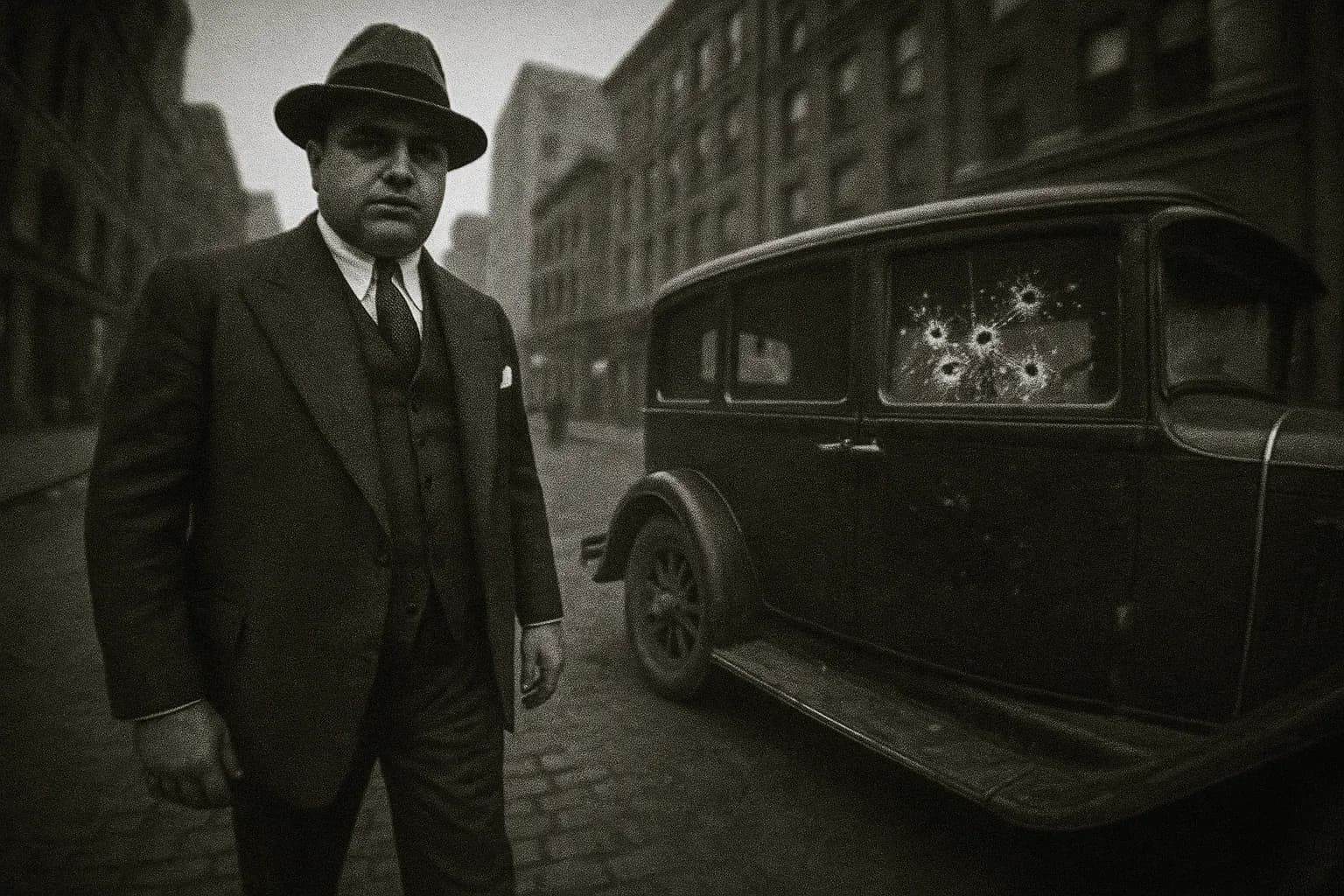
Seven men lay dead on the concrete floor of a Lincoln Park garage on February 14, 1929—victims of what would become one of America's most notorious unsolved murders. The Saint Valentine's Day Massacre marked a brutal escalation in Chicago's Prohibition-era gang wars and solidified the legend of Al Capone, though he was never convicted of the crime.
## The Attack
Between four and six men entered the garage on North Clark Street that winter morning. Two were disguised as police officers—a ruse that likely prevented the victims from resisting. The gang members and associates inside were ordered to line up against a wall. What followed was a fusillade of gunfire: Thompson submachine guns discharged 70 rounds while a sawed-off shotgun fired once. Within moments, the violence was over.
Timeline
The massacre in the garage
Seven men connected to the North Side Gang were lined up against the wall in a garage at 2122 North Clark Street and shot with Thompson submachine guns and a sawed-off shotgun. Six died instantly, the seventh survived briefly.
George 'Bugs' Moran avoids death
The primary target, George 'Bugs' Moran, leader of the North Side Gang, was not present as he arrived late for the meeting in the garage.
Frank Gusenberg refuses to identify attackers
Frank Gusenberg, the only short-term survivor, refused to identify the attackers before his death.
Case remains unsolved
Despite widespread suspicion of Al Capone, no one was ever charged or prosecuted for the massacre. Capone was on vacation in Miami, Florida at the time of the crime.
Six victims died at the scene. The seventh, Frank Gusenberg, was rushed to the hospital but died shortly after, refusing to identify his attackers despite police interrogation—a code of silence that would define the case.
## The Victims
The dead were identified as Albert Weinshank, Adam Heyer, Pete Gusenberg, James Clark, Frank Gusenberg, John May, and Dr. Reinhardt H. Schwimmer. Most were members or close associates of the North Side Gang, the primary criminal enterprise rivaling Capone's Chicago Outfit for control of bootlegging and other illicit operations during Prohibition.
## The Intended Target
Historians and police believe the massacre was orchestrated as a hit against George "Bugs" Moran, the North Side Gang's leader. But Moran had not yet arrived at the garage when the shooting began. The killers, reportedly unfamiliar with Moran's appearance, executed everyone they found instead—a catastrophic intelligence failure that transformed the attack into a mass killing.
## Capone's Shadow
Al Capone, then 30 years old and head of the Chicago Outfit, is widely suspected of ordering the massacre. The motive was straightforward: territorial control during the lucrative Prohibition bootlegging wars. The Mob Museum notes that "most people believe it was orchestrated by Al Capone," and police investigations of the era focused heavily on him and his organization.
In 1935, Fred "Killer" Bolton testified that Capone had ordered the hit specifically to seize Moran's territory. This claim, though never proven in court, aligned with police suspicions and remains a key piece of circumstantial evidence.
## Why No Conviction?
Despite being the leading suspect, Capone was never charged with the massacre. The investigation stalled—witnesses either died, disappeared, or refused to talk. The code of silence that gripped Chicago's underworld proved impenetrable.
Capone's criminal empire eventually caught up with him, but not through the Valentine's Day case. In 1931, he was convicted of tax evasion and bootlegging violations, a federal prosecution that sidestepped the massacre entirely. He served time in Atlanta Penitentiary and later Alcatraz before his release in 1939. He died in 1947, the massacre's mystery still unsolved.
## An Enduring Mystery
Ninety-five years later, the Saint Valentine's Day Massacre remains officially unsolved. No one has ever been prosecuted for the killings. The case stands as a testament to the violence of Prohibition, the reach of organized crime in 1920s America, and the limits of law enforcement when facing an underworld bound by silence.
## Sources
- https://en.wikipedia.org/wiki/Saint_Valentine's_Day_Massacre - https://www.youtube.com/watch?v=wA5pJqb7hwc - https://gehsspartanshield.org/4381/features/al-capone-and-the-valentines-day-massacre/ - https://arkiv.arbejderen.dk/artikel/2008-02-14/14-februar-1929-sankt-valentins-dag-massakren - https://stvalentinemassacre.org
Ask about this case
Answers from KrimiNyt's coverage onlyFollow this case
Get an email when a new documentary, podcast or book about The Saint Valentine's Day Massacre: Chicago's Unsolved Bloodbath appears, or when a verdict is reached.