Highway of Tears: Disappearances and Murders Along Highway 16
Decades of unsolved cases along a remote Canadian highway have left families without answers — and exposed a crisis affecting Indigenous women and girls.
Published June 6, 2025
Quick Facts
The Case in Brief
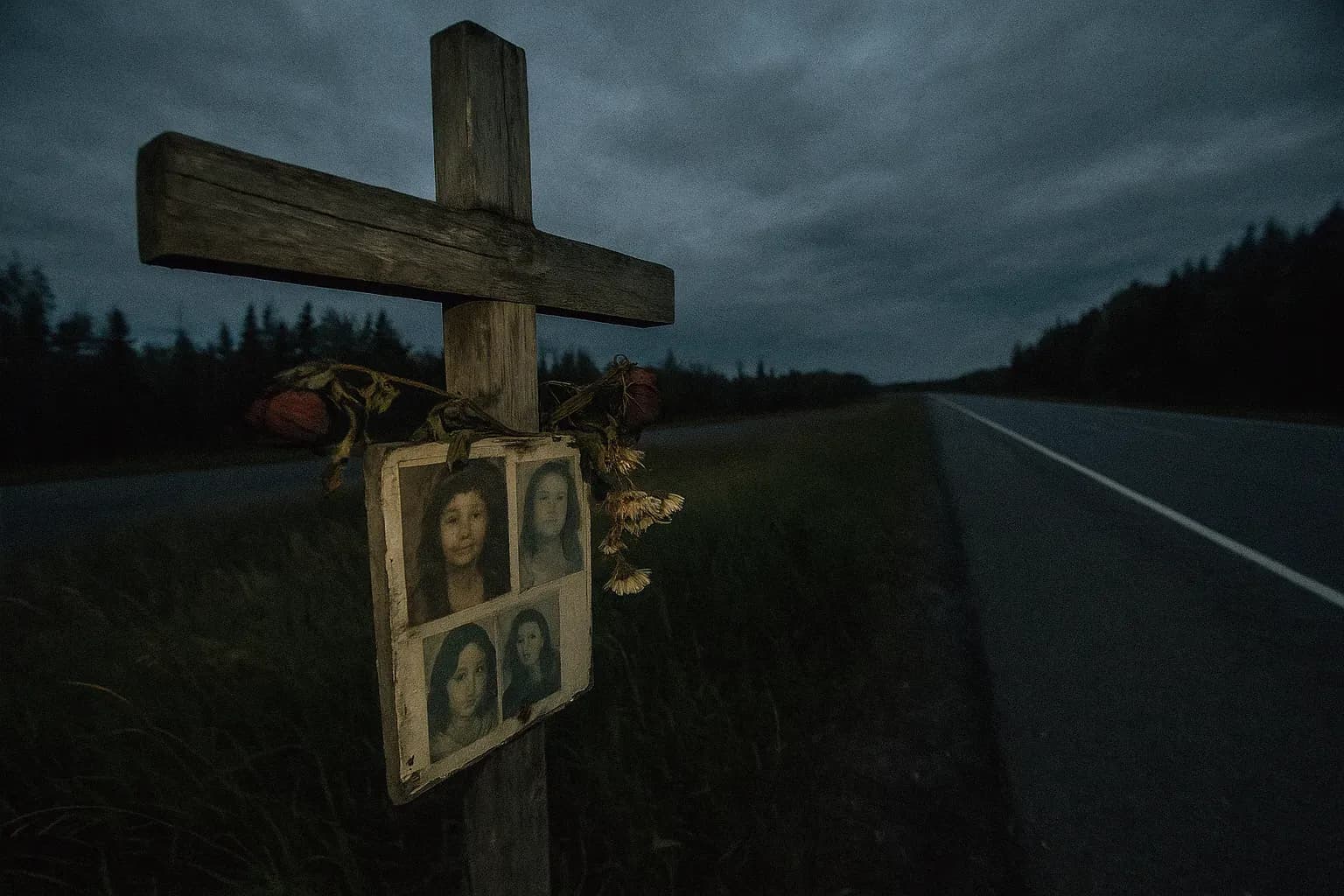
Highway of Tears is not a single criminal case but a collective term for a long series of disappearances and murders of women and girls along Highway 16 — also known as the Yellowhead Highway — in the Canadian province of British Columbia. The stretch runs approximately 724 kilometers between the cities of Prince George to the east and Prince Rupert to the west on the Pacific coast. The cases span from 1969 to the present day, and the majority remain unsolved.
A striking and deeply troubling feature of these cases is that a disproportionate number of victims are Indigenous women — a demographic group that is severely overrepresented as victims of violence and disappearances across Canada as a whole.
The RCMP (Royal Canadian Mounted Police) officially recognizes 18 cases between 1969 and 2006 under a dedicated investigation known as Project E-PANA. Indigenous organizations and local community groups in the region believe the true number is far higher — some estimate 40 victims, others more than 50, depending on how the geographic area and time frame are defined.
Timeline
Beginning of the documented cases
The first unsolved disappearances along Highway 16 are recorded, marking the start of a decades-long series of murders.
Monica Ignas disappears
15-year-old Monica Ignas from Thornhill is reported missing. Her body is found four months later buried under snow. The case remains unsolved.
Colleen MacMillen is killed
16-year-old Colleen MacMillen disappears while hitchhiking near Lac La Hache. The case remains unsolved for 38 years.
Alberta Rose is murdered
16-year-old Alberta Rose disappears after an evening in Prince Rupert. Her partially buried body is later found; the murder remains unsolved.
Alishia Germaine is murdered
15-year-old Alishia Germaine is found murdered in Prince George. She had been lured away from her school area.
Lana Derrick disappears
19-year-old Lana Derrick is last seen at a gas station near Terrace talking to a man in a pickup truck. She remains missing.
RCMP establishes special unit
The Royal Canadian Mounted Police establishes a special unit for the systematic investigation of the cases along the Highway of Tears.
Highway of Tears Symposium
First major symposium brings together victims' families, indigenous communities, and authorities to discuss solutions.
DNA breakthrough: Bobby Jack Fowler identified
Advanced DNA technology links American criminal Bobby Jack Fowler to the murder of Colleen MacMillen and at least ten other cases.
National inquiry begins
The Canadian government launches a comprehensive national inquiry into murdered and missing Indigenous women and girls.
Final report speaks of genocide
The final report of the national inquiry is published, describing the violence against Indigenous women as genocide.
The Crimes
The cases grouped under the Highway of Tears name are individual incidents spread across decades, but they share a number of common characteristics: young women and girls, many of them Indigenous, who disappeared or were found murdered along or near Highway 16. Many of the victims are believed to have been hitchhiking or seeking rides along a highway where public transportation has historically been extremely limited and distances between towns are vast.
Among the names appearing on RCMP and other major reference lists of victims are: Gloria Moody, Micheline Pare, Gale Weys, Pamela Darlington, Monica Ignas, Colleen MacMillen, Monica Jack, Maureen Mosie, Alberta Williams, Ramona Wilson, Roxanne Thiara, Alisha Germaine, Aielah Saric-Auger, Shelley Bascu, Tamara Chipman, Nicole Hoar, Lana Derrick, and Delphine Nikal. Behind each of these names lies a family's loss and, in most cases, a crime that has never been solved.
It is not possible to construct a single offender profile, because investigators do not believe a single perpetrator is responsible. The cases differ widely in detail and timing, and there is no overarching charge or trial addressing the Highway of Tears as a whole.
Investigation
The RCMP established Project E-PANA as a dedicated investigative team focused on cases along Highway 16. The project worked to map the 18 officially recognized cases and attempt to identify possible perpetrators or connections between them.
In connection with the murder of Colleen MacMillen, police identified Bobby Jack Fowler as a suspect. Fowler, an American citizen, was already imprisoned in the United States for other crimes and died in prison in 2006 — before he could be formally charged in the MacMillen case. His death brought this line of investigation to a provisional halt.
Another case that attracted attention is the murder of Monica Jack, in which Garry Taylor Handlen was charged. Due to conflicting information in available sources regarding the final legal outcome of the case, it is not possible to confirm how the proceedings concluded.
Cody Legebokoff was convicted in 2014 of the murder of Loren Donn Leslie and three other women. His case is geographically linked to the broader Highway of Tears area, but Canadian authorities do not place it among the 18 officially recognized cases along Highway 16.
One of the structural challenges facing investigators has been that the vast geographic area, long distances, and sparse population make it difficult to gather witness testimony and physical evidence. Critics — including Indigenous organizations — have for years pointed out that the authorities' response to the disappearances and murders of Indigenous women has historically been too slow and too inadequate.
Trial and Verdict
There is no single trial encompassing the Highway of Tears. Cases that have been solved or led to charges are handled individually by the relevant Canadian courts in British Columbia. The majority of cases — including most of the 18 on the RCMP's list — have never come before a court, simply because no perpetrator has been identified.
The legal and political debate surrounding the Highway of Tears has increasingly focused on systemic questions: Why have so many Indigenous women and girls disappeared? Have the authorities prioritized these cases adequately? And what responsibility does Canadian society bear for the structural vulnerability that many Indigenous women face?
The Case Today
In Canada, the Highway of Tears has become a symbol of a far broader crisis: the disappearance and murder of Missing and Murdered Indigenous Women and Girls (MMIWG). The Canadian government has launched national inquiries into this phenomenon, and the Highway 16 corridor is consistently cited as one of the most prominent examples.
Most of the cases remain unsolved. The victims' families are still waiting for answers. Local and Indigenous organizations continue to press for investigative resources, improved transportation along Highway 16, and greater public awareness of the victims' fates.
In 2019, the final report from the national inquiry was published and characterized the violence against Indigenous women as genocide — a conclusion that underscored the urgency felt by communities along the highway for decades.
The Highway of Tears is a reminder that behind criminal cases with unknown perpetrators there are always real people — with names, families, and lives that deserve to be remembered and investigated with the full seriousness that every crime demands.
Ask about this case
Answers from KrimiNyt's coverage onlyFollow this case
Get an email when a new documentary, podcast or book about Highway of Tears: Disappearances and Murders Along Highway 16 appears, or when a verdict is reached.