Landru: The Bluebeard Who Hunted War Widows
How Henri Désiré Landru turned newspaper romance into murder, deception, and flames
Published June 6, 2025
Quick Facts
On 12 April 1919, French police arrested Henri Désiré Landru at an apartment near Paris's Gare du Nord, ending a five-year spree that would define serial murder in early 20th-century Europe. The 50-year-old was living with his mistress, 24-year-old Fernande Segret, when detectives closed in—but by then, his carefully documented crimes had already claimed at least 11 lives, mostly women who believed they were meeting potential husbands.
Landru's method was brutally efficient. He placed newspaper advertisements seeking relationships with wealthy widows—a demographic abundant in France after the carnage of the First World War. Once he identified targets, he would seduce them, gain their trust, and persuade them to liquidate their assets or sign over their property. Then he would invite them to his homes: first in Vernouillet, later to an isolated villa in Gambais near Paris. From those properties, no victim would leave alive.
The confirmed death toll stands at 10 women and one teenage boy—the son of his first victim. But the scale of Landru's predation extended far beyond those murdered. Police discovered that he had maintained correspondence with 283 women across France. Of those, 72 were never located, suggesting the true victim count may be substantially higher.
Timeline
Landru begins his crime series
During 1915, Henri Désiré Landru begins systematically luring women via false marriage advertisements to his country houses in the Paris region.
The crime series ends
The verified crimes extend up to 1919, when Landru's activity as a marriage fraudster and murderer ceases.
Landru sentenced to death in Paris
At the Cour d'assises de la Seine in Paris, Henri Désiré Landru is found guilty of 11 premeditated murders and sentenced to death.
Landru guillotined in Versailles
After President Alexandre Millerand has rejected the plea for clemency, Henri Désiré Landru is executed by guillotine in Versailles before a large crowd.
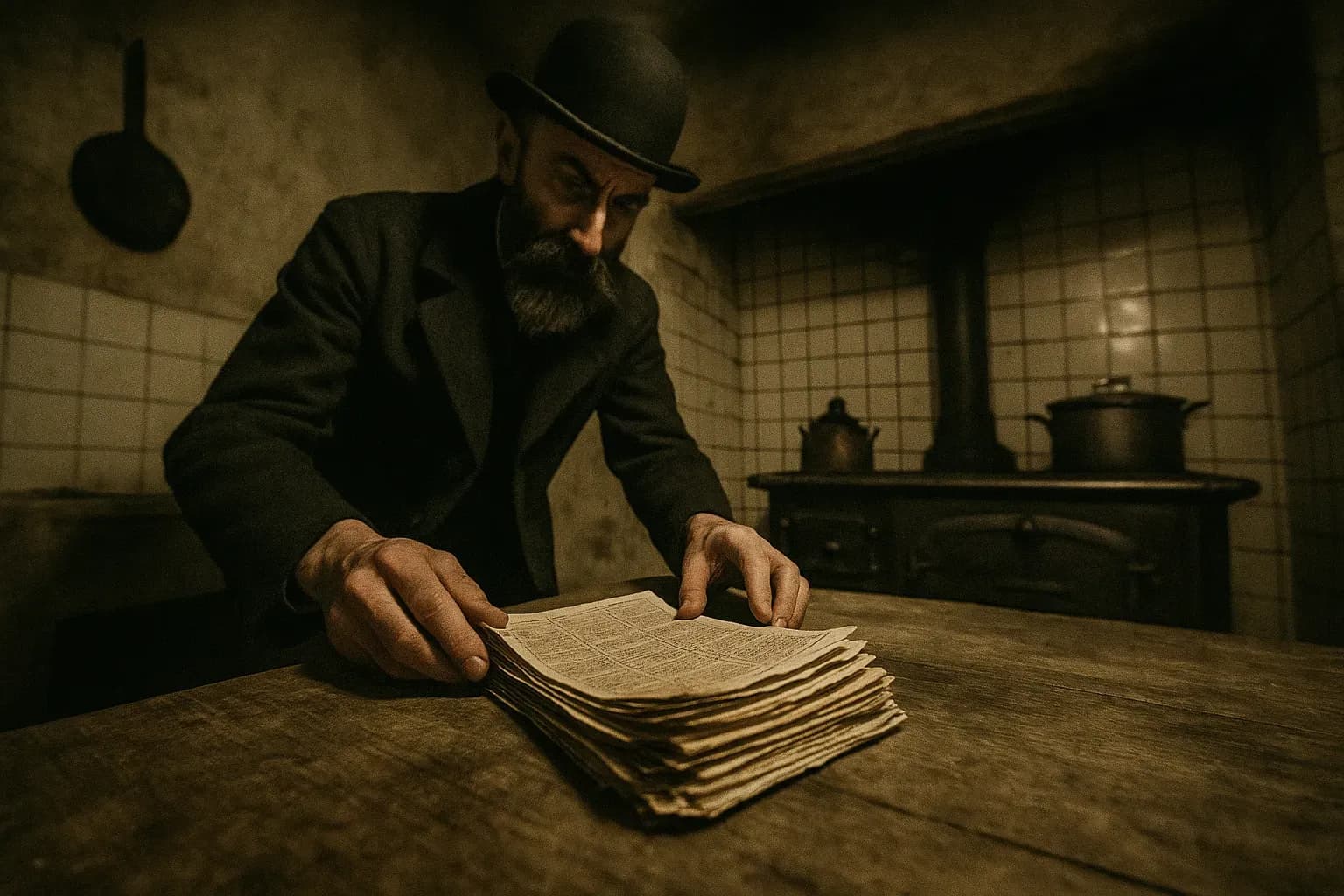
What made Landru exceptionally dangerous was not violence, but calculation. He maintained meticulous notebooks categorizing his targets by wealth and potential. He purchased saws and coal methodically. He arranged train tickets with sinister precision: round-trip passes for himself, one-way tickets for his victims. These records—dry, administrative evidence of human trafficking and homicide—would ultimately damn him in court.
Landru burned the bodies in his stove, reducing evidence to ash and bone. Yet the notebooks remained, a serial killer's unwitting confession written in his own hand.
When the case reached trial in November 1921 at Versailles, it captivated France and international observers. The proceedings attracted celebrities including author Colette and entertainer Maurice Chevalier. Newspapers covered every detail of a trial unlike any before it—a methodical accounting of industrial-scale murder in peacetime.
The prosecution faced an unusual challenge: no bodies had been recovered. Murder convictions typically depended on cadavers, evidence of violence, forensic proof. Instead, the case rested on circumstantial evidence—the notebooks, the correspondence, the pattern of disappearances, the train tickets, the purchases of materials for body disposal. On 30 November 1921, the jury returned a guilty verdict on 11 murder charges by majority decision.
Landru maintained his innocence to the end. On 25 February 1922, he was executed by guillotine.
His case became legend. Criminologists studied how a man without visible brutality could orchestrate mass murder. Artists were transfixed: Charlie Chaplin later drew direct inspiration from Landru's crimes when creating the protagonist of his 1947 film *Monsieur Verdoux*, a darkly comedic portrait of a man who seduces and murders women for profit.
More than a century later, Henri Désiré Landru remains synonymous with a particular horror—the predator who hides in plain sight, who exploits loneliness and grief, who reduces human beings to entries in a ledger. The Bluebeard of Gambais did not need violence to be monstrous. Calculation alone was enough.
Sources - https://en.wikipedia.org/wiki/Henri_D%C3%A9sir%C3%A9_Landru
Ask about this case
Answers from KrimiNyt's coverage onlyFollow this case
Get an email when a new documentary, podcast or book about Landru: The Bluebeard Who Hunted War Widows appears, or when a verdict is reached.