The Spy Who Brought Down a Chancellor
How Günter Guillaume's infiltration of West Germany's government forced Willy Brandt to resign
Published June 6, 2025
Quick Facts
In April 1974, West German authorities arrested Günter Guillaume, an East German Stasi spy who had spent years embedded in the highest levels of Chancellor Willy Brandt's government. The scandal that followed would shake West Germany's political establishment and force Brandt's resignation just days later.
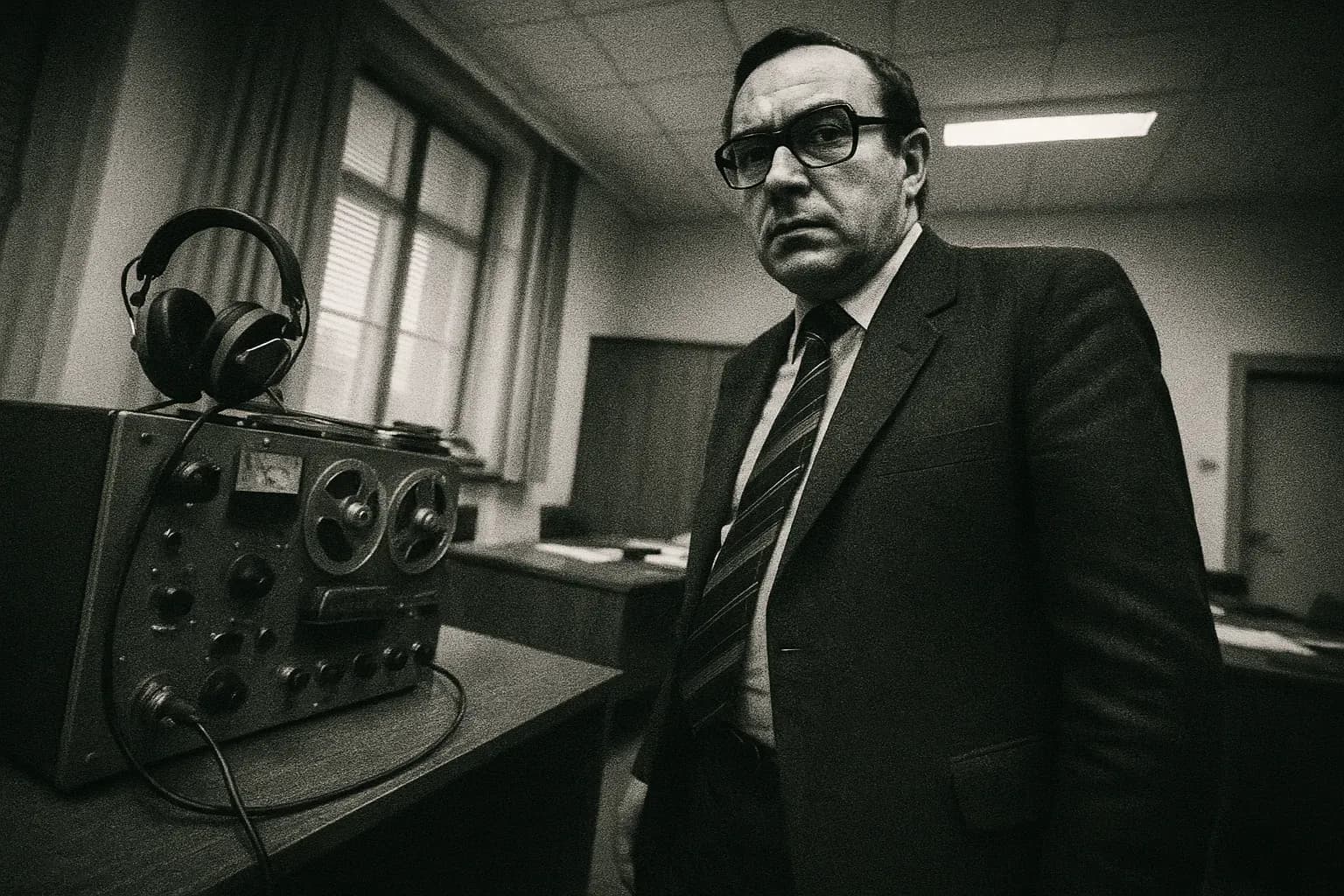
Guillaume and his wife Christel were no ordinary defectors. In 1956, they fled East Berlin with a carefully planned mission: to infiltrate West Germany's Social Democratic Party (SPD) on behalf of the Stasi, the East German secret police. Supervised by Markus Wolf, head of the Main Intelligence Administration (HVA), the Guillaumes were sleeper agents with a long-term objective.
For years, the operation worked flawlessly. Günter Guillaume rose through the ranks of the SPD, establishing himself as a trusted party functionary in Frankfurt. By 1969 or 1970, he had secured a position at the Federal Chancellery in Bonn—the very heart of West German government—as a desk officer handling trade union contacts. The real breakthrough came in 1972, when Guillaume was promoted to one of Chancellor Brandt's three personal assistants. In this role, he had direct access to classified files and attended confidential meetings at the highest levels of state.
Timeline
Günter and Christel Guillaume arrested in Bonn
On April 24, 1974, both spouses are arrested in Bonn, charged with espionage and high treason on behalf of East Germany's Stasi.
Chancellor Willy Brandt resigns
On May 7, 1974, two weeks after the arrests, Willy Brandt announces his resignation as Federal Chancellor as a direct consequence of the Guillaume scandal.
Guillaume spouses exchanged in spy swap
In 1981, Günter and Christel Guillaume are released and exchanged in an East-West spy swap; none of their convictions are overturned as a result.
Unbeknownst to Guillaume, however, West German security services had begun to suspect him. The Office for the Protection of the Constitution (BfV) and the Federal Intelligence Service (BND) grew suspicious after deciphering East German radio messages and analyzing patterns from previous espionage cases. By 1973, their doubts had solidified into serious concern.
In late May 1973, Interior Minister Hans-Dietrich Genscher informed Chancellor Brandt of the suspicions surrounding Guillaume. The implications were staggering—a Soviet-aligned spy with intimate knowledge of government secrets was still operating within the Chancellery. Yet remarkably, Brandt continued to work directly with Guillaume. In July 1973, just two months after being alerted, the Chancellor even took Guillaume on a vacation to Norway.
The investigation intensified over the following months. On 24 April 1974, authorities finally moved. Günter and Christel Guillaume were arrested in Bonn simultaneously, ending years of espionage that should never have continued once discovered.
But the damage to West Germany's political leadership was already done. Just twelve days after Guillaume's arrest, on 6 May 1974, Chancellor Willy Brandt resigned from his position. The 60-year-old leader, who had pursued détente with the Soviet bloc and was generally sympathetic to Soviet interests, took personal responsibility for what he called his "negligence" in the affair. By stepping down, Brandt hoped to avoid the vulnerability of being "blackmailable" by East Germany—a concern that must have weighed heavily after months of knowing a Stasi agent occupied his inner circle.
Brandt's resignation was a seismic political event in West Germany, though he remained chairman of the SPD until 1987. The Guillaume Affair, as it became known, exposed a critical security failure at the highest levels of government and raised uncomfortable questions about how a foreign intelligence service had successfully planted an agent so close to the center of power.
Interestingly, Soviet intelligence—the KGB—learned of Guillaume's exposure and reportedly ordered his extraction to protect Brandt, according to later accounts by Vasili Mitrokhin. Even the Russians valued their relationship with the West German Chancellor enough to try to shield him from further embarrassment.
The case remains one of the Cold War's most striking examples of how a single spy, given access and time, could destabilize an entire government.
Sources
https://en.wikipedia.org/wiki/Guillaume_affair https://research.blogs.bbk.ac.uk/2013/02/15/186/ https://www.bundesarchiv.de/themen-entdecken/online-entdecken/geschichtsgalerien/guenter-guillaume-der-spion-den-niemand-stoppte/ https://www.zeitklicks.de/zeitstrahl/1974/guillaume-affaere-spionage-im-bundeskanzleramt
Ask about this case
Answers from KrimiNyt's coverage onlyFollow this case
Get an email when a new documentary, podcast or book about The Spy Who Brought Down a Chancellor appears, or when a verdict is reached.