The 1MDB Scandal: How Malaysia Lost $4.5 Billion
Inside the world's largest sovereign wealth fund theft—and the powerful figures who orchestrated it
Published June 6, 2025
Classification:
Quick Facts
In 2009, Malaysian Prime Minister Najib Razak established 1Malaysia Development Berhad (1MDB) with noble intentions: a sovereign wealth fund designed to drive economic development, attract foreign investment, and improve the lives of ordinary Malaysians. Within six years, it had become a vehicle for one of history's largest embezzlement schemes.
Between 2009 and 2015, high-level 1MDB officials, government associates, and financier Low Taek Jho—known as Jho Low—systematically misappropriated over $4.5 billion. The stolen funds flowed through international money laundering networks spanning the United States, Switzerland, Singapore, and Luxembourg, eventually funding a lifestyle of jaw-dropping excess.
The Masterminds
Timeline
1MDB fund established in Malaysia
Malaysia's state investment fund 1Malaysia Development Berhad (1MDB) is established in 2009 with the aim of attracting foreign investment.
Scandal becomes publicly known
In 2015, investigative media and authorities begin mapping suspicious money flows from 1MDB, and the case breaks through to the public.
US indicts Jho Low and Roger Ng
The US Department of Justice brings an indictment against Low Taek Jho (Jho Low) and former Goldman Sachs banker Ng Chong Hwa (Roger Ng) for, among other things, money laundering and conspiracy.
Najib Razak found guilty in Malaysia's High Court
On 28 July 2020, Malaysia's High Court finds former Prime Minister Najib Razak guilty on 7 charges and sentences him to 12 years in prison and a fine of RM 210 million.
Malaysia's Federal Court upholds Najib's sentence
On 23 August 2022, Malaysia's highest court, the Federal Court, confirms the verdict against Najib Razak in full – the 12-year prison sentence and fine are upheld.
At the center of the conspiracy sat Jho Low, a financier who orchestrated the movement of vast sums through offshore shell companies. Goldman Sachs managing directors Tim Leissner and Roger Ng facilitated the scheme by overseeing 1MDB bond transactions that funneled money into the hands of conspirators. Leissner was later described as a co-mastermind alongside Jho Low; Ng would eventually be convicted in the United States.
But the scandal's most explosive revelation involved Najib Razak himself. In 2015, leaked documents published by *The Edge*, *Sarawak Report*, and *The Wall Street Journal* exposed that over RM2.67 billion—approximately $700 million—had been channeled into Najib's personal bank accounts. The Prime Minister who created the fund had become its primary beneficiary.
A Lifestyle of Excess
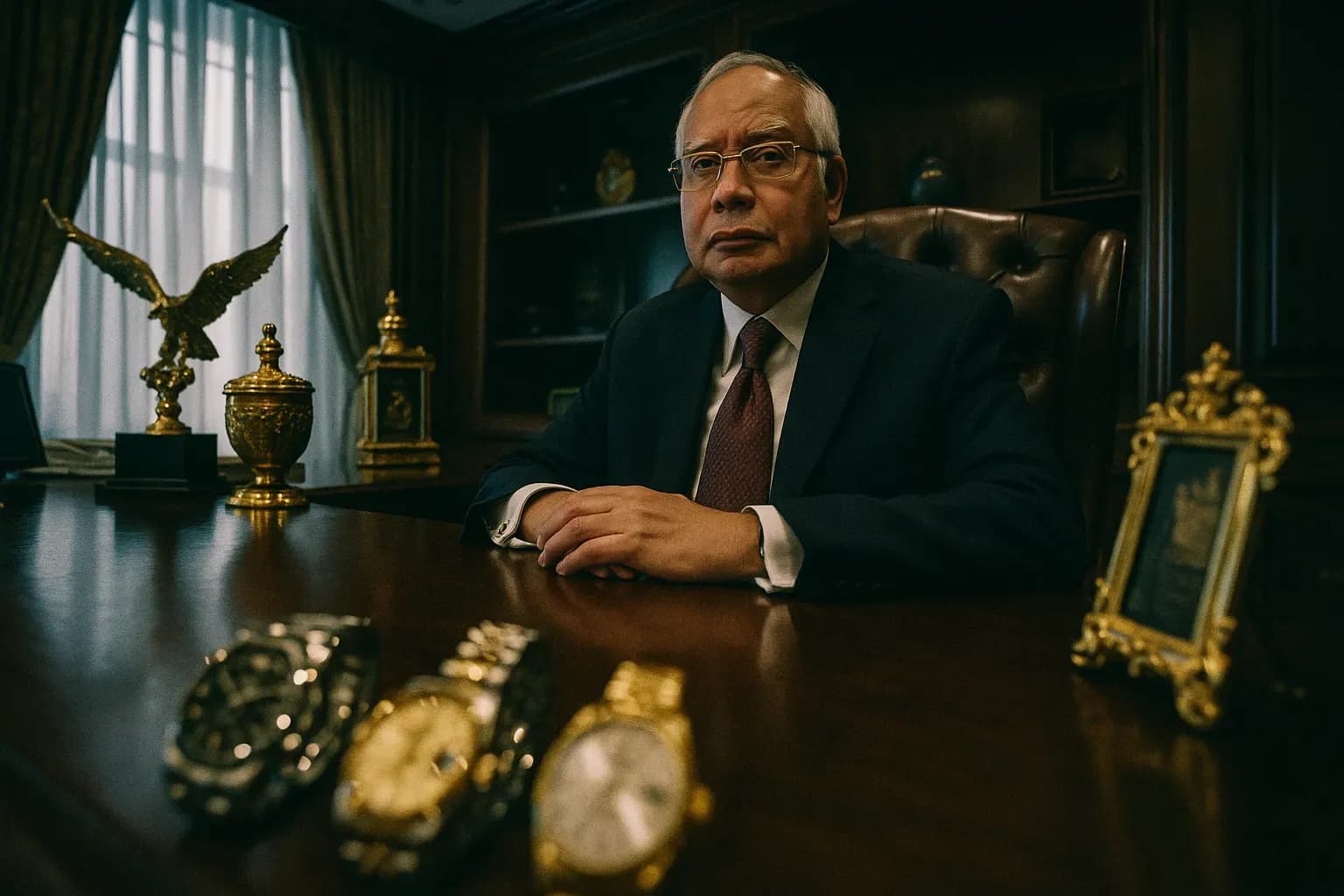
What did $4.5 billion buy? Investigators uncovered a shopping spree that read like a fantasy. Conspirators purchased luxury properties in Beverly Hills, New York, and London. They acquired a 300-foot superyacht. Art collections featuring works by Monet and Van Gogh decorated their homes. The stolen wealth became visible in the most conspicuous ways possible—a brazen display that ultimately helped expose the crime.
The Reckoning
The 2015 leaks triggered investigations across multiple countries. In Malaysia, Najib Razak was prosecuted for corruption and money laundering. His conviction came in 2020, with an initial sentence of 12 years (later reduced). His wife, Rosmah Mansor, faced her own legal battles. In September 2022, she was convicted on three counts of corruption related to a solar energy project, sentenced to 10 years in prison and fined RM970 million.
In the United States, Roger Ng's trial concluded on April 8, 2022, with a guilty verdict on charges including bribery of Malaysian and UAE officials, conspiracy, and violations of accounting controls. He received a 10-year sentence. Tim Leissner faced criminal prosecution for his role in the scheme.
The international nature of the crime also meant coordinated efforts to recover stolen assets. The U.S. Department of Justice eventually repatriated $1.2 billion in misappropriated 1MDB funds back to Malaysia—a partial but significant recovery of what was lost.
What It Reveals
The 1MDB scandal exposed vulnerabilities in global financial systems. A sovereign wealth fund meant to serve a nation's interests became a personal piggy bank for the powerful. International banks facilitated the crime. Shell companies obscured the money trail. And for years, the theft continued undetected at the highest levels of government.
Today, the 1MDB case stands as a stark reminder of how corruption operates at scale—with complicity from global financial institutions, the ability to hide stolen billions across borders, and consequences that, while significant, came only after billions had already vanished.
Sources
https://www.justice.gov/archives/opa/pr/justice-department-repatriates-14b-misappropriated-1mdb-funds-malaysia
https://www.britannica.com/event/1Malaysia-Development-Berhad-scandal
https://en.wikipedia.org/wiki/1MDB_scandal
https://www.acams.org/en/opinion/the-aftermath-of-the-1mdb-scandal
https://corpgov.law.harvard.edu/2019/05/14/goldman-sachs-and-the-1mdb-scandal/
Media coverage
TV series
- Man on the Run(2026)
Ask about this case
Answers from KrimiNyt's coverage onlyFollow this case
Get an email when a new documentary, podcast or book about The 1MDB Scandal: How Malaysia Lost $4.5 Billion appears, or when a verdict is reached.