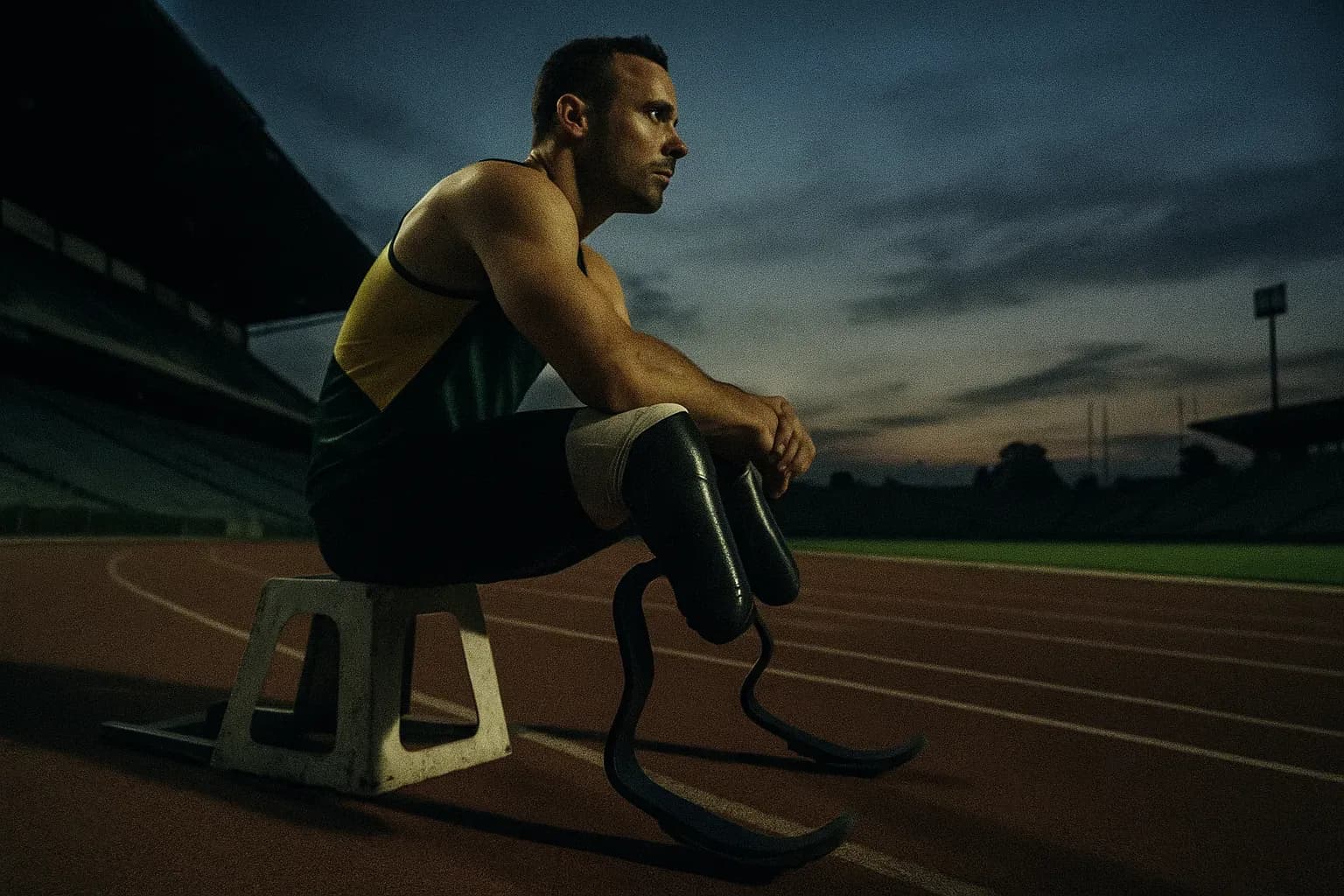
The Life and Trials of Oscar Pistorius
Viaplay, 2020 — the rise, fall and conviction of Paralympic icon Oscar Pistorius
What Is the Series About?
The Life and Trials of Oscar Pistorius is a documentary series available on Viaplay that chronicles one of the most publicised criminal cases in South African — and global — history. The series examines the full arc of Oscar Pistorius's life: his remarkable rise as a double-amputee sprinter who competed at both the Paralympic and Olympic Games, the shooting death of his girlfriend Reeva Steenkamp on Valentine's Day 2013, and the lengthy legal proceedings that ultimately resulted in a murder conviction. Drawing on extensive archive footage, courtroom recordings and interviews, the series attempts to situate the crime within the broader context of Pistorius's biography and South Africa's fraught relationship with crime, celebrity and the justice system.
The Case
In the early hours of 14 February 2013, Oscar Pistorius shot Reeva Steenkamp four times through a locked toilet door inside his home in the Silver Woods Estate, a gated community in Pretoria, South Africa. Steenkamp, a 29-year-old model and law graduate, was killed almost instantly. Pistorius called emergency services and was arrested later that morning.
Pistorius maintained from the outset that he had believed Steenkamp was an intruder hiding in the bathroom. He said he had woken in the night, heard a noise from the toilet cubicle, retrieved his licensed 9mm pistol and fired before realising his mistake. Prosecutors, led by advocate Gerrie Nel, argued that the shooting followed an argument between the couple and that Pistorius had fired knowing Steenkamp was behind the door.
The trial, which opened on 3 March 2014 at the North Gauteng High Court before Judge Thokozile Masipa, was broadcast live internationally — an unusual step in South Africa — and attracted a television audience comparable to major sporting events. Evidence presented during the months-long hearing included forensic reconstruction of the shooting, testimonies about the couple's relationship, and Pistorius's own emotional time on the stand.
On 12 September 2014, Judge Masipa found Pistorius not guilty of murder but convicted him of culpable homicide — broadly equivalent to manslaughter. The verdict was met with fierce criticism from legal scholars who argued Masipa had misapplied the doctrine of dolus eventualis, which holds that a person can be guilty of murder if they foresaw the possibility that their actions could cause death and proceeded regardless.
The National Prosecuting Authority appealed the verdict. On 3 December 2015, the Supreme Court of Appeal agreed with the prosecution, set aside the culpable homicide conviction and substituted a conviction for murder. The case was referred back to Judge Masipa for sentencing. In July 2016 she imposed a six-year prison term — again prompting widespread criticism as far below the minimum prescribed sentence of 15 years. The prosecution appealed once more, and in November 2017 the Supreme Court of Appeal increased the sentence to 13 years and 5 months.
Production
The four-part series was produced for and released on Viaplay in 2020. The production draws heavily on the unusually rich archive of recorded material available in this case: because cameras were permitted inside the courtroom throughout the 2014 trial, the series is able to incorporate direct footage of legal proceedings — Pistorius's testimony, cross-examination by Gerrie Nel, and the delivery of the verdict — in a way that few documentary productions can. This gives the series a visceral quality, allowing viewers to observe courtroom dynamics in real time rather than through reconstruction.
The series is structured both chronologically and thematically, moving between Pistorius's childhood in Pretoria, his athletic career and his emergence as a global symbol of human determination, before pivoting to the events of Valentine's Day 2013 and their aftermath. The director of the series has not been widely credited in available sources.
Reception
The series arrived in 2020 as public appetite for true crime documentary content was at a peak, and Viaplay positioned it as one of its flagship factual offerings for the year. Audience reception was generally positive among viewers already familiar with the case, who appreciated the depth of courtroom footage and the careful sequencing of a legally complex saga. Critics noted that the series benefits from arguably the most extensively documented criminal trial in South African history, giving it source material that comparable productions about other cases cannot match.
However, some reviewers and commentators raised ethical questions that have attended all media coverage of this case: whether the intense international focus on Pistorius's celebrity and athletic achievements has at times overshadowed the story of Reeva Steenkamp as an individual. Steenkamp's mother, June Steenkamp, has been vocal over the years about the need for her daughter to be remembered as more than a footnote to a famous man's downfall. An IMDb rating for the series was not available at the time of publication.
The series is one of several documentary productions to cover the case. A separate Netflix production, Pistorius, was released in 2018, meaning that by 2020 audiences had more than one long-form documentary treatment to choose from. This context shaped how The Life and Trials of Oscar Pistorius was received: Viaplay's version was seen by some critics as more comprehensive and more willing to linger on the courtroom process, while others felt the essential story had already been told.
The Case Today
Oscar Pistorius has been imprisoned at Atteridgeville Correctional Centre in Pretoria. In January 2024, after serving more than half of his 13-year-and-5-month sentence and following an earlier failed parole bid, Pistorius was granted parole by South Africa's Minister of Justice and Correctional Services. He was released on parole in January 2024 under conditions that include restrictions on his movements and public conduct. The decision was met with mixed reactions: Steenkamp's family expressed pain at his release, while others noted that Pistorius had by then served a substantial portion of his sentence under the applicable legal framework.
Reeva Steenkamp is remembered through the Reeva Rebecca Steenkamp Foundation, established by her mother June Steenkamp to work on issues of gender-based violence in South Africa — a country with one of the world's highest rates of femicide. The foundation has used the visibility brought by the case to advocate for legislative and cultural change.
The legal saga around the Pistorius case remains one of the most studied in South African jurisprudence, cited in ongoing debates about the application of dolus eventualis, the role of judicial discretion in sentencing, and the adequacy of minimum sentencing legislation in cases of gender-based violence. The case also sparked lasting discussion about whether the live broadcast of criminal trials serves the public interest or risks transforming justice into spectacle.