Reasonable Doubt: A Tale of Two Kidnappings
Netflix, 2021 — four wrongfully convicted men, a fender bender, and Mexico's broken justice system
Quick facts
What Is the Series About?
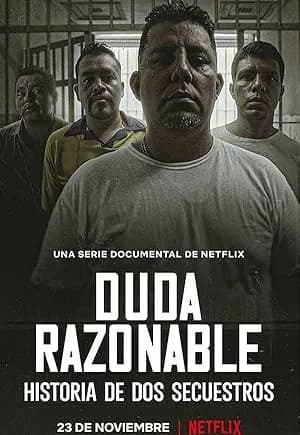
*Reasonable Doubt: A Tale of Two Kidnappings* is a four-part Netflix docuseries about one of the most troubling wrongful conviction cases in recent Mexican legal history: four men sentenced to 50 years in prison for a kidnapping that allegedly grew out of a minor traffic collision in Tabasco, Mexico, in 2015. Directed and created by Roberto Hernández, the series — originally titled Duda Razonable: Historia de dos secuestros — premiered on 23 November 2021 and uses the Tabasco case as a lens through which to examine systemic failures in Mexico's criminal justice system: coerced confessions, uncorroborated testimony, and a presumption of guilt that replaced any presumption of innocence.
The title's reference to "two kidnappings" is itself a pointed editorial claim: the series argues that the state, in convicting these men on weak evidence, committed its own form of abduction.
---
The Case
The facts, as reconstructed by Hernández and later confirmed in part by the Mexican Supreme Court, begin with a mundane event: a fender bender on a road in Tabasco in 2015. What followed was anything but mundane. One man involved in the collision was accused of kidnapping. Three more men — none of whom knew him or each other — were subsequently swept up in the same prosecution. All four were tried, convicted, and sentenced to 50 years in prison.
The four convicted men are:
- Héctor Muñoz Muñoz
- Gonzalo García Hernández
- Juan Luis López García
- Darwin Morales Ortiz
According to Mexico News Daily's reporting on the series, the men were strangers to one another at the time of their arrests — a fact that, critics argued, should have raised immediate questions about the prosecution's theory of the crime. Instead, all four were convicted on the basis of victim testimony that later proved inconsistent, with little corroborating physical or forensic evidence presented at trial.
The World Justice Project, which collaborated with Hernández on research connected to the series, described the prosecution as one in which the court "presumed them guilty" rather than applying the standard of innocence until proof of guilt. Their analysis highlighted the high human cost of incomplete justice and the way systemic failures compounded at every stage of the legal process.
During his investigation, Hernández interviewed hundreds of prison inmates across Mexico. Many described patterns of abuse during interrogation, including beatings, cigarette burns, waterboarding, suffocation, and electric shock — a broader context of coercion within which the Tabasco case, the series argues, must be understood.
Of the four men, Darwin Morales Ortiz was reportedly released earlier than the others, though according to available reporting he received no compensation for his detention. The remaining three — Muñoz Muñoz, García Hernández, and López García — remained imprisoned until December 2022.
---
Production
The series was written, created, and directed by Roberto Hernández, a Mexican filmmaker and researcher with a prior track record of investigative documentary work on the Mexican justice system. His previous documentary, Presumed Guilty (2010), had already drawn international attention to wrongful convictions in Mexico, and Reasonable Doubt represents a continuation of that mission.
Hernández's research methodology for this series was extensive. Beyond the four men at the center of the Tabasco case, he spent considerable time inside Mexican prisons, gathering testimony from a wide population of inmates about their experiences with the criminal justice system — particularly during arrest and interrogation. This broader canvas of testimony gives the series both its statistical weight and its emotional force.
The original Spanish title, Duda Razonable: Historia de dos secuestros, maps directly onto the English version, with the dual meaning of "two kidnappings" — the alleged crime and the state's response — intact in both languages. The series runs to four episodes and is available exclusively on Netflix.
According to reporting by Radio Times, the series was positioned by Netflix as a significant true-crime release for late 2021, premiering on 23 November of that year.
---
Reception
Decider reviewed the series on its premiere date, describing it as a sustained challenge to the legitimacy of the kidnapping allegations and a damning portrait of corruption within the Mexican justice system. The review praised Hernández's investigative rigor and his ability to build a coherent legal and human narrative from complex, fragmented source material.
The World Justice Project, which has closely followed both the series and the underlying case, described the documentary as capturing "the high human cost of incomplete justice" — language that reflects not only the specific suffering of the four convicted men but the broader implications for rule-of-law reform in Mexico.
The series carries the IMDb title ID tt15796900, though a verified aggregate score is not available from current sources.
The primary controversy surrounding the series is, appropriately, the case itself: the allegation that four men were imprisoned for 50 years on the basis of coerced or uncorroborated testimony, in a system structurally biased toward conviction. The documentary does not present this as a theory — it presents it as a documented reality, and the subsequent Supreme Court ruling gave that claim significant institutional validation.
---
The Case Today
The most significant development since the series' premiere came in December 2022, when the Supreme Court of Mexico ruled that Héctor Muñoz Muñoz, Gonzalo García Hernández, and Juan Luis López García had been unjustly convicted. The Court granted an amparo liso y llano — a direct constitutional protection — ordering their immediate release. The ruling found that the defendants' human rights had been violated and that the conviction rested on uncorroborated testimony.
The decision was widely reported in Mexico and internationally as a vindication of the documentary's central argument. El Financiero covered the ruling in detail, connecting it directly to the attention generated by Hernández's series.
Darwin Morales Ortiz, the fourth convicted man, had been released prior to the Supreme Court ruling, though reports indicate he received no financial compensation for the years he spent incarcerated.
As of the time of writing, questions of reparations and accountability for those responsible for the prosecution remain unresolved. The case has become a landmark reference point in Mexican debates about criminal justice reform, the treatment of suspects during interrogation, and the structural presumption of guilt that critics argue pervades the country's legal culture.