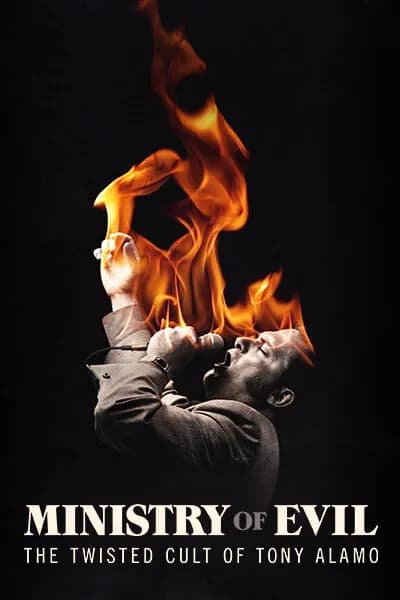
Ministry of Evil: The Twisted Cult of Tony Alamo
Viaplay · 2019 · Four-part docuseries on the Tony Alamo Christian Ministries abuse case
Quick facts
What Is the Series About?
Ministry of Evil: The Twisted Cult of Tony Alamo is a four-part documentary series that chronicles the decades-long rise and criminal fall of televangelist Tony Alamo and his Tony Alamo Christian Ministries. Released on February 27, 2019, the series is available on Viaplay, SundanceNow, Tubi, and Apple TV, and runs approximately 43 minutes per episode. Directed by Fenton Bailey and Randy Barbato — the production duo known for unflinching documentary work — the series uses archival footage, survivor testimony, and an exclusive deposition recording featuring Alamo himself to reconstruct one of the most disturbing cult-abuse cases in modern American history.
The BBC's programme listing frames the series as an investigation into "brainwashing, polygamy, necromancy" and shocking physical and sexual abuse, while The Guardian called it "an astonishing tale of brainwashing" — a description that captures both its emotional impact and its journalistic rigour.
The Case
Tony Alamo was born Bernard Karl Hoffman — also reported as Bernie LaZar Hoffman — and reinvented himself as a fire-and-brimstone televangelist in the late 1960s. In 1969 he and his wife Susan co-founded what would become the Tony Alamo Christian Foundation, a ministry that grew to include residential compounds, business enterprises, and a tight-knit congregation kept in line through extreme religious indoctrination and physical punishment.
Beneath the surface of the ministry's evangelical image lay a system of comprehensive coercive control. Former members have described children being subjected to brutal corporal punishment, members being forced into unpaid labour, and girls as young as eight years old being sexually abused by Alamo himself, who also engaged in polygamous "marriages" to underage girls sanctioned under his self-styled religious authority. The primary ministry compound was located in Texarkana, Arkansas, and victims were transported across multiple U.S. state lines — a critical factor that brought the case under federal jurisdiction.
Public scrutiny intensified significantly following a landmark Southern Poverty Law Center investigation that detailed the ministry's abuses and helped galvanise law enforcement attention. Federal investigators subsequently built a case against Alamo centred on the Mann Act and related child-sex-trafficking statutes. He was ultimately convicted on 10 federal counts related to transporting minors across state lines for sexual purposes and was sentenced to 175 years in federal prison in 2009.
Named plaintiffs in related civil proceedings, including Seth Calagna and Spencer Ondirsek in a beatings-related civil matter documented by the SPLC, represent only a portion of those who suffered under Alamo's authority. The criminal sex-crime prosecution involved multiple unnamed minor victims whose identities remain protected. Tony Alamo died in federal custody in 2017, having served less than a decade of his sentence.
Production
The series was directed by Fenton Bailey and Randy Barbato, the founders of World of Wonder Productions, a company with a long track record in documentary filmmaking. In a 2019 interview with Awards Daily, the directors discussed not only the mechanics of the Alamo case but also drew broader observations about the psychology of authoritarian religious movements.
A key asset of the production is an exclusive deposition recording of Tony Alamo himself, which gives viewers the rare and deeply unsettling opportunity to hear the perpetrator defend his actions and worldview in his own words. The series also draws on extensive archival footage from the ministry's own media output — Alamo was a prolific self-promoter who used television and print to spread his message — as well as interviews with former members who survived life inside the compound. This combination of first-person testimony and archival evidence gives the series a layered, prosecutorial quality that goes beyond surface-level true crime storytelling.
Each of the four episodes runs approximately 40 to 43 minutes, making the total runtime suitable for a single sitting or a short binge. The pacing reportedly moves from the ministry's charismatic origins through the escalating abuse, the investigations, the federal trial, and finally the aftermath for survivors.
Reception
Critical reception has been strongly positive. The Guardian's review praised the series as "an astonishing tale of brainwashing," highlighting the filmmakers' ability to make comprehensible how an entire community could be held captive by one man's religious megalomania for so many years. The BBC's programme description similarly underscores the series' willingness to engage with the most disturbing elements of the case without sensationalising them gratuitously.
SundanceNow, one of the series' distribution platforms, positioned the documentary as a deep dive into a cult that most viewers "have never heard of" — a framing that proved effective given the relative obscurity of the Alamo ministry compared to better-known cult cases. The availability of an exclusive Alamo deposition was cited as a particular draw for audiences interested in understanding the perpetrator's psychology.
An IMDb rating for the series was not available at the time of publication. The series carries the IMDb identifier tt8014800.
The Case Today
With Tony Alamo's death in federal custody in 2017, the criminal case itself is formally closed. However, the legal and human aftermath continues. Civil litigation brought by survivors has sought accountability from the ministry's remaining organisational structures and associated individuals, with the SPLC reporting on a multi-million-dollar civil judgment against entities connected to the Alamo organisation.
Former members continue to speak publicly about their experiences, and the docuseries has played a role in sustaining awareness of the case for audiences who were unaware of its scope. The ministry's compound and associated businesses have wound down, but questions about the long-term psychological impact on survivors — many of whom were raised from birth inside the organisation — remain deeply relevant.
For survivors and advocates, Ministry of Evil represents not just a true crime narrative but a documented record of institutional religious abuse that persisted for decades in plain sight, protected by claims of faith and First Amendment freedoms. The series stands as a sobering reminder of the human cost of unchecked authoritarian control exercised in the name of religion.