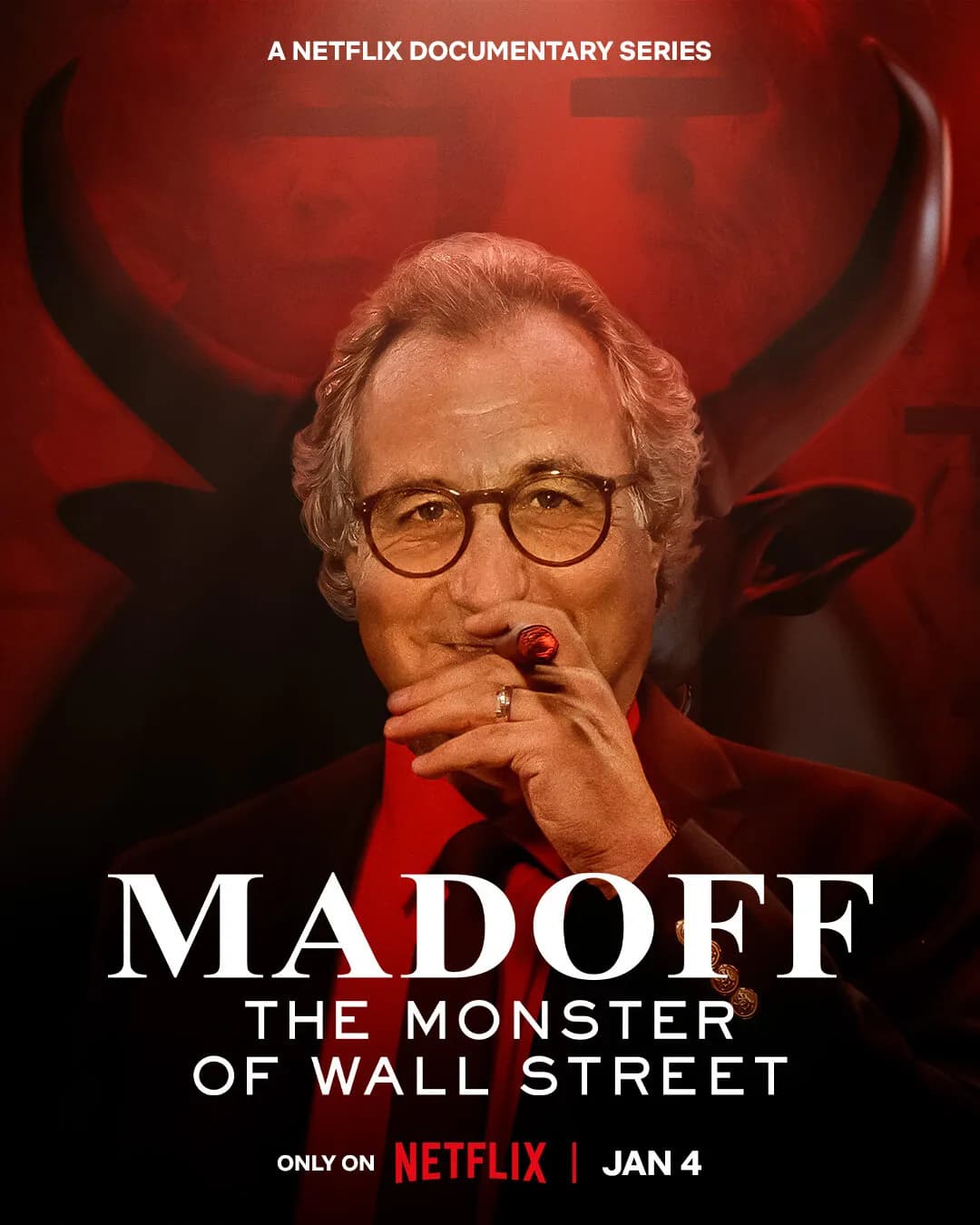
Madoff: The Monster of Wall Street
Netflix, 2023 — The rise and fall of history's most destructive Ponzi scheme
Quick facts
What Is the Series About?
Madoff: The Monster of Wall Street is a four-part Netflix documentary series directed by acclaimed true-crime filmmaker Joe Berlinger, released on January 4, 2023. The series examines one of the most catastrophic financial crimes in American history: the decades-long Ponzi scheme orchestrated by Bernard Lawrence "Bernie" Madoff, a former Nasdaq chairman and respected Wall Street figure who defrauded thousands of investors out of billions of dollars. Netflix describes the series as the definitive account of Madoff's "rise and fall" and of "one of the biggest Ponzi schemes in Wall Street history." Using never-before-seen deposition footage, interviews with whistleblowers, former employees, investigators, journalists, and victims, the series reconstructs how one man built — and sustained — a breathtaking financial lie for decades before it finally collapsed.
The Case
Bernie Madoff was, by all outward appearances, a titan of American finance. As founder of Bernard L. Madoff Investment Securities LLC and a former chairman of the Nasdaq stock exchange, he commanded enormous respect on Wall Street and in wealthy social circles. Behind that façade, however, Madoff was running the largest and most consequential Ponzi scheme in U.S. history — a fraud that flourished for decades by paying existing investors with money from new ones, with no legitimate investment activity generating returns.
The scheme collapsed dramatically in December 2008, when the global financial crisis triggered a wave of investor withdrawal requests that Madoff could not meet. He confessed to his sons, who immediately reported him to federal authorities. He was arrested days later. The Guardian described Madoff as a "financial serial killer," a framing that captures the series' argument: that this was not merely opportunistic theft but a systematic, predatory destruction of ordinary people's financial lives, carried out with cold calculation over many years.
The victims numbered in the thousands — individuals, families, charities, pension funds, and institutional investors who lost their savings and livelihoods. The documentary gives particular attention to those whose entire financial security was wiped out, illustrating the human cost behind the staggering headline figures.
In 2009, Madoff pleaded guilty to 11 federal felonies, including securities fraud, wire fraud, mail fraud, money laundering, and perjury. He was sentenced to 150 years in federal prison — the maximum available — by a U.S. district judge who called the fraud "extraordinarily evil." Madoff never walked free again. He died at the Butner Federal Medical Center in North Carolina on April 14, 2021, at age 82.
A central argument running through the series is that the fraud could — and should — have been stopped far earlier. Whistleblowers, most notably financial analyst Harry Markopolos, repeatedly raised red flags with regulators over many years, and the SEC failed to act. The documentary examines how Madoff's reputation and social capital insulated him from scrutiny, and how institutional failure on the part of regulators allowed the scheme to reach catastrophic scale.
Production
The series was directed by Joe Berlinger, one of America's most respected documentary filmmakers, known for his work on the Paradise Lost trilogy and the Ted Bundy tapes. Berlinger brings a structured, evidence-driven approach to the Madoff story, weaving together multiple layers of testimony and archival material.
A key element distinguishing this production from earlier Madoff coverage is its use of previously unseen deposition footage of Madoff himself, giving viewers a direct and unsettling window into how he explained — or deflected questions about — his actions. The series also draws heavily on Netflix's own promotional and research materials, and structures its four episodes to follow the arc from Madoff's early career through the mechanics of the fraud, the failure of oversight, the collapse, and the devastating aftermath for victims.
The four-episode format allows the series to move beyond the headline facts and explore the systemic conditions — on Wall Street, in regulatory culture, and in the psychology of trust — that made such a prolonged fraud possible.
Reception
Critical reception to the series was strongly positive. Rotten Tomatoes awarded Season 1 a 90% score, reflecting near-unanimous approval from critics. The Guardian's review called it "grubby and jaw-dropping from start to finish," praising its ability to sustain tension across a story whose ending is already well known.
The American Bar Association offered a measured but largely favorable assessment, calling the series a "compelling and largely accurate portrayal" of the Madoff scandal, while noting some caveats in how certain elements are framed. That kind of legal-community endorsement is relatively rare for true-crime documentary productions and speaks to the care Berlinger brought to the factual record.
Viewer reaction was similarly strong, with audiences responding to the series' combination of financial thriller pacing and genuine emotional weight. The use of first-person victim testimony and the deposition footage of Madoff himself were widely cited as particularly effective and disturbing elements.
The Case Today
Bernie Madoff died in federal custody in April 2021, meaning he faced no further legal proceedings. However, the consequences of his fraud continue to ripple through the financial system and the lives of his victims. The court-appointed trustee, Irving Picard, has spent years pursuing assets and clawbacks from those who withdrew money from the scheme — including investors who received fictitious profits — in an effort to return funds to verified victims. Billions of dollars have been recovered and distributed, though many victims received only a fraction of what they lost.
The Madoff case has also had lasting regulatory consequences, prompting reforms at the Securities and Exchange Commission and renewed debate about how financial fraud of this scale is detected and prosecuted. The series arrives as a document not only of one man's crimes but of a broader failure of financial oversight — a lesson that regulators, investors, and institutions continue to grapple with years after Madoff's death.