Last Take: Rust and the Story of Halyna
Disney+ / Hulu, 2025 — the fatal on-set shooting of cinematographer Halyna Hutchins
Quick facts
What Is the Series About?
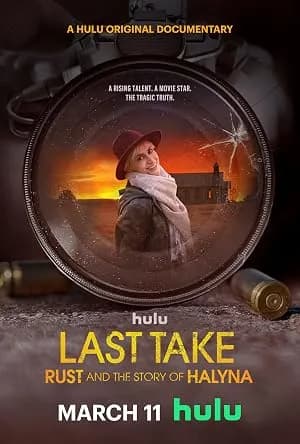
Last Take: Rust and the Story of Halyna is a 90-minute documentary film directed by Rachel Mason and released on Disney+ and Hulu on March 11, 2025. It examines one of the most shocking on-set tragedies in Hollywood history: the fatal shooting of cinematographer Halyna Hutchins on October 21, 2021, during the production of the Western film Rust at Bonanza City, New Mexico. Rather than a simple reconstruction of events, the film grapples with a harder question — how collective negligence on a film set can lead to irreversible catastrophe, and who ultimately bears responsibility when a system fails.
The documentary is not a multi-episode series. It is listed on Disney+ as a single feature-length film of approximately one hour and thirty minutes, making it a tightly focused portrait of both a tragedy and the woman at its center.
The Case
On the morning of October 21, 2021, the cast and crew of Rust had gathered at the Bonanza Creek Ranch outside Santa Fe, New Mexico for a rehearsal. Actor and producer Alec Baldwin was handed a Colt .45 revolver by first assistant director Dave Halls. The gun had been described as cold — industry shorthand for unloaded and safe. It was not. When Baldwin pointed the weapon toward the camera and the gun discharged, the live round struck director of photography Halyna Hutchins in the chest and passed through to wound director Joel Souza in the shoulder. Hutchins, 42, was airlifted to the University of New Mexico Hospital, where she was pronounced dead. Souza survived.
The immediate question was how a live round came to be inside a prop weapon on a regulated film set. Investigators focused on two key figures: Hannah Gutierrez-Reed, the production's armorer responsible for all firearms safety, and Dave Halls, the first assistant director who had checked and handed off the gun. Gutierrez-Reed was accused of failing to properly inspect and secure ammunition, while Halls accepted a plea deal, admitting negligent use of a deadly weapon.
In April 2024, Hannah Gutierrez-Reed was convicted of involuntary manslaughter and sentenced to 18 months in a New Mexico state prison. As of the documentary's release, she remains the only person incarcerated in connection with the shooting. Alec Baldwin, who faced his own involuntary manslaughter charges as both the person holding the gun and a producer of the film, saw his case collapse in the summer of 2024 when a judge dismissed all criminal charges after prosecutors were found to have improperly withheld evidence. Baldwin was exonerated of criminal liability, though a civil deposition connected to a lawsuit brought by Hutchins' family had already entered the public record by the time the documentary was released.
Production
Director Rachel Mason brings a humanizing lens to what had been, for years, primarily a legal story. The documentary takes its title literally — the last take, the final moment before everything changed — while centering Halyna Hutchins not as a victim defined solely by her death, but as a cinematographer of remarkable ambition and talent.
According to reporting on the documentary, the film features on-camera conversations with Joel Souza, the director wounded in the shooting, Dave Halls, the first assistant director who handed Baldwin the gun, members of Hutchins' camera crew, law enforcement officials who worked the case, and Kari Morrissey, the special prosecutor who led the criminal investigation. The combination of insider access and legal expertise gives the documentary a credibility that distinguishes it from more sensationalist treatments of the case.
The filmmakers also draw on Hutchins' own creative work and personal archive to reconstruct who she was — a Ukrainian-born cinematographer who had trained in Kyiv, worked her way through the independent film world, and had only recently begun earning the recognition her peers believed she deserved.
Reception
The documentary arrived on Hulu and Disney+ on March 11, 2025, and audience interest was immediate. According to IMDb news coverage, the film quickly reached number one on Hulu's streaming charts, suggesting that public appetite for a definitive account of the Rust tragedy had not diminished in the years since the shooting.
Critical reception was generally favorable, with a Rotten Tomatoes score of 86% and a Metacritic score of 70/100, indicating that reviewers found the film to be a competent and emotionally resonant account of events that had already been extensively covered. The IMDb user rating stands at 6.8/10, reflecting a slightly more divided audience response — not unusual for a documentary about a case in which public opinion on the central figures, particularly Alec Baldwin, remains sharply polarized.
USA Today framed the film's central tension as a blame-distribution problem: in an industry where responsibility for set safety is diffused across multiple departments and roles, the documentary asks whether the criminal system's focus on individual defendants adequately accounts for the broader culture of cost-cutting and safety shortcuts that characterized the Rust production.
The Case Today
As of the documentary's March 2025 release, the legal chapter of the Rust shooting is largely closed. Hannah Gutierrez-Reed is serving her 18-month sentence. Alec Baldwin's criminal case was dismissed with prejudice, meaning he cannot be recharged. Dave Halls fulfilled the terms of his plea agreement. The civil lawsuit brought by Hutchins' family was settled out of court.
What remains open is the cultural and industrial reckoning. The Rust shooting accelerated ongoing conversations about the use of live ammunition on film sets, the qualifications and working conditions of armorers, and the responsibilities of actor-producers who hold significant creative and financial control over productions. Several states and industry guilds have since tightened safety protocols, though advocates for Hutchins' legacy have argued that the changes do not go far enough.
For Halyna Hutchins' family, colleagues, and the wider cinematography community, Last Take represents something beyond a legal postmortem. It is an attempt to restore the full dimensions of a life that was reduced, in most of the coverage that followed her death, to the circumstances of her killing.