Kickback
Amazon Prime Video, 2022 — documenting decades of systemic corruption inside FIFA
Quick facts
What is the series about?
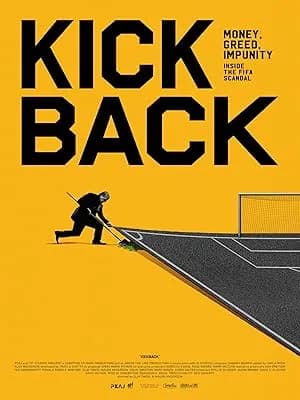
Kickback is a 2022 British documentary feature directed by Clay Tweel and Maura Anderson, available on Amazon Prime Video. Unlike most true-crime documentaries that focus on a single murder or one discrete criminal case, Kickback takes on an entire institution: FIFA, the governing body of world football. At its core, the film chronicles the remarkable decades-long investigative career of British journalist Andrew Jennings, whose relentless digging exposed a culture of bribery, embezzlement, and abuse of power that ran from the top of FIFA all the way through its regional confederations and commercial partners.
The documentary arrives at a politically charged moment, released on October 18, 2022 — just weeks before the opening of the FIFA World Cup in Qatar, a tournament that was itself mired in allegations about how hosting rights were awarded and the human cost of construction in the Gulf state. That timing was no accident. Tweel and Anderson frame the film as an urgent reckoning: how did a global institution entrusted with the world's most popular sport become so comprehensively corrupt, and why did it take so long for the world to listen to the reporters who saw it first?
The Case
The "case" at the heart of Kickback is not a single indictment but a systemic failure stretching across several decades. FIFA, headquartered in Zurich, Switzerland, is responsible for organizing the World Cup — the planet's most-watched sporting event — and for distributing billions of dollars in broadcasting and sponsorship revenue. According to the film, that financial power created an environment where senior officials treated the organization as a private treasury, accepting bribes in exchange for World Cup hosting votes, selling broadcasting rights through corrupt intermediaries, and shielding wrongdoers behind a culture of secrecy and institutional loyalty.
Andrew Jennings, a veteran of investigative journalism whose career pre-dates his FIFA work, spent years being dismissed, ridiculed, and stonewalled by the football establishment. Kickback traces how he built his case through interviews, leaked documents, and the painstaking cultivation of sources inside an organization that was deeply hostile to outside scrutiny. His books and television reports — produced long before the rest of the world caught up — are now recognized as foundational to the eventual prosecutions.
The legal reckoning Jennings' work helped precipitate came dramatically on May 27, 2015, when Swiss police arrested multiple senior FIFA officials at the Baur au Lac hotel in Zurich at the request of the United States Department of Justice. The U.S. prosecution, led by the Eastern District of New York, ultimately charged dozens of football officials and sports marketing executives with racketeering conspiracy, wire fraud, and money laundering, alleging more than $150 million in bribes and kickbacks. Because Kickback focuses on the systemic and investigative dimensions of the scandal rather than the courtroom proceedings of any one defendant, the film does not reduce the story to a single perpetrator or a single sentence — the corruption it describes was, by design, collective and institutional.
The documentary also connects the FIFA corruption story to the human-rights dimension of the 2022 Qatar World Cup, situating the bribery and vote-manipulation allegations within the broader question of what happens when powerful institutions operate without accountability.
Production
Kickback was produced by Campfire Studios and directed by the team of Clay Tweel and Maura Anderson. Tweel is an experienced documentary filmmaker whose previous work includes Gleason (2016) and Fyre Fraud (2019) — the latter also an examination of institutional deception and the abuse of trust, suggesting a deliberate thematic continuity in his output. Anderson brings her own documentary background to the collaboration.
The filmmakers were granted access to Andrew Jennings himself, who provides the film's investigative backbone through interviews and the sharing of archival material, including footage and documents that had not previously been seen publicly. The use of unseen material is a significant part of the film's appeal: it offers audiences a look behind the curtain of both the corruption and the journalism that exposed it, showing the human cost of speaking truth to a powerful and well-resourced institution that fought back.
The runtime of 1 hour and 36 minutes positions Kickback firmly as a feature documentary rather than a multi-episode series, a structural choice that gives the film a concentrated, argument-driven energy. Rather than spending multiple episodes on character backgrounds and dramatic reconstructions, Tweel and Anderson keep the focus on the investigative narrative and its political implications, trusting the material — and Jennings' extraordinary story — to carry the audience.
Reception
On IMDb, Kickback holds a rating of 7.4 out of 10, reflecting a broadly positive audience response. Viewer commentary on platforms including Letterboxd characterizes the film as a compelling and well-constructed account of FIFA's malpractice, with particular praise directed at the focus on Jennings as a central character — a real journalist whose vindication gives the film a satisfying, if sobering, narrative arc.
The film's release in October 2022, timed to precede the Qatar World Cup, ensured that it entered a public conversation already primed for scrutiny of FIFA. Critics and audiences who engaged with the documentary did so against a backdrop of daily news coverage about Qatar's labor conditions, the legitimacy of the hosting vote, and the ongoing legal fallout from the 2015 U.S. indictments. That context almost certainly amplified the film's reach and impact beyond what it might have achieved in a less politically charged moment.
The subject matter itself carries inherent controversy: FIFA is a body that commands fierce loyalty from billions of football fans worldwide, and a documentary that portrays it as institutionally corrupt is guaranteed to provoke strong reactions on both sides. The 7.4 IMDb rating suggests that, for most viewers who engaged with the film, the evidence presented was persuasive and the filmmaking was effective.
The Case Today
The FIFA corruption scandal did not end with the 2015 arrests or with the release of Kickback. U.S. federal prosecutions continued for years after the initial Zurich arrests, with guilty pleas and convictions accumulating steadily through the late 2010s and into the 2020s. Sepp Blatter, the FIFA president whose tenure dominated much of the period covered by the documentary, was banned from football by FIFA's own ethics committee and faced separate Swiss criminal proceedings, though he was acquitted of fraud charges in 2022 — a verdict that itself generated substantial controversy.
The 2022 Qatar World Cup, which frames the documentary's release, went ahead despite sustained international criticism. Investigations into the human-rights record associated with the tournament's construction and the circumstances of Qatar's hosting bid continued to generate reporting and legal scrutiny well into 2023 and beyond.
Andrew Jennings, whose life's work is celebrated in Kickback, spent decades being told he was wrong, obsessive, or simply inconvenient. The documentary serves, among other things, as a formal record of his vindication — and as a reminder that institutional corruption rarely collapses on its own. It takes someone willing to keep asking the questions no one wants answered.