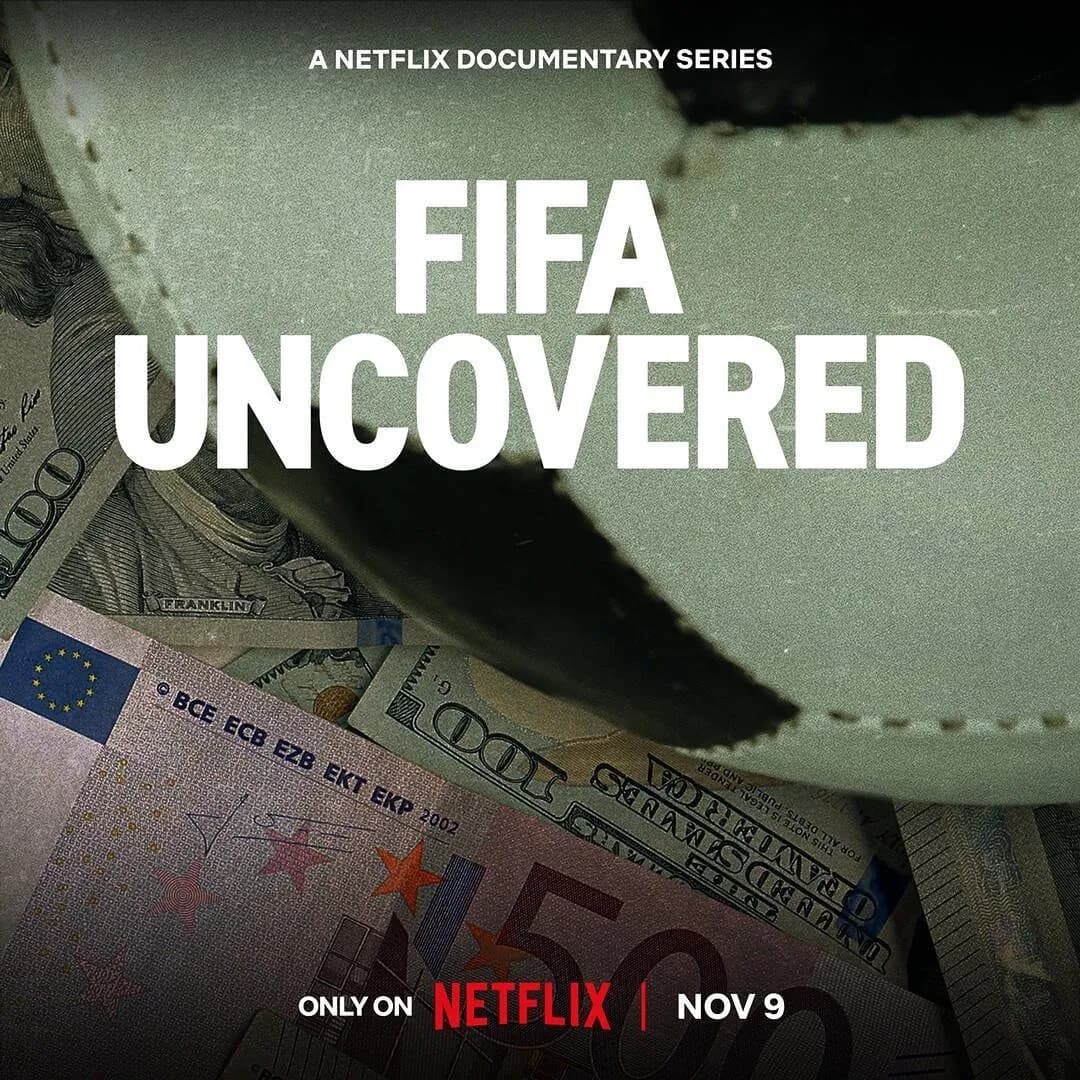
FIFA Uncovered
Netflix, 2022 — the four-part docuseries exposing decades of corruption inside world football's governing body
Quick facts
What Is the Series About?
FIFA Uncovered is a Netflix documentary series that investigates the sprawling, decades-long corruption scandal inside FIFA — world football's governing body. Released on November 9, 2022, and directed by Daniel Gordon, the four-part series traces how bribery, racketeering, wire fraud, tax evasion, and money laundering became embedded in FIFA's institutional culture, from the presidency of João Havelange in the 1970s through the Sepp Blatter era and into the explosive 2015 U.S. criminal investigation that sent shockwaves through the global football world. Arriving just days before the opening of the deeply controversial 2022 FIFA World Cup in Qatar, the series carried enormous immediate relevance.
This is not a victim-centered true crime documentary in the traditional sense — there is no single murder or missing person at its core. Instead, the "crime" is systemic and institutional: the abuse of FIFA's governance structures to funnel bribes, manipulate World Cup hosting votes, and enrich a network of officials and sports-marketing executives over multiple generations.
The Case
The corruption at the heart of FIFA Uncovered had been an open secret in football circles for years, but it took the United States Department of Justice to bring formal criminal accountability. On May 27, 2015, U.S. authorities coordinated with Swiss police to arrest 14 FIFA executive members at a luxury hotel in Zurich. The charges — racketeering, wire fraud, and money laundering — were sweeping, and the investigation rapidly expanded to implicate sports-marketing executives and other intermediaries who had allegedly paid and received tens of millions of dollars in bribes in exchange for media rights deals and World Cup hosting votes.
The series profiles the two men most closely associated with FIFA's long era of institutional corruption:
João Havelange, who served as FIFA president from 1974 to 1998, is presented as the architect of the corruption culture. Under his leadership, FIFA transformed from a modest bureaucratic body into a multi-billion-dollar commercial empire — one in which financial impropriety allegedly became routine. His administration is portrayed in the series as ground zero for the systemic rot that would metastasize over the following decades.
Sepp Blatter, who succeeded Havelange in 1998 and presided over FIFA until his resignation in 2015, is the documentary's most prominent living subject — and notably, he participated in the film, giving on-camera interviews that add a striking layer of self-justification and revisionism to the narrative. Blatter was at the helm during the awarding of the 2018 World Cup to Russia and the 2022 World Cup to Qatar, both decisions that became focal points of corruption allegations. He announced his resignation on June 2, 2015 — just days after being re-elected — as the U.S. criminal case continued to expand around him.
The Qatar 2022 hosting decision serves as the documentary's most contemporary flashpoint. The series examines the circumstances under which Qatar was awarded the tournament, the allegations of vote-buying that surrounded that decision, and the broader geopolitical and financial interests that allegedly shaped it. This thread gives the documentary its most urgent, timely edge, arriving as audiences worldwide were preparing to watch — or choosing to boycott — the Qatar tournament.
Because the scandal involves an organisational corruption network rather than a single defendant, the case's legal outcomes are distributed across dozens of individuals and proceedings in multiple jurisdictions. The 2015 U.S. indictments remain the anchor of the criminal narrative, with the FBI and the DOJ's investigation described by The Guardian's review as culminating in the Zurich arrests and the racketeering charges that followed.
Production
The series was directed by Daniel Gordon, a documentary filmmaker with a track record of sports-focused investigative work. Gordon structures the four episodes to move roughly chronologically — beginning with FIFA's origins and the Havelange era, building through the Blatter years and the explosion of commercial wealth in football governance, and culminating in the 2015 arrests and their aftermath.
One of the most notable production choices is the inclusion of Sepp Blatter as a participant. His willingness to appear on camera gives the series an unusual quality: the man most associated with FIFA's modern corruption era is present to offer his own account, defend his record, and, in the view of many critics, minimise his culpability. This dynamic creates genuine documentary tension, as Gordon is able to juxtapose Blatter's self-portrayal against the documented evidence of corruption under his watch.
The series draws on a wide range of archival footage, journalistic records, and interviews with investigators, whistleblowers, former officials, and journalists who covered the scandal. The Beyond Balcony review specifically characterised it as a true-crime-style docuseries, noting its methodical approach to building the corruption case across its four-episode run.
The timing of the release — just eleven days before the Qatar World Cup kicked off — was clearly deliberate, ensuring the series would land at a moment of maximum public attention and debate around FIFA's governance and credibility.
Reception
FIFA Uncovered was received as a significant and timely piece of investigative documentary filmmaking. The Guardian called it "such brazen wrongdoing it's like a particularly repulsive true-crime show," a description that captures both the series' sober, evidence-based tone and the almost cartoonish scale of the corruption it documents. The BFI described it as "a brief history of crime," emphasising the endemic and multigenerational nature of the institutional wrongdoing at its centre.
Critical coverage widely praised the series for its density of information and its willingness to connect individual acts of corruption to the broader political economy of world football. The presence of Blatter as an interview subject was noted as both a journalistic coup and a source of frustration for viewers who felt he was given too much opportunity to rehabilitate his image.
The documentary's proximity to the Qatar World Cup gave it an unusual real-world resonance: audiences watching the series could simultaneously observe the tournament that the series suggested was itself a product of the corrupt system it chronicled. This context generated considerable online discussion and positioned the series as essential viewing for anyone seeking to understand the political underpinnings of the 2022 tournament.
A verified IMDb rating was not available in reviewed sources at the time of publication.
The Case Today
The legal consequences of the 2015 FIFA corruption investigation continued to unfold for years after the initial arrests. The U.S. Department of Justice's case expanded significantly from the original 14 arrests, drawing in additional defendants across multiple continents and producing guilty pleas, cooperating witnesses, and ongoing trials in the years that followed.
FIFA itself underwent a formal governance reform process under its new president Gianni Infantino, elected in 2016, though critics argued that structural change remained superficial. The Qatar World Cup proceeded as scheduled in November–December 2022, despite the controversy and the ongoing questions about the integrity of the hosting vote that the series brought into sharp relief.
Sepp Blatter and former UEFA president Michel Platini both faced Swiss criminal proceedings; Blatter was acquitted in 2022 of criminal mismanagement charges in Switzerland, a verdict that generated significant controversy. The broader DOJ investigation into FIFA corruption remains one of the largest sports-related criminal cases in U.S. history.
FIFA Uncovered remains available to stream on Netflix and continues to serve as one of the most comprehensive documentary records of the scandal.