H.H. Holmes: America's First Serial Killer
Apple TV, 2004 — John Borowski's documentary on Herman Webster Mudgett, Chicago's 19th-century serial killer
Quick facts
What Is the Series About?
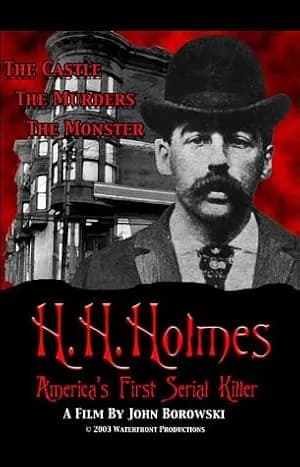
H.H. Holmes: America's First Serial Killer is a 2004 single-feature documentary film directed by John Borowski and available on the Apple TV Store. It examines the life, crimes, trial, and execution of Herman Webster Mudgett — best known under his alias Dr. H.H. Holmes — widely regarded as one of America's first documented serial killers. Running 64 minutes, the film is not an episodic television series but a self-contained documentary that takes viewers from Holmes's childhood in Gilmanton, New Hampshire, through the horrors of his Chicago "Murder Castle," to his conviction and death on the gallows in Philadelphia in 1896.
The film draws on archival materials, historical records, and biographical research to reconstruct a case that captivated the nation in the 1890s and has continued to fascinate true-crime audiences for more than a century.
---
The Case
The Perpetrator: Herman Webster Mudgett
Born on May 16, 1861, in Gilmanton, New Hampshire, Herman Webster Mudgett reinvented himself repeatedly throughout his short life. After obtaining a medical degree, he moved to Chicago in the mid-1880s, adopted the alias H.H. Holmes, and began a career defined by fraud, manipulation, and — according to investigators — systematic murder.
Holmes built a large, labyrinthine property on the south side of Chicago, strategically located near the site of the 1893 World's Columbian Exposition. The building — later sensationally called the "Murder Castle" by the press — contained features that investigators described as deliberate instruments of death: secret rooms, gas pipes routed into sleeping quarters, a soundproofed vault, a dissection table, and a kiln capable of incinerating human remains. The castle gave Holmes access to a steady stream of visitors, employees, and lodgers who, in numerous cases, were never seen again.
The Victims
The full scope of Holmes's crimes has never been definitively established. According to the UMKC law trial resource, Holmes initially confessed to 100 murders, later recanted, and revised the figure to 27. Scholarly estimates range from 27 to well over 100, though investigators have confirmed relatively few killings with forensic certainty. The disputed victim count remains one of the most significant controversies in Holmes scholarship and is addressed directly in the documentary.
The best-documented victim — and the one at the center of Holmes's criminal trial — is Benjamin Pitezel, a business associate whom Holmes murdered as part of an elaborate insurance fraud scheme. Three of Pitezel's children also died under circumstances investigators attributed to Holmes, though the documentary's primary legal focus is on the Pitezel murder itself.
Investigation and Trial
After a cross-country manhunt coordinated by the Pinkerton Detective Agency, Holmes was apprehended, tried in Philadelphia under his birth name Herman Mudgett, and convicted of Benjamin Pitezel's murder. Contemporary accounts described the proceedings as the "trial of the century." He was sentenced to death and executed by hanging on May 7, 1896, at Moyamensing Prison in Philadelphia — 34 years old at the time of his death.
The investigation that preceded his trial uncovered the true nature of his Chicago property, exposed his web of fraudulent schemes, and raised the alarm about missing persons connected to him — making it an early landmark in American forensic and investigative history.
---
Production
H.H. Holmes: America's First Serial Killer was written and directed by John Borowski, a filmmaker who has become one of the leading documentary voices on the subject of Victorian-era American serial killers. WorldCat catalog records confirm the film's runtime at 64 minutes and classify it as a documentary video, consistent with its status as a single feature rather than a multi-episode series.
Borowski structured the film as a comprehensive biographical account, moving chronologically from Holmes's New Hampshire origins through his Chicago crimes and into the Philadelphia courtroom. The production incorporates archival photographs, period illustrations, dramatic narration, and historical documents to reconstruct events that predate moving-picture technology — a challenge common to all documentaries covering 19th-century crimes.
The film's Apple TV listing positions it as a definitive account of Holmes's life from childhood through execution, suggesting Borowski intended it as a broad-audience introduction to the case rather than a specialist forensic study.
A note on format: some online video platforms and YouTube upload descriptions have framed the film as a "6-part documentary series," but this reflects a post-production segmentation for upload purposes only. Apple TV Store catalog records and WorldCat classify it unambiguously as a single documentary film.
---
Reception
Critical reception for the documentary, while not extensively documented in mainstream outlets, has been positive among true-crime audiences. Reviewer Dennis Schwartz describes the film as an **"engrossing factual"** documentary, crediting Borowski for assembling a coherent and compelling true-crime narrative from archival materials that are, by their nature, fragmentary and incomplete.
The film's IMDb title ID is tt0358500, though no aggregate IMDb rating score was available at the time of publication. Its enduring availability on the Apple TV Store — two decades after its 2004 release — suggests sustained viewer interest, consistent with the broader cultural fascination with the Holmes case that Erik Larson's 2003 bestseller The Devil in the White City helped to reignite.
The most persistent controversy surrounding any Holmes documentary or biography is the disputed victim count. As the UMKC trial resource makes clear, Holmes's own confessions were contradictory and self-serving, and forensic evidence from the 1890s investigation was limited by the technology of the era. Borowski's film acknowledges this ambiguity, and responsible viewers should treat all specific victim tallies — including the figure of 27 and the higher estimates — as disputed historical claims rather than established facts.
---
The Case Today
The H.H. Holmes case has never fully closed, in the sense that the complete victim list remains unknown. In 2017, Holmes's great-great-grandson, Jeff Mudgett, successfully petitioned a Pennsylvania court to exhume Holmes's remains for DNA testing, partly to investigate claims that Holmes may have also been the serial killer Jack the Ripper — a theory that mainstream historians regard with considerable skepticism.
Holmes's Chicago "Murder Castle" no longer stands; the building was destroyed by fire in 1895 and the site was eventually developed. A post office now occupies a portion of the original location. The case continues to generate books, podcasts, television specials, and films, cementing Holmes's grim status in the American true-crime canon.
For viewers seeking an accessible, historically grounded introduction to the Holmes case, Borowski's 2004 documentary remains one of the foundational screen treatments of a story that has lost none of its capacity to disturb.