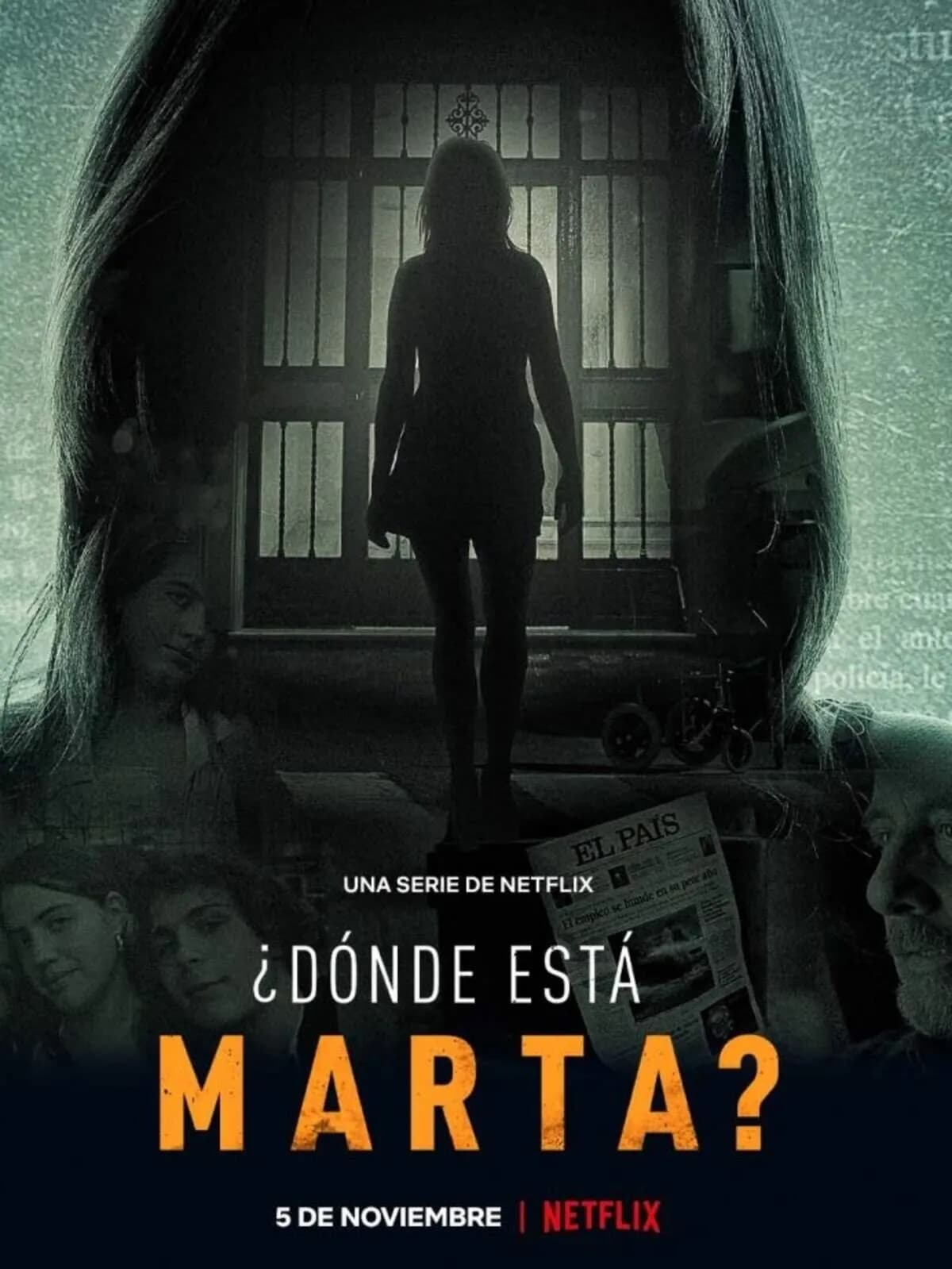
¿Dónde está Marta?
Netflix, 2021 — The disappearance and presumed murder of Marta del Castillo in Seville, Spain
Quick facts
What is the series about?
¿Dónde está Marta? is a Netflix documentary series that revisits one of the most haunting and emotionally devastating criminal cases in modern Spanish history — the disappearance and presumed murder of Marta del Castillo, a 17-year-old girl from Seville who vanished on 24 January 2009 and whose body has never been found. Across four episodes, the series examines the investigation, the legal proceedings, the confessions and contradictions of the accused, and the relentless campaign by Marta's family to find her remains and obtain justice. It is a case that transformed Spanish public discourse around juvenile crime, judicial transparency, and the rights of victims' families.
The Case
On the evening of 24 January 2009, Marta del Castillo left her family home in Seville to meet Miguel Carcaño Delgado, her 19-year-old ex-boyfriend. She never returned. Within days, her disappearance sparked a national outcry, with her family and volunteers conducting searches across the city and the banks of the Guadalquivir River.
On 7 February 2009, Miguel Carcaño was arrested. He confessed to killing Marta during a violent argument at the apartment he shared with family members. According to his account, she died after a physical altercation, and he disposed of her body in the Guadalquivir River with the help of others. What followed was one of the most exhaustive and painful searches in Spanish criminal history — divers, police units, and civilian volunteers combed the river and its surroundings for months. The body of Marta del Castillo was never recovered.
The absence of a body created enormous legal complications. Without physical remains, establishing the precise cause and circumstances of death was impossible. Carcaño changed his account of events multiple times — at various points claiming she was thrown in the river, buried in a cemetery, or disposed of in other locations — leading investigators on repeated searches that yielded nothing. His shifting testimony became one of the most agonizing aspects of the case for Marta's family, who have publicly stated that finding their daughter's remains and giving her a proper burial remains their primary goal to this day.
Several other individuals, including Carcaño's brother and associates present at the apartment that night, were tried for concealment of the crime. In 2011, the Audiencia Provincial de Sevilla convicted Miguel Carcaño of murder and sentenced him to 12 years — a sentence widely criticised in Spain as inadequate given the circumstances. Following appeals by both the prosecution and the del Castillo family, the sentence was later increased to 21 years. Co-defendants received sentences ranging from one to four years for their roles in concealing the crime.
The case sparked significant public debate in Spain about the sentencing framework for murders where no body is found, the rights of grieving families to information from convicted killers, and the adequacy of protections for young women. Marta's father, Antonio del Castillo, became a tireless public advocate, appearing in media and before legislators to demand reforms and, above all, answers about where his daughter's remains lie.
Production
¿Dónde está Marta? was produced for Netflix Spain and released in 2021, more than a decade after the crime first shocked the country. The series draws on archival news footage, court documents, reconstructed timelines, and interviews with key figures connected to the case — including, centrally, members of the del Castillo family. The documentary format allows the series to examine not only the facts of the crime but the emotional and psychological toll that a decade of uncertainty and unanswered questions has taken on Marta's parents and siblings.
The production makes extensive use of real television news footage from 2009, capturing the moment Spain became collectively gripped by the search for Marta. The series contextualises the case within broader Spanish society, noting how the visible grief of the del Castillo family and the cynicism of Carcaño's changing stories made this one of the defining criminal cases of the era. The director has not been widely identified in international reporting, but the series is understood to have had the cooperation of the del Castillo family, lending it an intimacy and moral weight that purely archival reconstructions often lack.
Reception
¿Dónde está Marta? was released to a Spanish audience already deeply familiar with the case, which had been covered intensively by national television and press for over a decade. The series was received with considerable emotional engagement, with viewers praising its respectful treatment of the del Castillo family's grief and its clear-eyed examination of the judicial failings and investigative frustrations that defined the case.
Spanish critics noted that the series succeeds less as a whodunit — Carcaño's guilt has never seriously been in doubt — and more as a portrait of institutional inadequacy and familial endurance. The central question the title poses, ¿Dónde está Marta? (Where is Marta?), is not answered by the documentary, because it cannot be: as of 2021, and as of the time of writing, the location of Marta del Castillo's remains is still unknown.
The series resonated strongly on social media in Spain, reigniting public calls for Carcaño to reveal the true location of the body and for legislative changes to address cases where convicted murderers withhold information about victims' remains. An IMDb rating for the series has not been widely circulated in international sources, and the series has had a more limited profile outside Spanish-speaking markets than some of Netflix's globally distributed true-crime productions.
The Case Today
Miguel Carcaño Delgado has served his sentence and has been reported in Spanish media as having been released from prison, having completed the period required under Spanish law. The del Castillo family has continued to speak publicly about the case, maintaining pressure on authorities and on Carcaño himself to finally disclose where Marta's remains are located. As of the most recent reporting, Marta del Castillo has never been found.
The case remains one of the most emotionally charged unresolved questions in recent Spanish criminal history — not in terms of guilt, which was legally established, but in terms of the basic human dignity of a burial. For Marta's family, the documentary series represented not a conclusion but another chapter in a search that, more than fifteen years on, has never ended.
The phrase ¿Dónde está Marta? has become something close to a national rallying cry in Spain — a demand for truth directed at a man who has, by most accounts, never told the full story of what happened on the night of 24 January 2009.