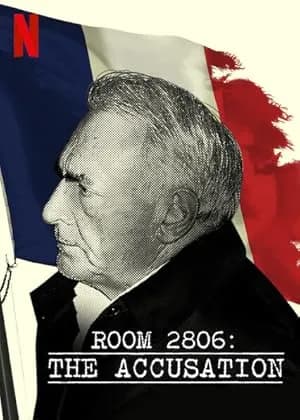
Chambre 2806 : l'affaire DSK
Netflix, 2020 — the documentary series covering the Dominique Strauss-Kahn sexual assault case
Quick facts
What Is the Series About?
Chambre 2806 : l'affaire DSK is a four-part French documentary series directed by Jalil Lespert and released on Netflix in August 2020. The title refers to the room number at the Sofitel New York hotel where, on May 14, 2011, Guinean immigrant and hotel housekeeper Nafissatou Diallo alleged that Dominique Strauss-Kahn — then Managing Director of the International Monetary Fund and widely considered France's most likely next president — sexually assaulted her. The series reconstructs the events of that day and the turbulent legal and media storm that followed, drawing on interviews with investigators, journalists, lawyers, and crucially, Diallo herself.
The documentary arrives nearly a decade after the incident, providing distance enough to reassess what happened — not only inside Room 2806, but in the corridors of power on both sides of the Atlantic. It is one of the few major documentary productions to place Diallo's perspective at its center, rather than treating the case primarily as a story about the fall of a powerful man.
The Case
Dominique Strauss-Kahn, commonly known by his initials DSK, was in May 2011 one of the most powerful people in the world. As head of the IMF he had steered global financial responses to the 2008 economic crisis, and polls consistently showed him as the frontrunner to win the French presidential election of 2012 against the incumbent Nicolas Sarkozy.
On May 14, 2011, Nafissatou Diallo, a 32-year-old housekeeper from Guinea working at the Sofitel New York, entered Room 2806 believing it to be empty. According to her account — which she has maintained consistently — Strauss-Kahn emerged from the bathroom and sexually assaulted her. She reported the incident to hotel management, and Strauss-Kahn was arrested by New York police officers as his Air France flight prepared to depart JFK Airport.
He was charged with attempted rape, criminal sexual act, sexual abuse, and unlawful imprisonment. He was initially denied bail and briefly held at Rikers Island before being transferred to house arrest. The arrest sent an immediate and profound shockwave through French society, where the political and media elite had long maintained a culture of silence around the private conduct of powerful men.
Within days, Strauss-Kahn resigned from the IMF. His political ambitions in France were effectively destroyed. However, the criminal case began to unravel in the summer of 2011 when prosecutors at the Manhattan District Attorney's office raised concerns about inconsistencies in Diallo's account of other matters — specifically related to her asylum application and a phone conversation she had shortly after the incident. Critics argued these issues were irrelevant to whether an assault had taken place, and that prosecutors had allowed powerful political and institutional pressures to influence their decision-making.
In August 2011, all criminal charges were dropped. Diallo subsequently filed a civil lawsuit, and the matter was settled out of court for an undisclosed amount. Strauss-Kahn returned to France, where he later faced separate legal proceedings related to an alleged organized prostitution ring in Lille. He was acquitted of those charges in 2015.
Nafissatou Diallo's story — that of an immigrant domestic worker with little institutional power confronting one of the most connected men on the planet — became a defining case in discussions about class, race, gender, and impunity.
Production
The series was directed by Jalil Lespert, a French filmmaker perhaps better known as an actor, who brought a measured, interview-driven approach to the material. The production is notable for securing the participation of Nafissatou Diallo, who speaks directly to camera at length about her experience — both the assault itself and the years of media scrutiny and victim-blaming that followed. Her willingness to revisit the events in such detail gives the series a gravity and moral clarity that distinguishes it from coverage that often centered on DSK's career trajectory.
The documentary also features interviews with the New York detectives who handled the initial investigation, members of the legal teams on both sides, French political commentators, and journalists who covered the story as it unfolded. Lespert structures the series to move chronologically through both the legal proceedings and the broader cultural reactions in France and the United States, contrasting the two countries' very different press traditions around the private lives of public figures.
The production does not appear to have secured an interview with Strauss-Kahn himself, and his perspective is represented through archival footage and the accounts of others — a choice that, deliberately or not, keeps Diallo's experience at the ethical heart of the narrative.
Reception
Chambre 2806 was released at a moment when the global conversation around sexual misconduct by powerful men — catalyzed by the MeToo movement from 2017 onward — had substantially shifted the lens through which such cases were viewed. Audiences in France and internationally engaged with it as a belated reckoning with a case that many felt had been mishandled, both legally and in the media.
French critics noted the series as an important corrective to the dominant narrative of 2011, in which much of the French press treated the arrest of Strauss-Kahn primarily as an American legal overreach or a political conspiracy, rather than examining Diallo's account seriously. The documentary was widely praised for centering the complainant's voice and for its structured, patient approach to a complex legal story.
While specific aggregated critical scores are not verified at time of publication, the series generated substantial discussion on social media and in the French and international press upon release, and was considered one of Netflix's more significant documentary offerings of 2020 in the French-language market.
The Case Today
Dominique Strauss-Kahn has remained a controversial figure in France. Though he returned to professional life — working as an economic consultant and adviser to various governments — his political career never recovered. The Lille prostitution case, despite his acquittal in 2015, further damaged his public standing.
Nafissatou Diallo continued to live and work in the United States. The civil settlement, while providing some financial resolution, left open the question of public accountability that the dropped criminal charges had foreclosed. In the years since the series aired, Diallo's case has frequently been cited in broader discussions about how justice systems treat low-income women of color who make allegations against wealthy and powerful men.
The Sofitel case remains a landmark moment in discussions about journalistic culture in France — where powerful men's behavior had long been protected by an informal omertà — and about the limits and failures of prosecutorial discretion in the United States. Chambre 2806 functions both as a document of a specific legal case and as a broader inquiry into how societies decide whose account of events is worth believing.