Casting JonBenet
Netflix, 2017 — the unsolved 1996 murder of 6-year-old JonBenét Ramsey in Boulder, Colorado
Quick facts
What Is the Series About?
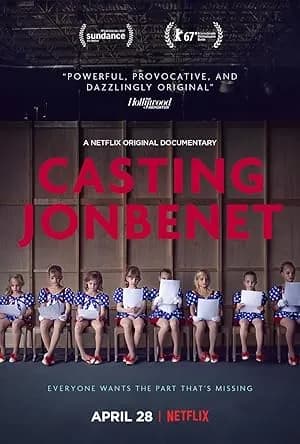
Casting JonBenet is a 2017 Netflix documentary film directed by Kitty Green about the unsolved 1996 murder of six-year-old JonBenét Patricia Ramsey in Boulder, Colorado. Unlike conventional true-crime documentaries, the film does not attempt to name a killer or present new forensic evidence. Instead, Green uses an unconventional casting-audition format — interviewing local Boulder residents who auditioned to play key figures in the case — to explore how the Ramsey murder embedded itself into American cultural memory and public obsession. The result is part documentary, part performance piece, and part social experiment, asking not just what happened to JonBenét, but why the world cannot let go of the question.
The Case
On Christmas Day 1996, six-year-old JonBenét Patricia Ramsey was reported missing by her mother, Patsy Ramsey, after a ransom note was discovered inside the family's home in Boulder, Colorado. Hours later, JonBenét's father, John Ramsey, found the child's body in the basement. She had been strangled and struck on the head. The exact time of death has never been definitively established.
The case immediately became one of the most sensationalized crimes in American history. JonBenét had competed in child beauty pageants, and footage of her in full stage makeup was broadcast on a loop by television news networks, fueling a media frenzy that shaped public perception of both the victim and the investigation. As NPR noted in its coverage of the documentary, the homicide remains fundamentally unresolved, and the cultural noise surrounding the case has always threatened to obscure the facts.
Suspicion fell early and heavily on JonBenét's parents, Patsy and John Ramsey, and later on her brother Burke Ramsey. The Boulder Police Department's handling of the crime scene was widely criticized. Despite years of investigation, grand jury proceedings, and intense media scrutiny, no one was ever charged. In 2008, Boulder authorities officially cleared the entire Ramsey family based on DNA evidence found on JonBenét's clothing that did not match any known family member. Patsy Ramsey had died of ovarian cancer in June 2006, never having seen the case resolved. As of publication, the murder of JonBenét Ramsey remains officially unsolved, and no perpetrator has been identified, charged, or convicted.
Production
Director Kitty Green took a radically different approach to the Ramsey case. Rather than conducting traditional interviews with investigators or journalists, Green held open casting calls in Boulder, Colorado, inviting local residents to audition for roles as Patsy Ramsey, John Ramsey, Burke Ramsey, Santa Claus, and other figures connected to the case. The auditioners — ranging from mothers to former law enforcement officers to schoolteachers — became the documentary's subjects, with Green capturing not just their performances but their personal stories, theories, and emotional investments in the case.
The structure deliberately collapses the boundary between fact and fiction, between the case itself and the mythology that has grown around it. Each auditioner brings their own history, trauma, and interpretation to their reading, revealing as much about Boulder's community and about human storytelling instincts as about the Ramsey case itself. The film premiered at the Sundance Film Festival in January 2017 before arriving on Netflix on April 28, 2017.
Reception
Casting JonBenet was received positively by critics. According to Wikipedia, the film holds an 81% approval rating on Rotten Tomatoes based on 47 reviews, with the critical consensus describing its unorthodox approach as making it a uniquely thought-provoking true crime documentary hybrid.
The Guardian later called it a true crime masterpiece, arguing that Green's film completely rejects the true-crime label even while operating within it. The Guardian's retrospective praised the film for challenging the assumption that anyone — journalist, detective, or viewer — can ever fully know what happened inside the Ramsey household on Christmas night 1996.
NPR characterized the film as an extremely unconventional examination of the case, emphasizing how Green uses the audition format to expose the many competing narratives that have always surrounded the murder. Not all viewers found the experimental approach satisfying: some critics and audiences noted that the film deliberately offers no new solution to the case and may frustrate viewers hoping for investigative revelations. That tension — between the film's artistic ambitions and the audience's desire for answers — became a central part of the conversation around its release.
The Case Today
The murder of JonBenét Ramsey remains one of the most famous unsolved homicides in United States history. The Boulder Police Department and the Boulder County District Attorney's Office have both maintained open case files. DNA evidence collected from JonBenét's clothing — pointing to an unidentified male — has never been matched to a known suspect. Advances in genetic genealogy technology, which have solved other cold cases in recent years, have kept public interest in the Ramsey case alive.
In 2024, Netflix returned to the subject with a separate documentary series, Cold Case: Who Killed JonBenét Ramsey, which took a more conventional investigative approach and argued that law enforcement and media had mishandled the case from the beginning. That series is entirely distinct from Kitty Green's 2017 film.
Casting JonBenet remains available to stream on Netflix. Nearly three decades after JonBenét Ramsey's death, the case is no closer to an official resolution — and Green's film stands as one of the most formally inventive attempts to reckon with what that unresolved mystery means for the culture that produced it.