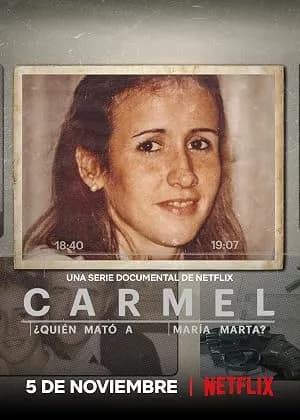
Carmel: Who Killed Maria Marta?
Netflix, 2020 — the notorious Argentine murder case of María Marta García Belsunce
Quick facts
What Is the Series About?
Carmel: Who Killed María Marta? is a Netflix true-crime documentary miniseries that chronicles one of the most controversial and protracted criminal cases in Argentine history: the killing of sociologist María Marta García Belsunce on 27 October 2002, the chaotic investigation that followed, and the decades of prosecutions, acquittals, and retrials that kept the case alive in the public imagination. Directed by Alejandro Hartmann and released in November 2020, the series spans four episodes and draws on interviews, archive footage, and judicial records to reconstruct a mystery that would not be legally resolved until 2024.
The Case
On the evening of 27 October 2002, María Marta García Belsunce — a 50-year-old Argentine sociologist — was found dead inside her home at the Carmel Country Club, a gated community in Pilar, Buenos Aires Province, Argentina. The initial assessment by police was that she had suffered an accident in her bathtub. Her body was buried without a full forensic autopsy, a decision that would later become central to the controversy surrounding the case.
Approximately six weeks after her death, a forensic review reached a starkly different conclusion: María Marta had been shot five times in the head, making her death an unambiguous homicide. The reclassification sent shockwaves through Argentina. The victim came from one of the country's most prominent upper-class families, and the Carmel Country Club — a symbol of privilege and security — suddenly became a crime scene.
Prosecutor Diego Molina Pico led the initial investigation and focused suspicion on those closest to María Marta. Her widower, Carlos Alberto Carrascosa, was charged with homicide. Her brother, Horacio García Belsunce, and her half-brother, John Hurtig, were prosecuted on cover-up charges, accused of having moved or concealed evidence in the immediate aftermath of the death. Carrascosa was convicted and spent roughly five years in prison.
The case, however, refused to reach a clean conclusion. DNA analysis later showed that blood recovered from the crime scene did not match Carrascosa, and in 2016 he was acquitted. The cover-up charges against Horacio García Belsunce and John Hurtig were also dismissed. Argentina was left with a high-profile homicide, a dead victim, and no convicted killer — a judicial vacuum that defined the case for years.
The investigation eventually turned toward Nicolás Pachelo, a neighbor of the García Belsunce family at Carmel Country Club who had a documented criminal background. His name had circulated in connection with the case for years before prosecutors formally built a case against him. According to reporting by the *Buenos Aires Times*, a Buenos Aires Province court ultimately sentenced Pachelo to life imprisonment for the murder of María Marta García Belsunce in a 2024 ruling, more than two decades after the crime.
Production
The four-episode series was directed by Alejandro Hartmann and produced for Netflix, premiering in November 2020. Hartmann structured the documentary to mirror the disorienting experience of following the real investigation: early episodes lean into the initial accident narrative before systematically dismantling it, reflecting how Argentine society itself came to understand — or misunderstand — the case over time.
The production drew on a substantial archive of television news footage, court documents, and on-camera interviews with individuals connected to the investigation and the legal proceedings. The access to multiple perspectives — including those who believed in Carrascosa's guilt and those who doubted it — gives the series much of its tension. Rather than presenting a single authoritative account, Hartmann allows contradictory testimony and forensic interpretations to sit alongside one another, trusting the viewer to weigh the evidence.
The setting itself — the manicured lawns and guarded gates of Carmel Country Club — is used throughout as a visual metaphor. The documentary interrogates the assumption of safety and insularity that gated communities project, and asks how that insularity may have allowed a murder to be misclassified, evidence to be disturbed, and justice to be delayed by years.
Reception
Following its release in November 2020, Carmel: Who Killed María Marta? was broadly described as a must-watch entry in the true-crime genre. The series was noted for reviving mainstream debate about a case that many Argentines had followed obsessively across two decades of legal proceedings. International audiences encountered the story fresh, and viewer reaction was strongly engaged, with many describing it as deeply unsettling precisely because of the extended period during which the case appeared to have no legal resolution.
Commentators and true-crime communities praised the series for its clarity in navigating a genuinely complex web of charges, appeals, and reversals. Critics highlighted how effectively the documentary conveyed the scale of institutional and forensic failure involved: a murder misclassified as an accident, a body buried without proper examination, and years of misdirected prosecution.
The series' IMDb entry is registered under title ID tt13244092, though a verified numeric rating is not available from current sources.
Controversy surrounding the documentary largely tracked the controversy of the case itself. Some observers questioned whether the intense media coverage of the García Belsunce family — wealthy, well-connected, and prominent in Argentine society — affected the direction of the investigation. Others focused on the adequacy of the original forensic work and the decision not to conduct a full autopsy at the time of discovery.
The Case Today
The legal arc of the García Belsunce case stretched well beyond the 2020 documentary's release. As reported by the *Buenos Aires Times*, Nicolás Pachelo was sentenced to life imprisonment by a Buenos Aires Province court in 2024, representing the most definitive judicial outcome in a case that had produced convictions, acquittals, and renewed prosecutions across more than two decades. Carrascosa, who had served approximately five years before being exonerated, was not subject to further criminal proceedings. The family members convicted or charged with cover-up offenses had also been acquitted prior to the Pachelo verdict.
The case remains a landmark in Argentine criminal justice — not only for its human drama, but as an example of how initial scene-of-death determinations, forensic standards, and the social status of the parties involved can shape, distort, and prolong the pursuit of accountability. Carmel: Who Killed María Marta? preserves that uncomfortable history in documentary form, ensuring the failures of the early investigation remain part of the public record.